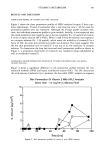
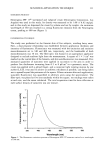
j. Soc. Cosmet. Chem., 47, 109-115 (March/April 1996) Quantitative assessment of sunscreen application technique by in vivo fluorescence spectroscopy L. E. RHODES and B. L. DIFFEY, Regional Medical Physics Department, Dryburn Hospital, Durham DH1 5TW, United Kingdom. Received September 1995. Synopsis For the first time, a method is described for measurement of surface density of sunscreen in vivo. Here, the method is used to measure the uniformity of sunscreen application. The intrinsic fluorescence of a sunscreen (Neutrogena SPF 15 ©) was quantified by fluorescence spectroscopy, and a dose-response relationship was established with sunscreen density on the skin. Sunscreen was then applied in a crude fashion to one forearm and carefully to the other forearm in five subjects. Fluorescence measurements were taken from 16 sites on each forearm and converted to an equivalent thickness of sunscreen using the dose-response relationship. Whereas the median thicknesses for crude and careful application were approximately the same, the range of thickness was higher after crude application (p 0.007). Hence fluorescence spectroscopy can quantify the adequacy of sunscreen application. This simple and rapid noninvasive in vivo technique for measuring sunscreen thickness could potentially provide a surrogate method for SPF determination in the clinical testing of new products. INTRODUCTION New sunscreens are developed with the aim of protecting the skin from sunburn and chronic photodamage. The protection offered by a sunscreen is assessed by the sun protection factor (SPF) following phototesting in vivo. Sunscreen efficacy is obviously dependent on appropriate application. Current laboratory testing of sunscreen efficacy is based on an even application thickness of 2mg/cm 2. This surface density of sunscreen is recommended by the U.S. Food and Drug Administration (1), the Standards Association of Australia (2), and the International Commission on Illumination (3), while the German Standards Organisation Deutsches Institut ffir Normung recommends the slightly lower surface density of 1.5 mg/cm 2 (4). However, crude assessments of application technique in a more natural setting suggest consumers apply a much lower average sunscreen thickness of 0.5-1.3 mg/cm 2. A number of investigators have determined the average layer thickness of sunscreen applied L. E. Rhodes' present address is: Dermatology Unit, University of Liverpool, P.O. Box 147, Liverpool L69 3BX, U.K. 109

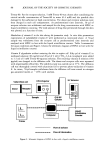
110 JOURNAL OF THE SOCIETY OF COSMETIC CHEMISTS by subjects by weighing the sunscreen containers before and after application, and then dividing the amount applied by the area treated. Using this method, Stenberg and Lark/5 (5) found that the average thickness of applied sunscreen was around l mg/cm 2 and that this varied little with region of the body or product. Minimal erythema dose (MED) testing then demonstrated that the SPF on areas of self-application of the cream was only 50% of that on areas given the generally recommended thickness of 2 mg/cm 2. Gottlieb et al. (6) also found the average application thickness at l. 3 mg/cm 2 to be nearer 1 than 2 mg/cm 2. Bech-Thomsen & Wulf (7) asked subjects to apply their own sunscreen to their whole body, in a beach setting. In this study, the amount of sunscreen applied was on average only 0.5 mg/cm 2. Some authors have studied application technique following the addition of fluorescent substances to sunscreens. The presence or absence of the sunscreen has then been confirmed by detection of fluorescent emission following irradiation with Wood's light, with peak excitation wavelength around 365 nm. Stenberg and Lark/5 (5) added 10% dihydroxyacetone as a fluorescent agent, while Loesch and Kaplan (8) employed doxy- cycline. In the latter study, subjects were asked to apply the sunscreen to their faces, and absence of fluorescence showed that certain sites tended to be completely missed. In the above studies, only the gross average density of sunscreen applied could be calculated, and the fluorescent emission of sunscreens was used in a purely qualitative manner. Sauermann and Hoppe (9) attempted to use fluorescence spectrometry for indirect assessment of sunscreens, observing attenuation of fluorescence of a dye, dansyl chloride, by the subsequent application of sunscreen. Fluorescence spectroscopy enables the use of a wide range of excitation and emission wavelengths, with quantification of the intensity of fluorescent radiation (10). These instruments are designed primarily for in vitro use, but by coupling suitable fiber optics, the excitation radiation may be conducted to remote sites and the emission radiation conducted back to the spectrometer (l 1). Hence the technique, which can employ either a laser or incoherent light source, has been used in the identification of atheromatous plaque (12) and abnormal gastric mucosa (13), and more recently, in the study of skin fluorophores. Differences have been described in the fluorescence patterns of photoaged and chronologically aged skin (14) and at the site of melanomas (15). We have now extended previous studies by examining the variation of sunscreen appli- cation technique in a quantitative manner, exploiting the intrinsic fluorescence of a sunscreen. MATERIALS AND METHODS MEASUREMENT OF FLUORESCENCE A fluorescence spectrometer (Fluoromax, Spex Industries Inc.) was adapted for use in this study. The radiation from a xenon arc lamp was focused into the excitation mono- chromator. The spectrometer was coupled to a bifurcated fiber-optic cable, enabling conduction of excitation radiation to the skin and collection of fluorescent radiation, which was directed into the entrance slit of the emission monochromator. The signals were processed and the data displayed using the computer software.
Purchased for the exclusive use of nofirst nolast (unknown)
From: SCC Media Library & Resource Center (library.scconline.org)