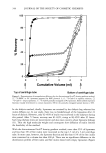
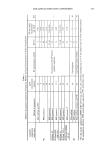
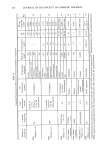
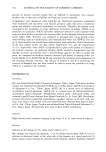
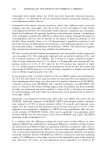
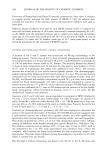
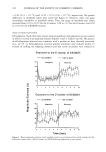
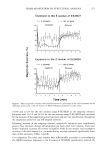
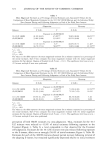
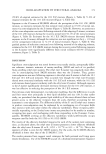
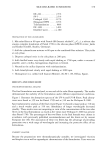
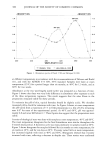
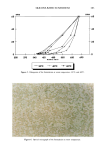
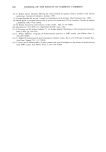
344 JOURNAL OF THE SOCIETY OF COSMETIC CHEMISTS lOO 80- 60- 20- 0 • f 1 I 0 1 2 3 4 5 Cumulative Volume (m,) Top of centrifuge tube Bottom of centrifuge tube Figure 3. Determination of encapsulation efficiency by the discontinuous Ficoll © density gradient method. O, •4C-DPPC in PC liposomes prepared by RPE protocol 2 A, •4C-Carb-I in aqueous solution, [•, •4C-Carb-I + empty liposomes O, •4C-Carb-I partially entrapped in PC liposomes. Solid symbols represent fractions visually determined to contain liposomes. EE for the partially entrapped sample shown is 38%. In the dialysis method, ideally, liposomes are retained by the dialysis bag whereas free inulin diffuses out. In our study, there was no breakthrough of the liposomes after 24 hours ofdialysis. However, only 62-66% of inulin was recovered in the dialysate during this period. After 72 hours, recovery was 81-83%, rising to 83-85% after 95 hours. Such long dialysis times are inconvenient and also raise concerns about liposome leakage (31). Thus the high molecular weight and consequent slow diffusion of inulin limited the feasibility of the method. With the discontinuous FicolI © density gradient method, more than 95% of liposomes and less than 3% of free inulin were recovered in the top 1.5 ml of a 5-ml centrifuge tube. In most cases, however, the liposome fraction and less than 0.5 % of the free inulin were contained in a volume less than 400 pl. There was no significant difference in the distribution profiles of free inulin and free inulin mixed with empty liposomes (Figure

ENCAPSULATION INTO LIPOSOMES 345
Purchased for the exclusive use of nofirst nolast (unknown)
From: SCC Media Library & Resource Center (library.scconline.org)