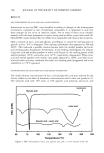
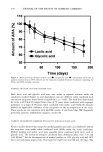
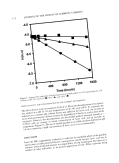
j. Soc. Cosmet. Chem., 48, 165-174 (July/August) Stability of lactic acid and glycolic acid in aqueous systems subjected to acid hydrolysis and thermal decomposition MELGARDT M. D• VILLIERS, DALE ERIC WURSTER, and KIRTI NARSAI, Research Institute for Industrial Pharma•y, PotchejStroom University for Christian Higher Education, PotchqStroom 2520, South Africa (M.M.d.V., K.N.), and College of Pharmacy, University of Iowa, Iowa City, IA 52242 (D.E.W.). Accepted for publication October 6, 1997. Synopsis Preformulation assessment of the compatibility of the o•-hydroxy acids (AHAs) lactic acid and glycolic acid using differential scanning calorimetry (DSC) showed a number of possible incompatibilities. Changes in the melting behavior of 1:1 mixtures of lactic acid and glycolic acid, lactic acid and sorbic acid, and lactic acid and methyl paraben were observed. To explore these interactions, the stability of aqueous solutions was determined at elevated temperatures. The kinetic parameters describing degradation were determined from HPLC or UV spectrophotometric analyses of solutions containing lactic and glycolic acids. Only sorbic acid and methyl paraben degraded when combined with either lactic acid or glycolic acid. Combination with these preservatives is not of practical importance since formulations at low pH are usually self-preserving. Other AHAs and commonly used non-ionic emulsion excipients had no influence on the rate of either glycolic acid or lactic acid decomposition. Both lactic acid and glycolic acid were extremely stable and not subject to thermal decomposition. INTRODUCTION Lactic acid and glycolic acid are from a group of weak hygroscopic acids, which contain an alcohol function in the alpha position relative to the carboxyl group (1). This group of acids, also known as the alpha hydroxy acids (AHAs), are the "star" ingredients in the new anti-aging, anti-wrinkle, and cell renewal products and are generally incorporated into formulations at less than 10% w/w (2). Products used in beauty salons may contain upto 40% and products used by physicians as skin peelers may contain up to 70% w/w AHAs. AHAs remove the outer layers of the skin through a process known as chemical exfoliation (1). Although products containing AHAs are numerous in skin care tech- nology, little information is available about the physicochemical properties and stabill- ties of the acids and their formulations (3). 165

166 JOURNAL OF THE SOCIETY OF COSMETIC CHEMISTS The purpose of this study was to determine the compatibility and stability of lactic acid and glycolic acid in combination with other important ingredients of emulsions. Pre- formulation assessment of the compatibility of several AHAs with these excipients, using 1:1 mixtures and by analysis by differential scanning calorimetry (DSC) (4,5), showed possible incompatibilities. To further explore these interactions, the stability of combinations of lactic acid and glycolic acid and non-ionic emulsion excipients in aqueous solutions was determined at elevated temperatures. MATERIALS AND METHODS MATERIALS Lactic acid (88% aqueous solution), sodium lactate (60% aqueous solution), glycolic acid (98% powder), sorbic acid (99% powder), methyl paraben (99% powder), glyceryl monostearate, cetyl alcohol, isopropyl myristate, isopropyl palmitate, stearic acid, glyc- erol, polyethylene glycol 1000 monostearate, lanolin, and sorbitol were supplied by either Sigma Chemicals (St. Louis, MO), Saarchem (Krugersdorp, South Africa), Croda (North Humberside, UK) or BASF (Ludwigshafen, Germany). All solvents used were analytical or HPLC grade. Water for HPLC and oxygen-free water were used. COMPATIBILITY EVALUATION BY DIFFERENTIAL SCANNING CALORIMETRY (DSC) 1:1 Mixtures of all possible combinations of lactic acid, glycolic acid, and the excipients were made by grinding in an agate mortar and pestle 200 mg of each component. The mixtures were transferred to 5-ml glass vials, closed, and left for at least 24 hours to reach equilibrium. Samples, 5-10 mg, were weighed and hermetically sealed in round- bottomed aluminum DSC sample pans. These samples were then heated at 10øC per minute, from ambient to 300øC, in a nitrogen atmosphere (Shimadzu DSC50, Shi- madzu, Kyoto, Japan). The instrument was calibrated using an indium standard with a melting point of 156.4øC. ACCELERATED STABILITY STUDIES A series of kinetic runs was carried out at 25, 40, 80, and 120øC. Ten percent w/w solutions of lactic acid and glycolic acid, alone and combined with excipients, were prepared in water. To study the effect of lactic acid concentration on the stability of preservatives, solutions containing 5, 10, and 20% lactic acid and buffered with sodium lactate at a pH of 3.83 (pKa of lactic acid) were prepared. Solutions were bubbled with oxygen-free nitrogen for at least two hours to reduce the oxygen concentration. Each solution was filled in 10-ml amber ampoules under a nitrogen atmosphere, and the ampoules were then transferred to incubators kept at 25, 40, 80, and 120øC. At predetermined times, samples were removed from the ovens, chilled, and stored on ice for analysis. At least duplicate samples were removed.
Purchased for the exclusive use of nofirst nolast (unknown)
From: SCC Media Library & Resource Center (library.scconline.org)