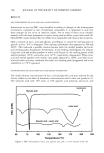
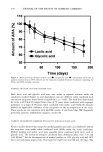
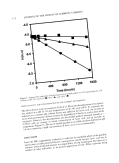
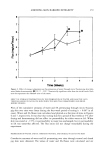
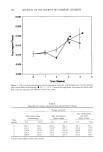
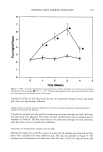
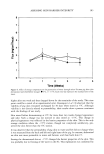
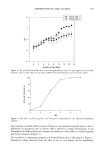
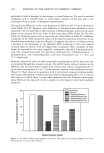
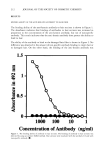
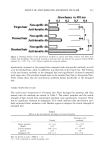
ASSESSING SKIN BARRIER INTEGRITY 185 4.00 3.00 I::: 2.00 •:mO.02, E ' 0.01 0.00 i i 9 o o o Pig 1 Pig 2 Pig 3 Number of Yucatan pigs studied Figure 8. Variability in the initial rates of permeation of water and salicylic acid among pigs studied. (I) water, ([•) salicylic acid, ([•) bars ratios. Each error bar represents the standard error of the mean. Bronaugh eta/. (2) studied the permeation of water through human skin. They reported that the permeability coefficient (Kp) of water through human skin was 1.54 x 10 3 q_ 0.14 cm/hr. In this study, the permeability coefficient for water through pig skin was calculated and found to be 2.6 x 10⁻³ q- 0.19 cm/hr. This shows that pig skin is approximately 1.7 times more permeable to water than human skin and that the vari- ability in results is very similar. CONCLUSIONS 1. Storing the skin after dermatoming at 4øC maintained its permeability unchanged for four weeks. 2. Storing the skin at a temperature of -15øC altered its permeation to water and SA significantly however, removing water from the skin prior to storage improved its stability. 3. Monitoring the change in flux of the two markers and their ratios over time is a rigorous way of testing skin barrier integrity. ACKNOWLEDGMENTS The authors would like to express their gratitude to Charles River Laboratories and SmithKline Beecham Consumer Healthcare for their financial support of this study.

186 JOURNAL OF THE SOCIETY OF COSMETIC CHEMISTS REFERENCES (1) T.J. Franz and P. A. Lehman, The use of water permeability as a means of validation for skin integrity in in vitro percutaneous absorption studies,J. Invest. Dermatol., 94, 525-528 (1990). (2) R.L. Bronaugh, R. F. Stewart, and M. Simon, Methods for in vitro percutaneous absorption studies. VII: Use of excised human skin, J. Pharm. Sci., 75, 1094-1097 (1986). (3) S. R. May and J. F. Wainwright, Integrated study of the structural and metabolic degeneration of skin during 4øC storage in nutrient medium, Cryobiology, 22, 18-34 (1985). (4) M.D. Rosenquist, A. E. Cram, and G. P. Kealey, Skin preservation at 4øC: A species comparison, Cryobiology, 25, 31-37 (1988). (5) G. S. Hawkins and W. G. Reinfenrath, Development of an in vitro model for determining the fate of chemicals applied to skin, Fund. Appl. Toxicol., 4, S133-S144 (1984). (6) R. Dulbecco and M. Vogt, Plaque formation and isolation of pure lines with poliomyelitis viruses,J. Exp. Med., 99, 167-182 (1954). (7) R.L. Bronaugh, R. F. Stewart, and E. R. Congdon, Differences in permeability of rat skin related to sex and body site, J. Soc. Cosmet. Chem., 34, 127-135 (1983).
Purchased for the exclusive use of nofirst nolast (unknown)
From: SCC Media Library & Resource Center (library.scconline.org)