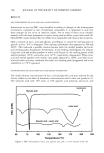
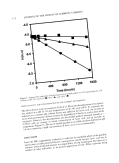
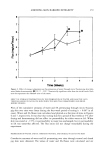
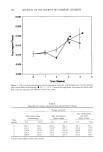
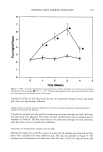
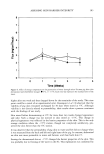
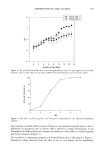
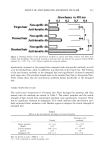
STABILTY OF LACTIC AND GLYCOLIC ACIDS 169 Endothermic Methyl paraben ß . Sorbic acid i i i I i i 50 75 100 125 150 175 200 225 Temperature (øC) Figure 2. DSC thermograms of methyl paraben, sorbic acid, and 1'1 w/w mixtures of glycolic acid and these preservatives. solution buffered at pH 3.8 with sodium lactate. The kinetic parameters describing decomposition were determined from appropriate analysis results obtained from cali- brated methods. Calibration data for analytical methods are listed in Table I. For all the analysis methods used, the resolution values (Rs) between the compounds and their main degradation products were greater than 1.3, and calibration graphs (Table I) showed excellent linearity in the concentration ranges of interest. The precision of the HPLC and UV methods were obtained by repetitive determinations (n -- 5) of standard solutions, and the relative standard deviations were found to be 1.3 + 0.3%. The relative standard deviations for parallel degraded samples (n = 5) varied by 1.5 + O.4%. The kinetics of degradation were investigated at elevated temperatures (Figure 3) since the decomposition rates of lactic acid, glycolic acid, methyl paraben, and sorbic acid at room temperature (25øC, Tables II, III) were too slow to obtain kinetic data within a reasonable time. At the conditions studied, the decompositions of these compounds followed apparent first-order kinetics because the mean correlation coefficient for all calculations was above 0.980. The apparent first-order reaction rate constants were determined from the slopes of the lines obtained by plotting the natural logarithm of the residual concentration versus time (Figure 4). Because the reaction mechanisms remained unaltered, the predicted rate constants were used to calculate shelf lives at 25øC. Predicted shelf lives and real time stability data at 25øC are listed in Tables II and III.

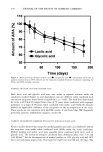
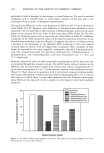
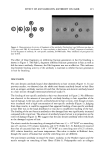
170 JOURNAL OF THE SOCIETY OF COSMETIC CHEMISTS 11o lOO '• 90 "- 8o = 70 o • 60 5o -•- Lactic acid -•- Glycolic acid 0 50 100 150 200 Time (days) Figure 3. Mean percentage decrease in lactic acid (I) and glycolic acid (0) concentration with time in aqueous solutions kept at 80øC. Results are the mean plus standard deviation of solutions containing the AHAs and AHA excipient mixtures. STABILITY OF LACTIC ACID AND GLYCOLIC ACID Both lactic acid and glycolic acid were very stable in aqueous solution under the conditions studied (Figure 3), and degradation was not different when combined with the various excipients tested (level of significance, p 0.05). The shelf lives determined for lactic acid (Table II) ranged from a low of 79 years, when combined with isopropyl palmitate, to a high of 98 years when combined with sorbic acid (Table II). Results showed no appreciable influence of the excipients on the decomposition of the acids. These results are not consistent with the DSC results. It was found that DSC frequently gives false positive, seldom-false negative, results (8). STABILITY OF EXCIPIENTS COMBINED WITH LACTIC ACID OR GLYCOLIC ACID Kinetic studies showed that except for methyl paraben and sorbic acid (Tables II, III) all the excipients were stable when combined with AHAs under the study conditions. Methyl paraben and sorbic acid were unstable when combined with lactic acid or glycolic acid. The activation energies calculated from Arrhenius plots were 3.45 and 3.84 kJ/mol -• for the decomposition of methyl paraben in 10% glycolic acid and 10% lactic acid solutions, respectively. The respective shelf lives were 88 and 164 days. The
Purchased for the exclusive use of nofirst nolast (unknown)
From: SCC Media Library & Resource Center (library.scconline.org)