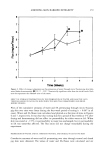
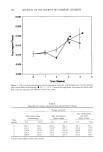
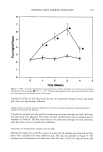
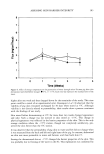
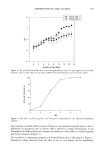
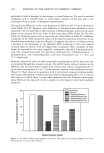
ASSESSING SKIN BARRIER INTEGRITY 177 from the 4øC station and placed at room temperature to equilibrate. A 250-300-pro- thick layer of the skin was dermatomed with a Padgett Electrodermatome (Padgett Dermatome, Division of Kansas City Assemblage Co., Kansas City, MO). Then the skin was cut into circular pieces (12 mm in diameter) and used in permeation experiments. Skin stored after dermatoming. The skin was handled as described in the previous paragraph, except that it was dermatomed before storage. Skin stored after dermatoming and drying. Upon receipt, the skin was washed, rinsed, and dermatomed as described above. The skin was then placed in a dessicator for 24 hours. The dried skin was then removed and stored at either 4øC or -15øC. Before starting the experiment, the skin stored at -15øC was removed and placed at 4øC overnight. Two hours before the beginning of the experiment, the two pieces of skin were removed from the 4øC station and placed in an isotonic buffer solution to hydrate. The skin was then cut into circular pieces and used in the experiment. Receptor fluid. Phosphate-buffered saline (PBS) was used. The buffer was based on Dul- becco's PBS (6) and contained the following ingredients: 0.008 M sodium phosphate, 0.002 M potassium phosphate, 0.14 M sodium chloride, and 0.01 M potassium chloride. This isotonic buffered saline has a pH of 7.4, which is an ideal pH for maintaining sink conditions for SA. Dosing. A 500-pl sample was applied, and the cells were covered throughout the ex- periment. In the preliminary work, this dose was adequate to study the permeation of water and SA over a period of 12 hours. Analysis. Each milliliter of formulation was spiked with 1 lnl of [•4C]SA and 3.3 !•l of [3H]H20. Each lnl of [•4C]SA and [3H]H20 contained 0.1 lnCi (2.2 x 10⁵ DPM) and 1 !•Ci (2.2 x 10 6 DPM), respectively. The receptor fluid from all permeation experi- ments was collected directly into scintillation vials. Ten milliliters of scintillation fluid were added to each vial, and all samples were analyzed in a scintillation counter (Beck- man Instruments, Inc., Fullerton, CA). STATISTICAL ANALYSIS OF DATA Analysis of variance was performed on the permeation rates obtained. The rates obtained over time were compared to the initial ones for any significant differences using Dun- nett's test (95% confidence level). A statistical package (SigmaStat 2.0, Jandel Scientific, San Rafael, CA) was used to process the data. RESULTS EFFECT OF STORAGE TEMPERATURE ON THE PERMEATION OF WATER AND SALICYLIC ACID THROUGH MICRO-YUCATAN PIG SKIN WHEN THE SKIN WAS STORED BEFORE DERMATOMING Plots of the cumulative amounts of water and SA permeating through micro-Yucatan pig skin over time were linear during the four-week period of testing (r 0.997 in all cases). A typical example of such plots is presented in Figure 1. Water and SA flux values were calculated for all cases and plotted as a function of time in Figures 2 and 3, respectively. Most of the flux values obtained at the third and fourth

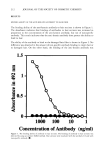
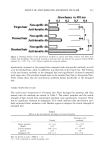
178 JOURNAL OF THE SOCIETY OF COSMETIC CHEMISTS 6O 5O c: ,-! o ._• 0 10 ! I I I I 0 2 4 6 8 10 12 Time (Hours) Figure 1. Change in the permeation of water through micro-Yucatan pig skin stored at -15øC for a period of four weeks. ß initial, O one week, ß two weeks, V three weeks, ß four weeks. Each error bar represents the standard error of the mean. weeks were significantly different from the initial values. An increase in flux of both permeants was noticed with time. The ratios of water to SA flux are displayed in Table I. Most of the ratios calculated for the second and fourth weeks were significantly different from the initial ratio calculated. EFFECT OF STORAGE TEMPERATURE ON THE PERMEATION OF WATER AND SALICYLIC ACID THROUGH MICRO-YUCATAN PIG SKIN WHEN THE SKIN WAS DERMATOMED BEFORE STORAGE Plots of the cumulative amounts of water and SA permeating through micro-Yucatan pig skin over time were linear during the four-week period of testing (r 0.995 in all cases). Water and SA fluxes were calculated for all cases and plotted as a function of time in Figures 4 and 5, respectively. Skin stored at - 15 øC was significantly more permeable to both molecules after one week of storage, whereas the permeability of the skin stored at 4øC was almost unchanged for the four-week period of study. Only one point was significantly different from its initial value. During the study, the flux ratios obtained were in agreement with the data obtained from the rates only.
Purchased for the exclusive use of nofirst nolast (unknown)
From: SCC Media Library & Resource Center (library.scconline.org)