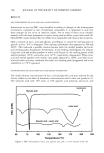
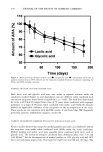
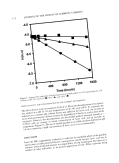
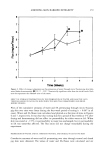
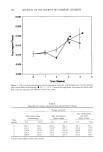
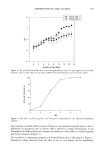
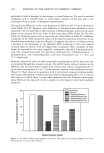
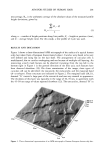
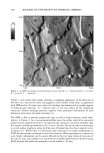
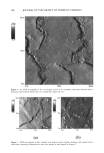
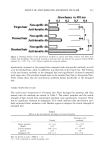
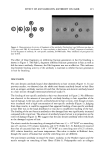
214 JOURNAL OF THE SOCIETY OF COSMETIC CHEMISTS FRACTURE GENERATION IN HAIR BY BRUSHING Fracture generation in hair treated with the antibody is shown in Figure 3. The fre- quency of fracturing of the hair treated with the antibody, but not non-specific antibody, was less then that of the control hair. This result indicates that the antibody also inhibited fracture generation in damaged hair by brushing. The effect of bivalent binding sites of the antibody on fracture generation was examined. F(ab') 2 and Fab fragments of the antibody were prepared using enzyme digestion of the intact antibody. Binding activity of the antibody fragments to hair keratin was dem- onstrated using the Ouchterlony technique (Figure 4). The F(ab')2 fragment formed the precipitin line with hair keratin the same as with the intact antibody, but not the non-specific antibody. The Fab fragment inhibited the portion of the precipitin line between human keratin and intact antibody in the area of diffusion of the Fab fragment. Those results show that their fragments performed well in restricting the binding activity to hair keratin. 40.1 20 0 200 400 Number of brushing (strokes) Figure 3. Effect of the antibody on inhibiting fracture generation in permed hair. The hair lock was treated with the antibody (¸), non-specific antibody (O), and solution buffer as a control ([•).

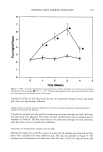
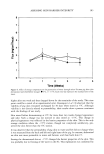
EFFECT OF ANTI-KERATIN ANTIBODY ON HAIR 215 Figure 4. Demonstration of activity of fragments of the antibody. Ouchterlony's gel diffusion was done in 1.2% agar with PBS. K: hair keratin, A: intact antibody to hair keratin, C: F(ab') 2 fragment of antibody, D: Fab fragment of antibody, N: non-specific antibody, B: PBS buffer. Note inhibition of precipitin line near well D. The effect of these fragments on inhibiting fracture generation in hair by brushing is shown in Figure 5. The F(ab') 2 fragment inhibited fracture generation in hair as well as did the intact antibody. However, the Fab fragment was not as effective. This indicates that bivalent binding activity of the antibody is essential to inhibit fracture generation in hair by brushing. DISCUSSION The anti-keratin antibody bound dose-dependently to hair sections (Figure 1). In our previous studies, we observed that the rabbit anti-keratin antibody bound to hair fiber with an antigen-antibody reaction (6) and that the bovine anti-keratin antibody bound to a hair section through immunocytochemical study (7). The binding of non-specific antibody to hair was determined in Figure 2. No difference was observed in the amount of non-specific antibody binding to hair regardless of the type of damage. Little non-specific antibody bound to hair sections, even though sections were incubated with a high concentration of non-specific antibody (Figure 1). Judging from these results, it could be suggested that apparent binding of non-specific antibody to hair fiber was in the basal absorbance or was due to insufficient washing of the hair. The binding of the anti-keratin antibody to the damaged hair was significantly increased compared with virgin hair. The amount of antibody bound to hair is in proportion to the extent of damage (Figure 2). We suggest that the anti-keratin antibody selectively binds to the damaged regions of hair. The elastic modulus for stretching of mongoloid hair was 4.3 x 10⁹ N/M 2 at a stretching rate of 5 cm/min, 65% relative humidity, and 22øC (Table I). C. R. Robbins (2) reported that that of caucasoid hair was 3.89 x 10⁹ N/M 2 at a stretching rate of 0.25 cm/min, 60% relative humidity, and room temperature. Our value is similar to Robbins' data, though the source of human hair and the stretching rate are different. The anti-keratin antibody increased the elastic modulus in the Hooken region and the tensile strength on stretching of hair fibers (Table I). Polypeptides such as collagen
Purchased for the exclusive use of nofirst nolast (unknown)
From: SCC Media Library & Resource Center (library.scconline.org)