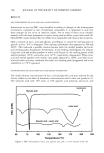
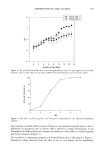
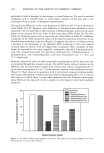
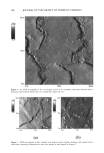
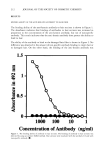
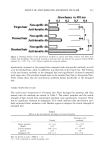
216 JOURNAL OF THE SOCIETY OF COSMETIC CHEMISTS 6o = 40 20 0 200 400 Number of brushing (strokes) Figure 5. Effect of fragments of the antibody on inhibiting fracture generation in permed hair. The hair lock was treated with the intact antibody (¸), F(ab')2 fragment (/•), Fab fragment ( 0 ), and solution buffer as a control ([-]). hydrolysate (3), ginseng saponin (4), and carboxymethyl chitin (5) increased the tensile strength of hair fiber, and collagen hydrolysate and ginseng saponin increased the elongation of hair (4). On the other hand, the antibody did not increase the elongation of hair. It was only observed that the elastic modulus was influenced by relative hu- midity or moisture content (11,12) and temperature (13). Judging from these results, we surmise that the antibody is influenced by a different mechanism from former materials the increased elastic modulus results in improvement of the tensile strength of the damaged hair. The antibody inhibited fracture generation in permed hair through excessive brushing (Figures 3, 5). Excessive brushing causes stretching of hair and then generates fractures of hair. In order to maintain its healthy state, it is important to raise the hair's resistance against stretching. We expect that the strengthening of the elastic modulus of hair fiber by treatment with antibody will result in inhibiting fracture generation of the hair.

EFFECT OF ANTI-KERATIN ANTIBODY ON HAIR 217 Bivalent binding activity of the antibody is essential to inhibit fracture generation in hair by brushing (Figure 5). Antibody molecules, such as bovine immunoglobulin G, are Y-shaped molecules with two identical antigen-binding sites and can cross-link antigen molecules. An antibody has a flexible hinge region where the arms of the Y join the tail, allowing the distance for the two antigen-binding sites to vary. It is suggested that the antibody cross-linked the keratin filaments to inhibit fracture generation in hair. We conclude that the anti-keratin antibody with two binding sites on the keratin of hair increases resistance to stretching and inhibits damage to hair. ACKNOWLEDGMENTS I am grateful to Dr. Ohta for critical reading of the manuscript. I also wish to thank Dr. Murakami for many helpful discussions during the course of this work. REFERENCES (1) J. A. Swift and A. C. Bews, The critical determination of fine changes in the surface architecture of human hair due to cosmetic treatment, J. Soc. Cosmet. Chem., 23, 695-702 (1972). (2) C. R. Robbins, Chemical and Physical Behavior of H•man Hair (Springer-Verlag, New York, 1994), pp. 301-307. (3) Y. Kamimura and I. Yoshida, The application and effect of collagen derivatives to hair, FragranceJ., 39, 75-78 (1979). (4) C.K. Kim, S.J. Yang, and O. S. Lee, Effect of ginseng saponin on hair, Cosmet. Toilerr., 94, 49-64 (1979). (5) Y. Chikamatu, The application of Chinese herbs and Chinese medicine to cosmetics, &lo•hats• Kaga/e•, 42, 3-28 (1983). (6) H. Uchiwa, M. Hirano, Y. Ono, U. Murakami, M. Ohta, and T. Ebina, Production of anti-hair keratin antibody and its biological activity, Jap. J. Dermato/., 104, 855-860 (1994). (7) T. Ebina, M. Ohta, H. Uchiwa, and U. Murakami, Production of anti-hair keratin antibody and its characteristics, Anita, Sci. Techno/., 65, 580-590 (1994). (8) S.I. Wie, K.J. Dorrington, and A. Froese, Characterization of the proteolytic fragments of bovine colostral IgG1, J. Imm•no/., 121, 98-104 (1978). (9) H. Fey, Light chains, Fab and F(ab') 2 from antibody, Imm•nochemistry, 14, 99-106 (1977). (10) J. S. Garvey, N. E. Cremer, and D. H. Sussdorf, &lethods in Immunology (Benjamin/Cummings Pub- lishing Co., Massachusetts, 1977), pp. 256-266. (11) J. Menkart, Caucasian hair, negro hair, and wool: Similarities and differences,J. Soc. Cosmet. Chem., 17, 769-787 (1966). (12) M. Feughelman and M. Robinson, The relationship between some mechanical properties of single wool fibers and relative humidity, Text. Res. J., 37, 441 (1967). (13) L. Rebenfeld, Temperature dependence of the mechanical properties of human hair in relation struc- ture, J. Soc. Cosmet. Chem., 17, 525-538 (1966).
Purchased for the exclusive use of nofirst nolast (unknown)
From: SCC Media Library & Resource Center (library.scconline.org)