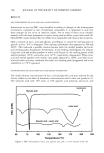
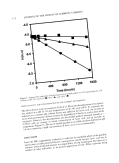
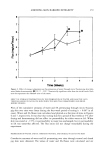
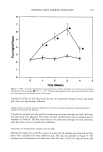
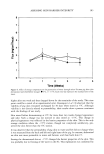
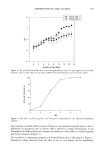
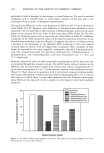
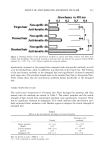
ABSORPTION OF AHAs IN SKIN 193 1.2 0.8 I).6 I).4 0.2 0.0 I----I Control • Formulation A (pH3) • Commercial Product 1 [x x:x3 Commercial Product 2 [•1 Formulation A (pH 7) n-I-FI Formulation B (pH 3) GLYCOLIC ACID FORMULATIONS Figure 1. The effect of various glycolic acid formulations on the barrier properties of hairless guinea pig skin. The values are the mean q- SEM of three to four determinations in each of two to five animals. A one-way ANOVA indicated that none of the formulations were significantly different from each other (p 0.05). chemical dose. The receptor fluid percentage absorbed is significantly lower at the 0.5 % dose level, but the skin and total absorption percentages are not statistically different (t-test, p 0.05). There was no significant difference between 0.5% 2-hydroxyhexanoic, 2-hydroxyoctanoic, and 2-hydroxydecanoic acids with regard to total absorption (ANOVA, p -- 0.19) or receptor fluid levels (ANOVA, p = 0.28). However, 2- hydroxyhexanoic acid totals in skin values were significantly higher than corresponding values for the other AHAs. Skin from two human skin donors was assembled in diffusion cells, treated with an O/W emulsion (Formulation A, without AHA), at pH 3, and maintained in the cells for 24 h. The skin was removed from the cells, and the pH of the skin surface was determined initially and following each of 15 tape strippings (Figure 3). Initial skin surface pH values were approximately 5.3 for the two donors. The pH of the stratum corneum increased gradually to 6.5 and 7.3 for the two donors as the stratum corneum layers were completely removed. DISCUSSION The percutaneous absorption of GA is dependent on the pH of the formulation since the ionized molecule is more polar and therefore less readily absorbed. The effect of pH on the ionization of GA (pKa = 3.8) can be calculated from the Henderson-Hasselbach equation (Figure 4). At pH 3.0, the GA remains mostly un-ionized (87%) and even at pH 3.8, 50% of the compound is in the un-ionized form. We have evaluated GA and

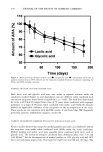
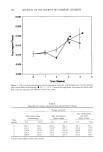
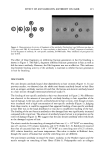
194 JOURNAL OF THE SOCIETY OF COSMETIC CHEMISTS 50 45- 40- 35- 30- 25- 20 0.05 0.10 0.15 0.20 0.25 0.30 0.35 % Tritiated Water Penetration (20 min. Test) Figure 2. Human skin variability: correlation between barrier integrity and glycolic acid absorption. The values are the mean of two to six determinations in each of five subjects. Table IV Percent Applied Dose Absorbed of 0.5% AHA in Formulation A 0.5% 2-OH-hexanoic 0.5% 2-OH-octanoic 0.5% 2-OH-decanoic acid acid acid Location pH3 pH3 pH3 Receptor fluid 10.1 _+ 2.7 15.4 _+ 3.1 8.8 _+ 2.5 Stratum corneum 3.2 _+ 0.9 1.4 _+ 0.3 2.6 + 0.6 Epidermis 8.4 + 1.i n 2.8 + 0.4 a'b 5.8 _+ 0.9 b Dermis 6.7 _+ 0.7 a'• 1.4 _+ 0.2 • 2.1 + 0.3 • Total in skin 18.3 _+ 2.6 •'• 5.5 _+ 0.9 • 10.5 _+ 1.0 • Total absorption 28.4 _+ 3.9 21.0 _+ 2.5 19.3 + 3.1 Values are the mean _+ SEM of two to five determinations in each of three subjects. Values in each location with similar superscripts are significantly different from each other (ANOVA, p 0.05). other AHAs at pH 3.0 to simulate the acidic pH of some commercial cosmetic products containing these ingredients. The effect of pH is clearly seen in Table II on both receptor fluid and skin levels of the three lower-chain AHAs. The magnitude of reduction in absorption at pH 7.0 differed among the AHAs in some locations. Less of a pH differ- ence was seen in the skin levels obtained with lactic acid and 2-hydroxyhexanoic acid. Even at pH 7.0, between 9% and t0% of the applied lactic and 2-hydroxyhexanoic acid was absorbed. The differing GA absorption profiles with Formulations A and B (Tables II and III) illustrate the potential effects of cosmetic vehicles on AHA absorption. Differences in
Purchased for the exclusive use of nofirst nolast (unknown)
From: SCC Media Library & Resource Center (library.scconline.org)