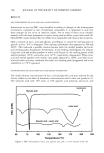
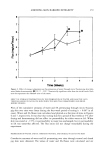
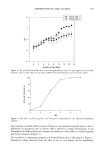
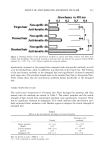
ASSESSING SKIN BARRIER INTEGRITY 181 • 5 • 4 _ _ I I I I I 0 I 2 3 4 5 Time (Weeks) Figure 4. Effect of storage temperature on the permeation of water through micro-Yucatan pig skin (skin dermatomed before storage). ß 4øC, ¸ -15øC. * Statistically significant value from the initial result. Each error bar represents the standard error of the mean. displayed in Table II. The flux values for the two molecules through ventral and dorsal skin were not significantly different. PERMEATION OF WATER AND SA THROUGH YUCATAN PIG SKIN OBTAINED FROM DIFFERENT AREAS OF THE BODY OF THE PIG Cumulative amounts of water and SA permeating over time through the back, left ham, and right ham were obtained. The values of water and SA fluxes were calculated and are displayed in Table II. The flux values for the two molecules through the back, left ham, and right ham were not significantly different. VARIATION IN PERMEABILITY AMONG PIGS STUDIED During this study, the initial flux values of water and SA through pig skin and the flux ratios were calculated for three different pigs. The data are plotted in Figure 8. The average rates of permeation for both water and SA were 2.58 + 0.19 mg/cm2/hour and

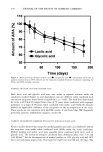
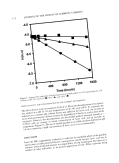
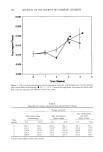
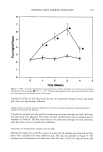
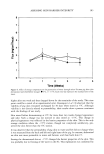
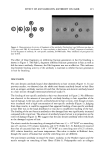
182 JOURNAL OF THE SOCIETY OF COSMETIC CHEMISTS 0.030 0.025 0.020- • o. o15 u. 0.010 0.005 0.000 I I I I I 0 1 2 3 4 5 Time (Weeks) Figure 5. Effect of storage temperature on the permeation of salicylic acid through micro-Yucatan pig skin (skin dermatomed before storage). ß 4øC, ¸ -15øC. * Statistically significant value from the initial result. Each error bar represents the standard error of the mean. 0.01 ___ 9.7 x 10 -4 mg/cm2/hour, respectively. The average value of the flux ratios was 269.84 ___ 23.63. Based on the values of the standard error of the means obtained, it is clear that the variability among pigs for the rates obtained was very limited. DISCUSSION The flux ratio reinforced in many instances the results obtained by the individual rates. At the two-week time point for skin stored before dermatoming, the individual flux values for both markers at both storage temperatures did not differ significantly from the baseline value (Figures 2, 3). However, the flux ratios for these data were significantly different from the reference values (Table I). On the other hand, at three weeks under the same conditions, there were significant differences in individual flux values but not in the ratios. Therefore, the most rigorous test for barrier integrity is to require that both the individual marker flux values and their ratios remain unchanged from the initial values. Storing skin at 4øC after dermatoming appears to be the most appropriate and conve- nient method of storage. In all cases, the flux did not change significantly over time from the initial values. One exception was noticed when the flux value of SA was significantly
Purchased for the exclusive use of nofirst nolast (unknown)
From: SCC Media Library & Resource Center (library.scconline.org)