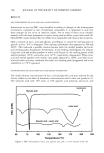
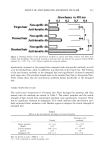
STABILTY OF LACTIC AND GLYCOLIC ACIDS 171 Table II Stability Results for Lactic Acid and Excipients Combined With Lactic Acid Combination Stability of* pH Concentration left after 6 months at 25øC (%) Shelf life at 25øC (to. 9 = years) Glycolic acid LA 1.91 98.2 83 Methyl paraben LA 1.84 98.6 85 Methyl paraben MP 1.84 46.7 0.5 Sorbic acid LA 1.87 99.2 98 Sorbic acid SA 1.87 53.5 0.5 Sodium lactate LA 3.83 98.4 96 Glyceryl monostearate LA 1.92 97.6 85 Cetyl alcohol LA 1.90 99.2 82 Stearic acid LA 1.89 98.5 84 Glycerol LA 1.87 97.4 84 Lanolin LA 1.94 96.3 82 Sorbitol LA 1.95 97.5 81 PEG 1000 monostearate LA 1.92 97.3 82 Isopropyl myristate LA 1.91 97.6 82 Isopropyl palmitate LA 1.90 99.3 79 * LA = lactic acid MP = methyl paraben GA = glycolic acid SA = sorbic acid. Table III Stability Results for Glycolic Acid and Excipients Combined With Glycolic Acid Combination Stability of* pH Concentration left Shelf life after 6 months at 25øC at 25øC (%) (to. 9 = years) Lactic acid GA 1.88 97.7 70 Methyl paraben GA 1.87 98.2 67 Methyl paraben MP 1.87 32.1 0.2 Sorbic acid GA 1.83 96.3 89 Sorbic acid SA 1.83 44.2 0.5 Glyceryl monostearate GA 1.92 99.6 89 Cetyl alcohol GA 1.94 95.2 82 Stearic acid GA 1.87 98.3 81 Glycerol GA 1.88 97.3 79 Lanolin GA 1.87 98.6 86 Sorbitol GA 1.84 95.4 87 PEG 1000 monostearate GA 1.92 96.3 84 Isopropyl myristate GA 1.90 98.7 90 Isopropyl palmitate GA 1.86 99.2 86 * LA = lactic acid MP = methyl paraben GA = glycolic acid SA = sorbic acid. equivalent acitvation energies were 13.2 and 14.9 kJ/mol -• for the decomposition of sorbic acid. In the presence of glycolic acid, sorbic acid decomposes rapidly with a predicted shelf life at 25øC of only 185 days, and when sorbic acid was combined with lactic acid, the shelf life was 197 days. This is not of practical importance since these preservatives are not commonly used at such low pH, and at very low pH most emulsions are self-preserving.

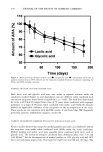
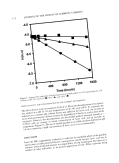
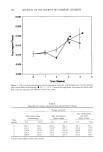
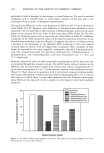
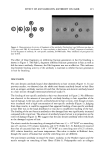
joURNAL OF TliE SOCIETY OF cosMETIC CliEMISTS -4.0 -4.5 -5.0 -6.0 -6.5 -7.0 800 1200 1600 0 400 Time Ihours) Apparent first-order plots of the decomposition of methyl paraben in a t0% aqueou glycoliacid Figure 4. and 40øC ([])' 80øC (&)' and 120øC ([])' solution at pH 1.87 EFFECT OF LACTIC ACID coNCENTRATION ON TIdE STABILITY OF ExCIPIENTStheexcipiinincreaseofmaintathe(roflinearlyorinatincreaseanbufferedAnToacidacid.increasedemuls*onacid120øC'lacticdecompoandAlIAtheparaben The effect of lactic acid concentration (0.06-0-22 M) on the was studied at a pH of 3.8 and temperatures of 40, 80, solutions at a constant pli, sodium lactate was added to most lactic acid concentration did not increase the degradation of the lactic ß . . .. entration of lactic and However, the decomposition rate for methyl excipients- n•c .... ¬• 'n an . with an increase m m•t)al 0.9962) ,•:•,•o % The use ot metny• P• .... n * temperature kr,• ...... ß 3.8 and containing a high concentration of lactic acid is not recomme' DiscUSSION From the DSC compatibility eYaluation interactions actually predicted kinetic consequencea'marebeinacidofpossiblethematerilacticwhichWhenbecausewould(4,5,8).concludedmostlybenotapplicationcouldit was solution- Users of thermal analysis in compatibility testing agree that there number of other difficulties in its general
Purchased for the exclusive use of nofirst nolast (unknown)
From: SCC Media Library & Resource Center (library.scconline.org)