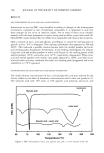
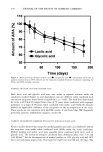
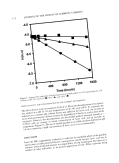
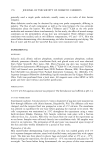
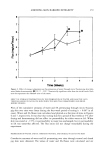
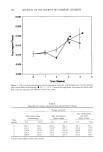
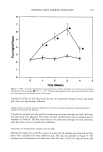
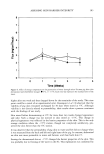
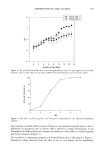
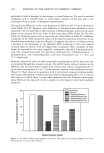
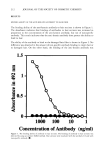
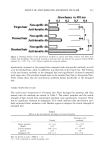
STABILTY OF LACTIC AND GLYCOLIC ACIDS 173 4.0 2.0- 1.0- =0 •'• ! ! 0.00 0.05 0.10 0.15 0.20 0.25 Concentration (M) Figure 5. Effect of lactic acid concentration on the apparent first-order rate constant of methyl paraben decomposition at pH 3.83 and 40øC (I), 80øC ('), and 120øC (O). tested have almost identical melting points, it is difficult to distinquish the thermal events attributed to each component. Interpretations of DSC curves are also impossible when one component dissolves in another. In these studies, dissolution occurred either in the melt of the lower melting glycolic acid (melting point equal to 79øC) or in the lactic acid solution. All this indicated that false positives were likely when DSC data are used to predict possible incompatibilities. Therefore, to substantiate interactions seen by DSC, the thermal stability of aqueous solutions was studied to determine the kinetics of decomposition of various combina- tions of the compounds. Information on the stability of AHAs is scarce, but lactic acid and glycolic acid are reported to be very stable in aqueous solution. This was found true because both lactic acid and glycolic acid remained stable (Figure 3), regardless of exposure to high temperature, for six months. Furthermore, combination with excipi- ents, and exposing these mixtures to high temperature, did not decrease the AHA stability. Information about the stability of the other excipients at low pH was also not readily available. Results obtained from accelerated thermal stability studies of AHAs and excipient mixtures revealed that only methyl paraben and sorbic acid were unstable at

174 JOURNAL OF THE SOCIETY OF COSMETIC CHEMISTS pH less than 2. This correlated well with results obtained by previous investigators (9,10). Methyl paraben underwent acid-catalyzed ester hydrolysis in aqueous formula- tions, such as o/w emulsions, yielding p-hydroxy benzoic acid and methanol (9,10). In aqueous solution, sorbic acid undergoes auto-oxidation, forming aldehydes and other carbonyl-containing compounds (7). Both were stable at a slightly higher pH in par- ticular, methyl paraben at a pH of 3.8 was very stable, as seen in Tables II and III. CONCLUSIONS Combination of AHAs with the excipients tested had no influence on the rate of either glycolic acid or lactic acid decomposition. These two AHAs were stable. Among the excipients studied, sorbic acid and methyl paraben were prone to decomposition when combined with either 10% lactic acid or 10% glycolic acid in aqueous solutions at a pH below 2. This result is not important because these preservatives are not commonly used in products at such a low pH. When lactic acid was buffered at a slightly higher pH of 3.8, a marked improvement in the stability of methyl paraben was observed. An increase in lactic acid concentration from 5 to 20% at pH 3.8 led to an increase in decomposition, but decomposition was still slower than at pH less than 2. REFERENCES (1) R. W. Siegfried, Formulating with alpha hydroxy acids, Drug Cosmet. Ind., 156(6), 30-37, 104-105 (1995). (2) B. Idson, Treatment cosmetics II. Retinoids and AHAs, Drug Cosmet. Ind., 156(5), 24-28 (1995). (3) State of the industry, Drug Cosmet. Ind., 156(6), 28-35, 43-44 (1995). (4) A. Smith, Use of thermal analysis in predicting drug-excipient interactions, Anal. Proc. 559-561, (December 1982). (5) M.J. Hardy, Drug-excipient compatibility prediction by DSC, Anal. Proc., 556-557 (December 1982). (6) H. Cheng and R. R. Gabbe, Stability-indicating high-performance liquid chromatographic assay for lactic acid in lotions,J. Chrom., 335, 399-406 (1986). (7) S.S. Arya, Stability of sorbic acid in aqueous solutions,J. Agric. Food. Chem., 28, 1246-1249 (1980). (8) A.A. Van Dooren, Design of drug-excipient interaction studies, Drug Dev. Ind. Pharm., 9, 43-55 (1983). (9) K. A. Connors, G. L. Amidon, and V. J. Stella, Chemical Stability of Pharmaceuticals (John Wiley & Sons, New York, 1986), pp. 580-586. (10) N. N. Raval and E. L. Parrott, Hydrolysis of methylparaben, J. Pharm. Sci., 56(2), 274-275 (1967).
Purchased for the exclusive use of nofirst nolast (unknown)
From: SCC Media Library & Resource Center (library.scconline.org)