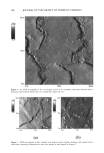
210 JOURNAL OF THE SOCIETY OF COSMETIC CHEMISTS creases the elastic modulus of damaged hair and inhibits fracture generation in hair. We confirm that bivalent binding activity of the antibody is essential to inhibit fracture generation in hair. EXPERIMENTAL HAIR For this experiment, the hair of Chinese women was used. The hair was treated for 30 minutes with a cold waving agent containing 6% ammonium thioglycolate (pH 9.0) at room temperature. Then the permed hair was brushed manually with 10,000 strokes. PREPARATION OF ANTI-KERATIN ANTIBODY The anti-keratin antibody was prepared using the method described by T. Ebina et aL (7). The milk containing the antibody (immunoglobulin G) was obtained by immuniz- ing cows with human hair keratin. The fat was then removed from the milk by cen- trifugation. Casein was precipitated from whey proteins by the addition of diluted hydrochloric acid. The antibody fraction was separated from the other whey proteins by two repetitive precipitations with saturated ammonium sulfate. The antibody was fur- ther purified by column chromatography. As a control, non-specific antibody was pre- pared from milk of non-immunized cows. FRAGMENTATION OF ANTIBODY Digestion was essentially performed according to S. Wie et al. (8). To prepare the Fab fragment of the antibody, 400 mg of antibody was incubated with 4 mg of mercuri- papain (Worthington Biochemical Corp.) in 0.! M acetate buffer (pH 5.5) containing 2 mM EDTA and 10 mM cysteine, at 37øC, for two hours. Digestion was terminated by the addition of 20% molar excess of recrystallized iodoacetamide. To prepare the F(ab')2 fragment of the antibody, 400 mg of antibody was incubated with 12 mg pepsin (Worthington Biochemical Corp.) in 0.! M acetate buffer (pH 4.5) at 37øC for four hours. The reaction was stopped by adjusting the pH to 8.0 by NaOH. The precipitation of Fc fragment and intact antibody by addition of ZnSO 4 was per- formed essentially according to H. Fey (9). Each of the digestion products was dialyzed against saline. A solution of 250 mM ZnSO 4 was added to bring the final concentration to 50 raM, and the mixture was left at room temperature for two hours. After centrifu- gation, 1% tetrasodium EDTA was added to the supernatant to chelate excess Zn ions. The products were dialyzed against saline two times and then against phosphate- buffered saline (PBS). These fragment solutions were prepared as the equivalent molar concentration of intact antibody. Binding activity of these fragments was determined by applying the Ouchterlony technique (10) to human hair keratin. ENZYME-LINKED IMMUNOSORBENT ASSAY TO HAIR SECTIONS The assay was performed by using the indirect enzyme-linked immunosorbent assay (ELISA) method on a 96-well plate, with a nitrocellulose membrane forming the bottom

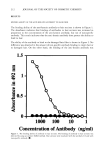
EFFECT OF ANTI-KERATIN ANTIBODY ON HAIR 211 of the wells (MultiScreen plate, Millipore Ltd.). Five-micrometer-thick sections were sliced off from human hair with a cryostat. Sections of fifteen hundreds were put in each of the wells. The plate was then blocked for one hour at room temperature with 3% bovine serum albumin (Seikagaku Kogyo Co.) in PBS. It was then washed twice with 0.02% Tween©-20 in saline. Each dilution (100 lal) of the anti-keratin antibody or non-specific antibody was applied to each well and incubated for one hour at room temperature. After the wells were washed five times, rabbit anti-antibody peroxydase conjugate (Kappel) that was diluted 1:500 was added (100 lal) to each well and incubated for one hour. Wells were washed again five times and 0.4 mg/ml 0-phenylenediamine in 0.1 M Na2HPO4, 0.05 M citric acid, and 0.006% H202 was added (tOO lal/well). After 30 min, 3N H2SO 4 was added to stop the coloring. The amount of color was read at 492 nm with a microplate reader (MTP-32, Colona Electric Co., Ltd.). In the binding assay of the antibody to hair fiber, a lock of tOO hair strands was immersed in PBS containing 0.3% antibody for one hour at 30øC. The strands were thoroughly rinsed with t000 ml of 0.05% Tween©-20 in PBS (PBS-T) and then fixed with 0.25% glutaraldehyde, rinsed with PBS-T, and sliced into sections. To detect the amount of antibody binding to hair fibers, application of ELISA to the hair sections was performed according to the above-mentioned method. TENSILE PROPERTIES In order to reduce the deviation attributed to the inequality of the diameter of each hair, two adjoining sections (7 cm) of the same hair were used as a pair. One of the two sections was immersed in PBS containing 0.3% antibody for one hour at 30øC and another in PBS. These fibers were then rinsed with tap water for ten minutes. Stress- strain curves for individual hair fibers were obtained at 22øC and 65% relative humidity using the tensile tester. The hair fiber (5 cm) was stretched at a rate of 5 cm/min. The elastic modulus (Es), (the ratio of stress to strain) in the Hookean region, was calculated as• Es = AF * L/A * AL (N/M 2) where AF = the change in force induced by a change in length, L = fiber length in meters, AL -- fiber extension in meters, and A = fiber cross-sectional area in meters squared, which was determined by the weight per length, supposing the density is t g/cm 3. We evaluated the stress to breaking point (the tensile strength) and the percentage extension to breaking point as other parameters of load elongation curves. For statistical analysis of those parameters, we used paired t-tests. GENERATION OF FRACTURE BY BRUSHING Two grams of hair strands (15 cm in length) were immersed in PBS containing 0.3% antibody, its fragments, or non-specific antibody for one hour at 30øC. As a control, a hair lock was immersed in PBS. The hair was rinsed with tap water for ten minutes after a hundred brush strokes. Before brushing, the hair lock was immersed in water for one minute and was partially dried by using a drier for one minute in order to accelerate the damage to hair by brushing. The hair was brushed manually using the blind study method. The number of fractures generated in hair locks was counted.
Purchased for the exclusive use of nofirst nolast (unknown)
From: SCC Media Library & Resource Center (library.scconline.org)