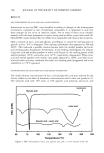
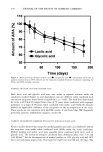
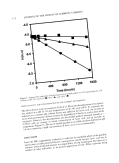
174 JOURNAL OF THE SOCIETY OF COSMETIC CHEMISTS pH less than 2. This correlated well with results obtained by previous investigators (9,10). Methyl paraben underwent acid-catalyzed ester hydrolysis in aqueous formula- tions, such as o/w emulsions, yielding p-hydroxy benzoic acid and methanol (9,10). In aqueous solution, sorbic acid undergoes auto-oxidation, forming aldehydes and other carbonyl-containing compounds (7). Both were stable at a slightly higher pH in par- ticular, methyl paraben at a pH of 3.8 was very stable, as seen in Tables II and III. CONCLUSIONS Combination of AHAs with the excipients tested had no influence on the rate of either glycolic acid or lactic acid decomposition. These two AHAs were stable. Among the excipients studied, sorbic acid and methyl paraben were prone to decomposition when combined with either 10% lactic acid or 10% glycolic acid in aqueous solutions at a pH below 2. This result is not important because these preservatives are not commonly used in products at such a low pH. When lactic acid was buffered at a slightly higher pH of 3.8, a marked improvement in the stability of methyl paraben was observed. An increase in lactic acid concentration from 5 to 20% at pH 3.8 led to an increase in decomposition, but decomposition was still slower than at pH less than 2. REFERENCES (1) R. W. Siegfried, Formulating with alpha hydroxy acids, Drug Cosmet. Ind., 156(6), 30-37, 104-105 (1995). (2) B. Idson, Treatment cosmetics II. Retinoids and AHAs, Drug Cosmet. Ind., 156(5), 24-28 (1995). (3) State of the industry, Drug Cosmet. Ind., 156(6), 28-35, 43-44 (1995). (4) A. Smith, Use of thermal analysis in predicting drug-excipient interactions, Anal. Proc. 559-561, (December 1982). (5) M.J. Hardy, Drug-excipient compatibility prediction by DSC, Anal. Proc., 556-557 (December 1982). (6) H. Cheng and R. R. Gabbe, Stability-indicating high-performance liquid chromatographic assay for lactic acid in lotions,J. Chrom., 335, 399-406 (1986). (7) S.S. Arya, Stability of sorbic acid in aqueous solutions,J. Agric. Food. Chem., 28, 1246-1249 (1980). (8) A.A. Van Dooren, Design of drug-excipient interaction studies, Drug Dev. Ind. Pharm., 9, 43-55 (1983). (9) K. A. Connors, G. L. Amidon, and V. J. Stella, Chemical Stability of Pharmaceuticals (John Wiley & Sons, New York, 1986), pp. 580-586. (10) N. N. Raval and E. L. Parrott, Hydrolysis of methylparaben, J. Pharm. Sci., 56(2), 274-275 (1967).

j. Soc. Cosmet. Chem., 48, 175-186 (July/August 1997) Dual-probe method for assessing skin barrier integrity: Effect of storage conditions on permeability of micro-Yucatan pig skin HANI M. FARES and JOEL L. ZATZ, Rutgers University College of Pharmacy, P.O. Box 789, Piscataway, NJ 08855-0789. Accepted iCt publication September 30, 1997. Synopsis The effect of several storage conditions on the permeability of pig skin was investigated. Three different storage conditions were studied, each at two temperatures: 4øC and -15øC. Skin was stored before der- matoming, after dermatoming, and after dermatoming and drying. The variability in the flux of water and salicylic acid (SA), and their ratios (water/SA) over time, served as indicators for the change in the barrier properties of skin. It was found that storing the skin after dermatoming at 4øC kept the permeability of the skin unchanged for four weeks. Storing the skin at a temperature of -15øC altered its permeation to water and SA significantly, however when the skin was dried before storage, its stability at -15 øC was improved. Monitoring the fluxes of two compounds of different polarities and their flux ratios over time is a more rigorous way of testing retention of the barrier integrity of skin than studying the change in flux of one molecule. INTRODUCTION The similarities in histology and barrier properties between porcine and human skin led researchers to use porcine skin in studying permeation. The use of fresh skin in every permeation experiment is very expensive and impractical. Thus, there is a need to store the skin for future use. A wealth of information is found in the literature on the effect of storage on the barrier properties of human skin (1,2). However, similar data on porcine skin is very limited. May and Wainwright (3) studied the structural and meta- bolic degeneration of porcine skin stored in Eagle's minimum essential medium (MEM) at 4øC. During the first week, the authors reported a significant loss of cellular enzyme activity and integrity as well as a shrinkage of the epithelium. The effect of storing animal skin in Roswell Park Memorial Institute (RPMI) 1640 tissue culture media on skin's viability was investigated by Rosenquist et al. (4). The results indicated that the viability of rabbit and pig skin was similar to that of human skin, whereas dog, rat, and mouse skin were significantly different in viability as compared to httman skin. Limited information on the effect of storage on pig skin permeability was found in the literature. Hawkins and Reinfenrath (5) showed that freezing pig skin at -80øC changed its permeability to N,N-diethyl-m-toluamide after one week. Previous investigators have 175
Purchased for the exclusive use of nofirst nolast (unknown)
From: SCC Media Library & Resource Center (library.scconline.org)