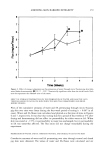
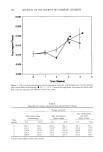
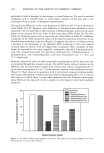
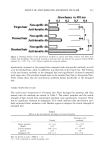
184 JOURNAL OF THE SOCIETY OF COSMETIC CHEMISTS 0.030 0.025 '•' 0.020 o E .e. o o.o15 E x • O.OLO 0.005 0.000 I I I 1 I 0 1 2 3 4 5 Time (Weeks) Figure 7. Effect of storage temperature on the permeation of salicylic acid through micro-Yucatan pig skin (skin dermatomed and dried before storage). ß 4øC, ¸ -15øC. * Statistically significant value from the initial result. Each error bar represents the standard error of the mean. Table II Variability in Water and SA Flux Among Different Areas of the Body of the Pig Water Salicylic acid Standard error Standard error Flux of the mean Flux (x 102) of the mean (x 102) Skin area (mg/cm2/hour) (mg/cm2/hour) (mg/cm2/hour) (mg/cm2/hour) Ventral 2.45 0.584 1.08 0.135 Dorsal 2.55 0.865 1.07 0.186 Back 2.44 0.419 1.18 0.062 Left ham 2.36 0.185 1.18 0.247 Right ham 2.80 0.464 1.01 0.050 the fact that the barrier of the dried skin stored at -15 øC was less damaged than for the skin stored at - 15 øC without drying, as noted from the flux values. The results obtained confirm the findings by Hawkins and Reinfenrath (5), who showed that freezing pig skin at -80øC increased its permeability to N,N-diethyl-m-toluamide after one week.

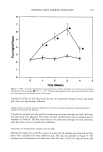
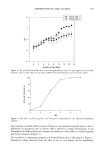
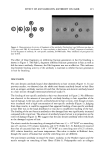
ASSESSING SKIN BARRIER INTEGRITY 185 4.00 3.00 I::: 2.00 •:mO.02, E ' 0.01 0.00 i i 9 o o o Pig 1 Pig 2 Pig 3 Number of Yucatan pigs studied Figure 8. Variability in the initial rates of permeation of water and salicylic acid among pigs studied. (I) water, ([•) salicylic acid, ([•) bars ratios. Each error bar represents the standard error of the mean. Bronaugh eta/. (2) studied the permeation of water through human skin. They reported that the permeability coefficient (Kp) of water through human skin was 1.54 x 10 3 q_ 0.14 cm/hr. In this study, the permeability coefficient for water through pig skin was calculated and found to be 2.6 x 10⁻³ q- 0.19 cm/hr. This shows that pig skin is approximately 1.7 times more permeable to water than human skin and that the vari- ability in results is very similar. CONCLUSIONS 1. Storing the skin after dermatoming at 4øC maintained its permeability unchanged for four weeks. 2. Storing the skin at a temperature of -15øC altered its permeation to water and SA significantly however, removing water from the skin prior to storage improved its stability. 3. Monitoring the change in flux of the two markers and their ratios over time is a rigorous way of testing skin barrier integrity. ACKNOWLEDGMENTS The authors would like to express their gratitude to Charles River Laboratories and SmithKline Beecham Consumer Healthcare for their financial support of this study.
Purchased for the exclusive use of nofirst nolast (unknown)
From: SCC Media Library & Resource Center (library.scconline.org)