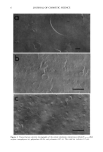
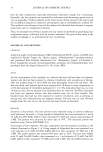
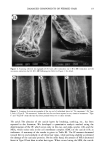
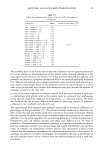
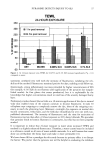
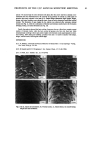
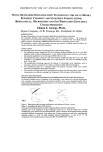
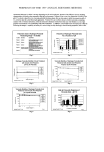
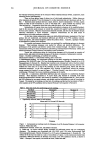
PREPRINTS OF THE 1997 ANNUAL SCIENTIFIC MEETING 41 spaced. The second type of cuticle abrasion took place after the cuticle had been cracked or de- cemented and was characterized by the removal of big potlions of cuticle (2). Both types of abrasion have been repotled in the past (2-3). Cuticle shape distortion: Open ripples, bulges, bumps, and crater formation were among the main forms of cuticle distortion found after cyclical stresses. The formation of open ripples by the cuticles was ohsended after extension cyclical stresses (see Fig. 1), while the combination of thermal and extension cycles lead to the formation of bulges, bumps, and crater formation (see Fig. ld). Finally, the analysis showed that hair cuticles of persons who use a blow dryer contain a great number of thermal cracks, while the hair cuticles of persons who blow dry their hair while simultaneously combing it show open cuticle ripples with thermal cracks superimposed on them. Iron curling, blow drying and combing practices were seen to result in cuticles with bumps, bulges, vetlical cracks, and irregular cuticle edges. REFERENCES (1) C. R. Robbins, "Chemical and Physical Behavior of Human Hair", 3rd ed. (Springer-Verlag, New York, 1994) pp. 211-226. (2) S. B. Reutsch and H. D. Werigmann, J. Soc. Cosmet. Chem., 47, 13-26 (1996) (3) J. A. Swift, Int. J. Cosmet. Sci., 13, 143 (1991) i I,, 1200X 1140X •,• . 1450X ld Fig. 1 a-d) la, Cuticle de-cementation lb, Thermal cracks lc, Cuticle fusion, ld, Cuticle bumps, bulges and crater formation.

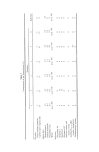
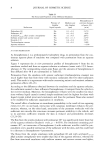
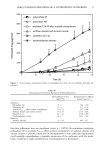
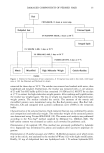
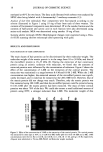
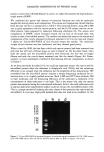
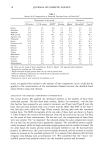
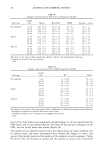
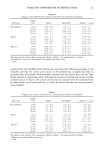
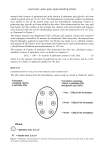
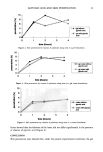
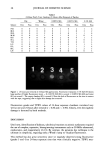
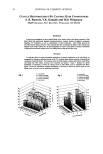
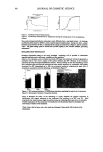
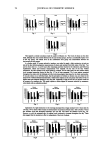
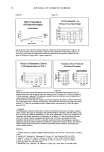
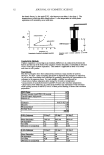
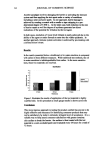
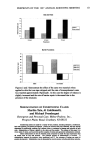
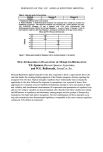
42 JOURNAL OF COSMETIC SCIENCE CUTICLE REINFORCEMENT BY CATIONIC HAIR CONDITIONERS S. B. Ruetsch, Y.K. Kamath and H.D. Weigmann TRl/Princeton, P.O. Box 625, Princeton, NJ 08542 Introduction In l•evious investigations we have studied lifdng of the surface cuticle cells dttring extension of hair fibers which had experienced stanclaxd grooming practices, cosmetic chemical treatments, mechanical fatiguing, UV irradiation as wen as combinations of these treatments. Scale lilting observed by microfiuorometry during extension of the untreated hair fiber is facilitated by failure in the endocuticular domains of the surface cuticle cell. In this investigation we report on the effects of catJoint conditioners of high and low molecular weight on the scale lilting behavior and on hair fiber creep. Discussion To study the effects of single and multiple applications of cationic conditioners on the scale lifting, we detenuined the chaages in autofluorescence in the UV excitation beam during extension of untreated and conditioner treated hair fibers. The extension levels at which urndom, common and extreme scale lifting, and finally hair fiber failure occurred,. were measured and plotted. Figure I displays the typical distribution of extensions at which the various levels of scale lifting occur in untreated hair fibers. Figure 2 shows the significantly changed distribution of extensions at which the various levels of scale lifting occur, or do not occur, in conditioner Ixeated hair. Fig. 1 A = unextended A -- unextended B = random scale lifting Fig. 2 • = random scale lifting C = common scale • C = common scale • D = extreme scale rifting D = extreme scale liflgxg E = fiber failure E = fiber failure - 30 - 10 StreSS phenomena
Purchased for the exclusive use of nofirst nolast (unknown)
From: SCC Media Library & Resource Center (library.scconline.org)