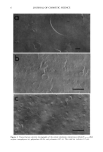
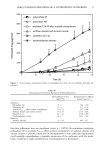
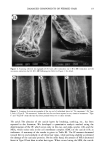
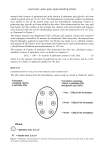
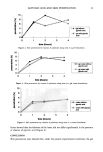
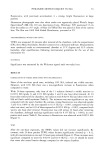
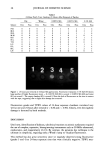
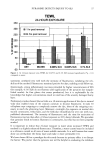
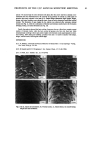
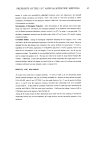
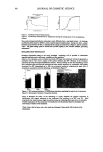
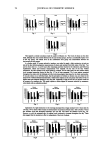
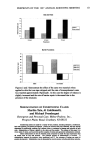
PREPRINTS OF THE 1997 ANNUAL SCIENTIFIC MEETING 43 Fig. Subsequent scanning electron microscopy of the extended hair fibers provided greater detail about the nature of scale lifting and the failure location. Surface cuticle cells of untreated hair fibers tend to respond with a scale litting mechanism to release the stress of extension. During extension, shear forces ate generated between the different layers of the cuticle cell, and at high levels of extension and shearing, stress concentrations at the scale edge of the surface cuticle cell lead to failure in the easily extensible, weakly cross-linked endocuticular domain.• This failure within the endocuticle results in delamination and lilting of the unexteusible, highly cross- linked upper layers of the surface cuticle cell, thus producing the scale lilting phenomenon, (Figure 3). During extension of conditioner treated hair, the high level of scale litting, so characteristic of unaltered hair, is almost completely eliminated. Even intermediate and low levels of scale litting occur at higher extension levels or not at all. This suggests that the conditioning compounds modify the upper cuticular layer by reinforcing the scale edges and/or the intercuticular zone. However, when scale lifting occurs in the conditioner treated hair fiber, it involves intercellular failure in the CMC beneath the surface cuticle cell, rather than intracellular failure in the endocuticle as observed in the case of untreated hair, (Figure 4). This suggests that the conditioners modify the deformation behavior of the endocuticle which becomes reinforced and resists intracellular failure/fxaeture. This behavior is true also of low moleeulat weight quaternary. compounds and may involve hydsophobic bonding of lipid chains. When scale lifting can not take place, stress is released by scale cracking. This ol•en leads to fiber fracture and occurs only at high levels of extension. The ease of scale lifting is directly associated with the ablation of cuticle cells during grooming. Conditioner treatments which make scale lifting mor• difficult, thus provide ablatlon resisting properties to the cuticle and therefore are beneficial in preventing longterm grooming damage to hair fibers. Besides affecting scale lifting as a mechani•m of stress release during extension, the conditioners also affect hair fiber creep. Multiple applications of the high molecular weight quatemized cellulose derivative significantly change the creep behavior of hair fibers in comparison to the untreated controls. This change in creep behavior suggests conditioner-induced Improved cohesion within the intercellular cement and the weakly cross-linked endocuticle of at least the outer layer of the cuticular sheath, which in fine hair fibers, stops movement of the cuticle cells relative to each other, when limiting levels of shear deformation have been reached. Our studies lead to the conclusion that at least at slow strain rates the propexties of the cuticula in fine fibers can have a direct bearing in the creep deformation behavior of the cortex, contrary to generally accepted concepts. I Fig,4 I

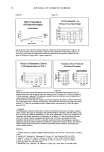
44 JOURNAL OF COSMETIC SCIENCE FORMULATING FOR MILDNESS WITH SULFOSUCCINATES Andrea Allardice Witco Corporation While sulfosuccinates have been widely used for years within the personal care industry for formulating mild skin and hair cleaning products, their importance today is greater than ever. Formulating novel products will be discussed. Synergies of sulfosuccinates with other low irritation surfactants will be shown. This will allow the formulators to achieve the performance characteristics the consumer demands while maintaining the low irritation profile required. In addition, the general chemistry and variations of sulfosuccinates will be outlined. The main focus is to be the dermatological properties. These will be demonstrated by the comparison of in-vivo and in-vitro tests, especially the Red Blood Cell Test. A MATHEMATICAL TREATISE OF THE PERCEIVED ATTRIBUTES AND RHEOLOGICAL PROPERTY CORRELATIONS OF THE SKIN CARE CREAMS J. Mendoza, H.Y. Kung, M Wang, I. Dumanli, C. Lee and M.S. Kislalioglu Cosmetics and Personal-Care Products Technology Program, Department of Applied Pharmaceutical Sciences, The University of Rhode Island, Kingston, RI, 02881 INTRODUCTION Functional properties and sensory perceptions are equally important in cosmetic product development. Determination of a universal model that can provide acceptable correlations between the physical and perceived properties of a wide range of emulsions was among ongoing interests of this group. This study seeks mathematical correlations between the rheological properties of 10, 30, 50 % O/W and 10, 30, 50 % W/O skin creams and their perceived attributes. It is continuation of the former studies that is expected to explain the functional and perceived property relationships of such products one step further METHODS Preparation of Emulsions: All emulsions were perpared using castor oil (Ruger, NJ) as the oil phase, sorbitan stearate (ICI, NJ) and ceteareth-6 & stearyl alcohol (BASF, NJ) as surfactants. The oil phase and water containing 5.0% (w/w) surfactant were heated up to 72 o C and mixed together using a Ross Mixer ME 100 LC (Charles Ross & Son Co, NY) at 5,000 rpm for 10 minutes. O/W and W/O emulsions containing 10, 30 and 50% w/w dispersed phase were prepared and characterized. All emulsions were in the cream form and had similar appearences. Determination of Perceived Attributes: Twelwe untrained oriental female adults with healthy skin, whose ages ranged from 24 to 32 years participated in these studies. Emulsions prepared were placed in identical containers and presented to the panel for evaluation. The panel members were asked to rank the pick-up (firmness, stickiness, peaking and cohesiveness), rub-out (wetness, thickness, absorbency,
Purchased for the exclusive use of nofirst nolast (unknown)
From: SCC Media Library & Resource Center (library.scconline.org)