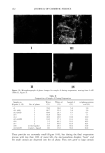
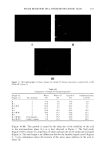
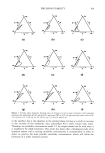
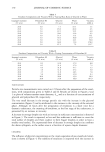
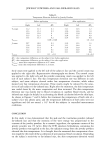
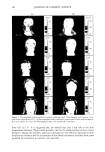
JEWELRY POWDERS AND FAR-INFRARED RAYS 181 Table II. Temperature Elevation Induced by Jewelry Powders Before application After application Right Left AT, Right Left AT 2 T-cream TT,mean J-cream Tj,mean 31.2 31.3 0.1 31.3 32.5 1.2 32.3 32.4 0.1 32.6 33.6 1.0 32.0 32.0 0 32.9 33.8 0.9 32.5 32.5 0 32.8 33.7 0.9 33.5 33.3 0.2 32.9 33.7 0.8 0.08 _+ 0.08 1.0 _+ 0.2 29.7 30.0 0.3 31.0 32.3 1.3 33.6 33.8 0.2 33.3 34.4 1.1 31.4 31.4 0 31.9 33.0 1.1 32.2 32.3 0.1 32.1 32.9 0.8 32.2 32.3 0.1 33.1 33.9 0.8 0.1 -+ 0.1 1.0 _+ 0.2 ATe: skin temperature differences on the subject's face before application. AT2: skin temperature differences on the subject's face after application. TT ..... : mean skin temperature differences in T-cream. T3 .....: mean skin temperature differences in J-cream. the J-cream were applied to the left side of the subject's face and the control cream was applied to the right side. Representative thermographs are shown. The control cream was applied to the right side and the powder-containing cream was applied to the left side of each subject's face. The skin temperature elevation rate was different in each subject, and some subjects showed rather late temperature elevation, while others showed very fast temperature elevation. These results might be induced by the sensi- tivity of each subject to far-infrared rays. Right after the treatment, the skin temperature was cooled down by the water evaporation and then increased. The skin temperature elevation rate was mainly due to blood circulation in capillary blood vessels, and far infrared rays might be helpful in accelerating the blood circulation below the skin layer. As shown in Figures 7 and 8, before the treatment the temperature of both side of a subject's face was almost same, and the temperature differences of both sides were not significant and did not exceed + 0.3 ø for all the subjects in controlled measurement conditions. CONCLUSION In this study it was demonstrated that the jade and the tourmaline powders radiated far-infrared rays and that the intensity of the wave energy was proportional to the contents of the jewelry powders. As a cosmetic ingredient, the optimum content of the jewelry powders was 1% (w/w). After the O/W emulsion formulations containing the jewelry powders were applied to the face, the radiation energy from the jewelry powders elevated the skin temperature. It is thought that the measured skin temperature eleva- tion might be the result of the acceleration of percutaneous blood circulation. Depending on the subject's sensitivity to far-infrared rays, the skin temperature elevation varied

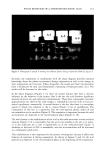
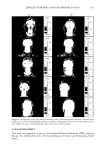
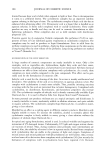
182 JOURNAL OF COSMETIC SCIENCE (a) (b) Figure 7. Thermograph of the tourmaline powder-containing cream. Thermographs were taken at a con- stant room temperature of 25 ø. (a) Thermographed before treatment temperatures of both sides of subjects' faces were almost the same. (b) Thermographs taken 210 seconds after treatment. from 0.6 ø to 1.5 ø. It is suggested that far-infrared rays play a key role in the skin temperature elevation. These results provide a clue for the understanding of wave crystal therapies. Among the jewelries, jade and tourmaline are very effective materials for skin temperature elevation and the acceleration of skin blood circulation, and they show great potential for utilization as cosmetic raw materials.
Purchased for the exclusive use of nofirst nolast (unknown)
From: SCC Media Library & Resource Center (library.scconline.org)