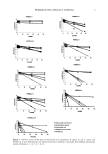
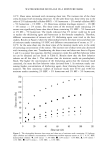
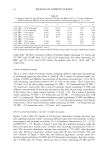
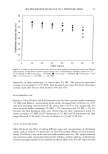
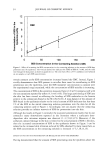
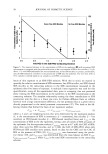
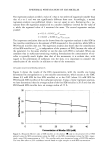
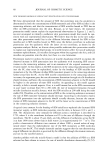
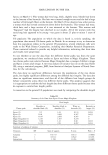
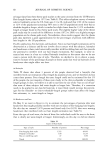
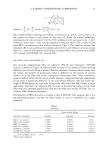
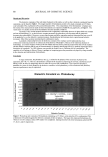
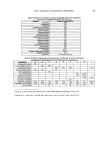
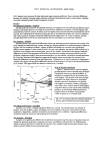
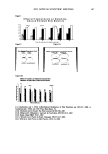
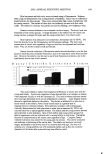
WATER-SOLUBLE MUCILAGE IN A MOISTURE MASK 13 0.2øC. Shear stress increased with increasing shear rate. The increase rate of the shear stress decreased with increasing shear rate. At the same shear rate, shear stress was in the order of 2% hydroxyethyl cellulose (HEC) + 5% humectant 2% methyl cellulose (MC) + 5% humectant 1% HEC + 1% Monostroma nitidium mucilages (extract) 1% MC + 1% extract 2% extract. The shear stress of the moisture mask containing 2% extract was significantly lower than that of those containing 2% HEC + 5% humectant or 2% MC + 5% humectant. The results indicated that 2% extract could not be used to replace the thickening agent and humectant in the formula completely. Therefore, different concentrations of extracts and 1% thickening agent were tried in the later studies. Results in Figure 2 show the relationship between the shear stress and shear rate of moisture masks containing 1% HEC and different concentrations of extract at 25 ø + 0.2øC. At the same shear rate the shear stress of the moisture masks were in the order of increasing concentration of the extract. The increase rate of shear stress also decreased with increasing shear rate. Transforming the shear stress and shear rate data in Figures 1 and 2 to a power law equation, the flow consistency index (k), and flow behavior index (n) can be obtained and are listed in Table II. Results show that the flow behavior indexes are all less than 1. This indicates that the moisture masks are pseudoplastic fluids. The higher the concentration of the thickening agents that the moisture mask contained, the more the flow behavior index deviated from 1. In moisture masks con- taining higher concentrations of thickening agent, shear thinning became more pro- nounced. The flow consistency indexes of moisture masks were 87.61 and 39.86 for moisture masks containing 2% HEC + 5% humectant and 2% MC + 5% hurnectant, 180 160 140 ,•, 120 • 80 m 60 40 2O ß ß ß ß ß ß ß ß ß ß ß ß x ß x x x ß x x x x I I I I 0 20 40 60 80 100 120 Shear rate (l/s) Figure 2. The relationship between shear stress and shear rate of moisture mask containing 1% hydroxy- ethyl cellulose and different concentrations of 34onostroma nitidiam aqueous extract ar 25 ø _+ 0.2øC. HEC: hydroxyethyl cellulose. •, 2.0% extract + 1.0% HEC. I, 1.0% extract + 1.0% HEC. &, 0.5% extract + 1.0% HEC. O, 0.25% extract + 1.0% HEC. x, 1.0% HEC.

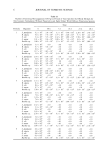
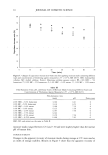
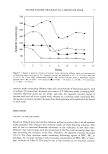
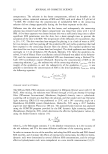
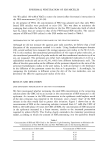
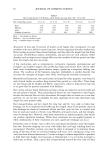
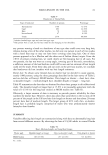
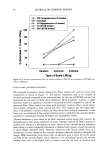
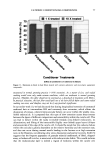
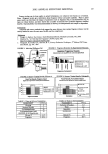
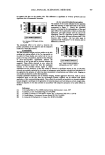
14 JOURNAL OF COSMETIC SCIENCE Table II Consistency Index (k), Flow Behavior Index (n) of Power Law Model and L, a, b Values of Moisture Masks Containing Different Types and Concentrations of Thickening Agents at 25 ø _+ 0.2øC n k L a b 2.0% HEC + 5.0% humectant 0.271 87.61 5.54 1.08 -2.79 2.0% MC + 5.0% humectant 0.466 39.86 12.47 1.23 -6.02 1.0% HEC + 1.0% extract 0.461 21.63 15.39 -0.21 -3.00 1.0% MC + 1.0% extract 0.510 19.10 15.18 -0.58 -2.81 1.0% HEC + 2.0% extract 0.296 38.31 28.21 -2.61 4.96 1.0% HEC + 1.5% extract 18.47 -1.24 -2.85 1.0% HEC + 0.5% extract 0.548 10.65 9.21 0.68 -3.46 1.0% HEC + 0.25% extract 0.597 7.65 7.25 1.25 -3.77 n and k were calculated from Figures 1 and 2. HEC: hydroxyethyl cellulose. MC: methyl cellulose. Extract: water-soluble mucilage of B4o•stroma •tidium. respectively. The flow consistence indexes of moisture masks containing 1% extract and 1% HEC and 1% MC were 21.63 and 19.10, respectively. For those containing 1% HEC and 2%, 0.5%, and 0.25% extract the indexes were 38.31, 10.65, and 7.65, respectively. COLOR OF MOISTURE MASKS The L, a, and b values of moisture masks containing different types and concentrations of thickening agents are also listed in Table II. The L values of moisture masks con- taining 1% HEC and different concentrations of the extract increased from 7.25 to 28.21 with increasing concentration from 0.25% to 2.0% of the extract. The L values were 5.54 and 12.47 for those masks containing 2% HEC + 5% humectant and 2% MC + 5% humectant, respectively. The a values of moisture masks containing 1% HEC and different concentrations of the extract decreased in the order of increasing concentration of the extract, the a values ranging between 1.25 and -2.61. The a values of moisture masks containing 2% HEC + 5% humectant and 2% MC + 5% humectant were 1.08 and 1.23, respectively. The b values of moisture masks containing 1% HEC and different concentrations of the extract increased from -3.77 to 4.96 with increasing concentration of the extract. The b values of moisture masks containing 2% HEC + 5 % humectant and 2% MC + 5% humectant were -2.79 and -6.02, respectively. EFFECT ON WATER-HOLDING CAPACITY OF MOISTURE MASKS Figures 3 and 4 show the changes in the electrical capacitance increase ratio over time after applying moisture masks containing different types and concentrations of thick- ening agents with (control) or without 5% 1,3-butadiene (humectant) at 23 ø + 0.5øC and RH 65% + 5%. Results in Figure 3 show that after applying moisture masks the electrical capacitance increase ratio increased with increasing concentration of the ex- tract. The electrical capacitance increase ratio increased to 57%-68%, then decreased over time. Electrical capacitance increase ratios after 60 min were between 59% and 42%. Results in Figure 4 show that the electrical capacitance increase ratios of a moisture mask containing 2% HEC and 5% humectant were higher than that contain- ing 1% HEC plus 1% extract, which was close to those containing 2% MC and 5%
Purchased for the exclusive use of nofirst nolast (unknown)
From: SCC Media Library & Resource Center (library.scconline.org)