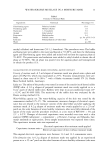
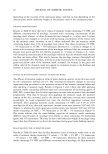
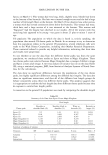
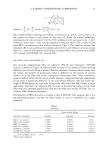
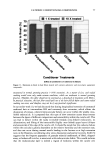
WATER-SOLUBLE MUCILAGE IN A MOISTURE MASK 11 Table I Formula for Moisture Mask Ingredients Chemicals Percentage (%) Film-forming agent Polyvinyl alcohol 15.0 Thickening agent Methyl cellulose 2.0 Humectant 1-3 butadiene 5.0 Alcohol Ethyl alcohol 12.0 Preservative Methylparaben 0.4 Buffer Sodium citrate q.s. for pH 6.2-6.4 Surfactant Polyoxyethylene 20 oleyl ether 0.5 Water q.s. 100 methyl cellulose) and humectant (5% 1,3 butadiene). The procedures were: The buffer and humectant were added to the water and heated at 70-80øC, and then the thickening agent and film-forming agent were added and mixed well to form the aqueous phase at 70-80øC. The preservative and surfactant were added to ethyl alcohol to obtain the oil phase at 70-80øC. The oil phase was poured into the aqueous phase and homogenized to obtain the product (13). CHARACTERISTICS OF MOISTURE MASKS CONTAINING AQUEOUS EXTRACT Viscosity of moisture mask. A 5-ml aliquot of moisture mask was placed onto a plate and plate cell (PQ 45), which was maintained at 25øC. Viscosity measurements were per- formed at shear rates of 0-100 s i with a Haake viscometer (model CV 20, Haake Mess-Technik Gmbh., Germany). Saj•ty test. The safety of the product was tested in terms of the sensitivity of shaved rabbit (NZW) skin. A 0.1-g aliquot of prepared moisture mask was evenly applied to ca. a 9-cm 2 patch of shaved rabbit skin. Rabbits were kept in an air-conditioned room (25 ø + 0.5øC and 50-60% RH). The sensitivity of the rabbit skin was evaluated by the Draize scoring method (24). Water-holdi,g capacity test. The water-holding capacity of the skin was tested by the corneometer method (25-27). The corneometer measures changes of electrical capaci- tance that are related to the moisture content of the skin before and after applying the moisture mask. A 0.2-g aliquot of moisture mask was evenly applied to ca. a 25-cm 2 patch on the volar forearms of seven healthy volunteers, who were fully informed of the nature of the study and the procedure involved, in a test room of RH 60% + 5% and 23 ø + 0.5øC. Changes of electrical capacitance were recorded over time with a skin analyzer SHP88 (sebumeter + corneometer + pH-meter, Courage and Khazaka, Ger- many) randomly at eight points. Every sample measurement was repeated three times. The capacitance increase ratio was expressed as: Electrical capacitance after moisture mask applied Capacitance increase ratio = Electrical capacitance of skin without moisture mask The original electrical capacitances were between 13.4 and 14.2 corneometer units. Film formation time. A 0.2-g aliquot of moisture mask was applied by an experienced person to ca. a 2 5-cm 2 patch on the volar forearms of seven healthy volunteers (who were

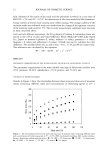
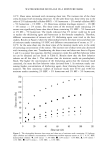
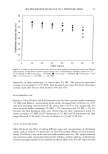
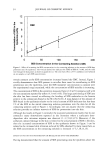
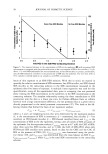
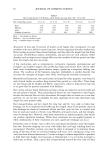
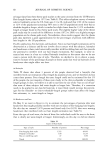
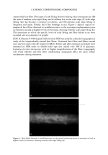
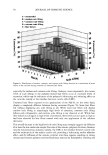
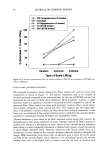
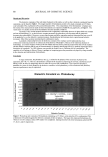
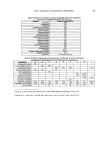
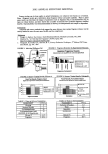
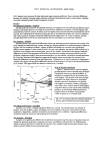
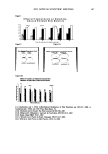
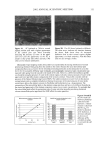
12 JOURNAL OF COSMETIC SCIENCE fully informed of the nature of the study and the procedure involved) in a test room of RH 65% + 5% and 20 ø + 0.5øC, for observation of the time needed for film formation. Storage stability of moisture mask containg water-soluble mucilage. The storage stability of the moisture mask was evaluated every two weeks from the change of the apparent viscosity of the moisture mask stored at 4øC. The viscosity measurement conditions were the same as those described above. Color and color difj•rence measurement. An 8.0-g aliquot of vitamin E-containing cream was placed in the cell of a Color and Color Difference Meter (Model JP7100F, Juki Optek Co., Japan) to measure lightness (L value), redness (+a value), greenness (-a value), blueness (-b value), and yellowness (+b value). A blank was used to calculate the color difference. The standard plates of a, b, and L were -0.01, -0.38, and 98.29, respectively. The whiteness was calculated by the equation: a 2 b2] 1/=. W = 100 - [(100 - L) 2 + + RESULTS PROXIMATE COMPOSITIONS OF THE WATER-SOLUBLE MUCILAGE OF &IONOSTROMA NITIDIUM The proximate compositions of the water-soluble mucilage of Monostroma nitidium were 8.5% moisture, 58.44% carbohydrate, 2.51% protein, and 22.62% ash. VISCOSITY OF MOISTURE MASKS Results in Figure 1 show the relationship between shear stress and shear rate of moisture masks containing different types and concentrations of thickening agents at 25 ø _+ 300 250 200 150 50 0 20 40 60 80 100 120 Shear rate (I/s) Figure 1. The relationship between shear stress and shear rate of moisture mask containing different types and concentrations of thickening agents at 25 ø + 0.2øC. HEC: hydroxyethyl cellulose. MC: methyl cellulose. Extract: Monostroma nitidium aqueous extract. ', 2% HEC + 5% humectant. I, 2% MC + 5% humectant. A, 1% HEC + 1% extract. x, 1% MC + 1% extract. O, 2% extract.
Purchased for the exclusive use of nofirst nolast (unknown)
From: SCC Media Library & Resource Center (library.scconline.org)