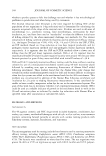
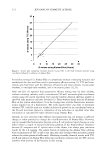
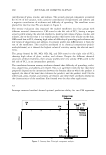
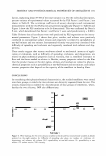
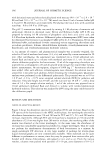
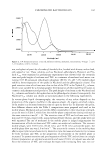
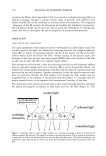
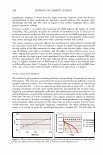
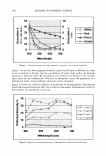
180 JOURNAL OF COSMETIC SCIENCE contribution of gloss, residue, and oiliness. The second principal component accounted for 36.3% of the variance, with a positive contribution of slipperiness and softness and a negative contribution of stickiness and difficulty of spreading. The emollient scores plotted for the first two PCs are shown in Figure 2. The sensory evaluation data separated the studied emollients into four groups with different sensorial characteristics. CM scored to the left side of PCl, having a unique sensory profile among the selected emollients, showing low values of gloss, residue, and oiliness, due to the fact that it is a volatile product that leaves little residue on the skin. DM scored low in PC2, showing high values of difficulty of spreading and stickiness and low values of slipperiness and softness. Its sensory profile also differentiates it from the rest of the emollients. This could be attributed to its chemical composition (polydi- methylsiloxane), as it showed the highest values of viscosity among the selected emol- lients. The group formed by SO, MO, OD, SQ, and DO scored to the right side of PCl, showing high values of gloss, residue, and oiliness. Despite the different chemical structures of these emollients, their sensory profiles were very similar. IPM scored to the left side of PCl, in an intermediate position. The correlation between sensory attributes showed that difficulty of spreading, sticki- ness, slipperiness, and softness are related. This is in agreement with the fact that these properties depend on the interaction between the forearm skin on which the product is applied, the skin of the hand that evaluates the product, and the product itself. On the other hand, gloss, residue, and oiliness are related, and these three attributes depend on the characteristics of the emollient film formed over the skin after application. PLS Leverage-corrected residual showed optimal prediction ability for two PLS regression N 0 Q. .5 CM • -2 Slipperine1& Softness . SQ 0.5 M "� D • 1PM • n DO ♦SO -1.5 -1 -0,5 0.5 Gloss -0.5 Residue Oiliness -1 -1.5 -2 DM .. 5 Difficulty Qt Spreading r"'\.t, I Stickiness Figure 2. Sensory data: Principal component analysis.

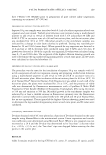
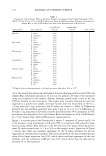
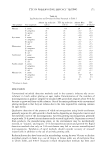
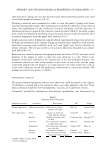
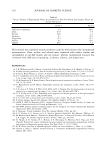
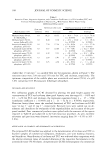
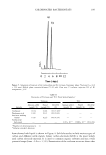
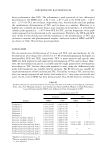
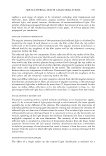
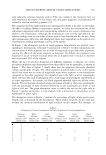
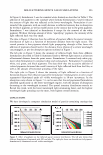
SENSORY AND PHYSICOCHEMICAL PROPERTIES OF EMOLLIENTS 181 factors, explaining about 87 .9% of the total variance in y. For the individual descriptors, percent variance of experimental values accounted for by PLS Factor 1 and Factor 2 are shown in Table II. The correlation coefficients of sensory descriptors and instrumental measurements with the two PLS factors are presented graphically (Figure 3). Table II and Figure 3 show the PLS correlation to be bi-dimensional. This was confirmed by Osten's F-test, which determined that Factor 1 and Factor 2 were valid predictions (p 0.001). Table II shows that all attributes were well predicted by PLS regression on the instru- mental parameters. Figure 3 shows that gloss, residue, and oiliness were positively correlated to instrumental surface tension and negatively correlated to spreadability at one-half minute and one minute. Instrumental viscosity was positively correlated with difficulty of spreading and stickiness and negatively correlated with softness and slip- periness. These results suggest that sensory attributes related to mechanical instances of appli- cation or evaluation, such as difficulty of spreading, stickiness, and slipperiness, are related to physicochemical properties such as viscosity, that is, emollient resistance to flow and the forces needed to achieve it. Besides, sensory properties related to the film that the product leaves on the skin (gloss, oiliness, and residue) are related to physico- chemical properties such as spreadability at one-half minute and one minute, and surface tension, properties that depend on the capacity of the emollient to develop films. CONCLUSIONS In considering their physicochemical characteristics, the studied emollients were sorted into three groups, in which the two silicones are distinctly separated from the rest. The sensory characteristics enabled the discrimination of four groups of emollients, where, besides the two silicones, IMP also differentiates. 0.8 sof 811 0.4 0.2 glo oH N 0.4 '88 I -0.8 -0.8 -DA -0.2 0.2 0.8 0.8 -0.2 -DA da et1 -0.1 -1 PLS FaclDr 1 Figure 3. PLS2 loadings for the seven sensory variables (y-block) and four instrumental variables (x-block) analyzed on the eight samples. ds: difficulty of spreading. glo: gloss. res: residue. sti: stickiness. sli: slipperiness. sof: softness. oil: oiliness. SO.S: spreadability at one-half minute. Sl: spreadability at one minute. ST: surface tension. VIS: viscosity.
Purchased for the exclusive use of nofirst nolast (unknown)
From: SCC Media Library & Resource Center (library.scconline.org)