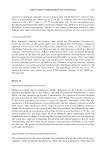
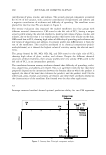
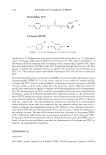
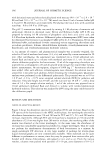
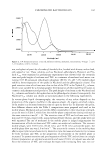
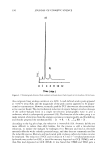
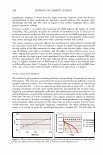
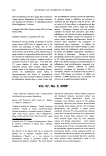
184 JOURNAL OF COSMETIC SCIENCE Triclocarban, TCC - II - Cl 0 �I Cl-o- �-C-�-\ ;1 Triclosan, DP-300 Figure 1. Structural formulae of triclocarban and triclosan. irradiation (14). Pregnant rats were given triclosan feed during days 7 to 17 of gestation and its teratogenic effect was examined in the fetuses (15). TCC and its metabolites in the biological fluids of human subjects bathing with commercially available TCC soaps have been monitored by GC/MS, as the TCC is absorbed through the skin (16-18). The agency evaluated the validation reports to support the long-term use of triclosan and TCC (19). The Chinese cosmetic law allows a maximum limit of 0.3% for triclosan and TCC. Gas chromatography/mass spectrometry (GC/MS) (20,21) and high-performance liquid chromatography (HPLC) (23-27) are widely applied to the analysis of samples for the triclosan and TCC levels. It is fairly difficult to determine traces of triclosan by GC/MS directly, owing to their peak tailing and low sensitivity. These difficulties must be avoided by converting the analyte to methyl esters after methylation with diazomethane. The GC determination of TCC could be accomplished after preparing trimethylsilyl derivatives, using N-methyl-N-trimethyl-silyl trifluoroacetamide as the derivatizing agent. HPLC procedures require a gradient elution system or tertiary solvent system and a two-channel ultraviolet-visible absorbance detector for triclosan and TCC at 280 and 260 nm, respectively. The electrochemical oxidation of triclosan at a screen-printed carbon electrode shows that this compound has the phenolic moiety and was used to analyze toothpaste and mouthrinse products (28). However, other chlorinated bacterio- stats such as TCC have no phenolic group and it was not easy to determine oxidation at the carbon electrode. The aim of the present study was, therefore, to investigate HPLC with a differential refractometer for simultaneous determination of triclosan and TCC. Comparison of the electrochemical redox of chlorinated bacteriostats and HPLC proce- dures is based on the published principles for determination of triclosan and TCC in cosmetic and pharmaceutical products. EXPERIMENTAL APPARATUS The HPLC system consisted of a Model CCPM (Tosoh Corporation, Japan), a Model

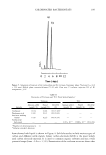
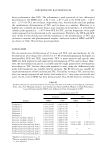
CHLORINATED BACTERIOSTATS 185 7125 injector equipped with a 250-µl sample loop, and a Model 410 differential re- fractometer (Waters Assoc.). The function of a differential refractometer is to measure the small differences in refractive indices (RI) between a reference solution and a sample solution. A temperature of 39°C, a sensitivity of 4, and a scan factor of 20 were maintained in the refractometer. The difference in RI is referred to as Ll n. The Ll n is measured in 2.5 x 10- 4 RIUFS (RI unit full scale). Chromatograms and peak areas were obtained with a SC-8010 data processing program (Tosoh). Absorbance measurements were on a Cary UV visible spectrophotomer (Varian Australia Pty Ltd.). Nucleosil (250 x 4.6 mm, particle size 5 µm, pore size 10 nm), µBondapack, Hypersil, and a Vydack C18 column were for the separation of the triclosan and TCC. All electrochemical experiments were performed using an EG&G Princeton Research (Princeton, NJ) Model 253 Versatat connected to an EG&G Model 616 rotating electrode system. A three- electrode system was employed, consisting of a working electrode (GCE and M+n/GCE), a platinum counter, and a saturated calomel electrode (SCE) reference electrode. REAGENTS Triclosan and TCC were supplied by TCI (Tokyo Kasei Kogyo Co., Japan) and the McIntyre Group Ltd, respectively. Methanol (HPLC grade) and acetonitrile (HPLC grade) were supplied by Merck (Darmstadt, F.R.G.). Water was prepared from deionized water by an ultra-purification system (Watermaster WD 1106). The other chemicals were of analytical reagent grade. Samples of toothpaste, deodorant, anti-acne washing cleanser, and antibacterial hand and body wash were obtained from a number of retail outlets in the south of Taiwan. PROCEDURES Determination of triclosan and triclocarban (TCC) by LC-RI detector. The triclosan and TCC stock solution were prepared in 100% methanol. Each stock solution was diluted with methanol and water (1: 1, v/v) and mixed thoroughly to produce a working stock stan- dard. Approximately 1 g of the sample was accurately weighed into a 15-ml beaker, 5 ml of methanol was added, and the sample was dissolved by applying gentle heat on the hot plate. Five milliliters of 1: 1 (v/v) acetonitrile:water or methanol:water was added. The solution was centrifuged and transferred into a 10-ml volumetric flask and diluted to volume with methanol. Sample and standard solutions were filtered using 0.45-µm membrane filters before LC analysis. An LC-RI detector was used to determine triclosan and TCC levels. A series SC-8010 liquid chromatograph delivered eluant at a constant 1.5 ml/min rate to a 250 x 4.6 mm reversed-phase column (Nucleosil 5 µm ODS). The eluants were composed of methanol and water containing 0.3 M sodium perchlorate or pH 4.95 acetate buffer (80:20, v/v) or acetonitrile and water containing 0.05 M potassium dihydrogen phosphate, pH 3.05 (70:30, 60:40 and 50:50 v/v). Injection (250 µl) of sample and standard solution were by the injection valve. Quantitation was based on the compound peak area. Determination of triclosan (DP-300) and triclocarban (TCC) by differential pulse voltammetry (DPV). The thin-film metal electrode was produced by the following method: Prior to analysis, the glassy carbon electrode (3-mm diameter) was mirror polished sequentially with an aqueous suspension of 1.0, 0.5, and 0.05 µm alumina. The electrode was rinsed
Purchased for the exclusive use of nofirst nolast (unknown)
From: SCC Media Library & Resource Center (library.scconline.org)