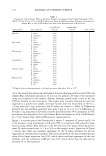
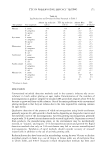
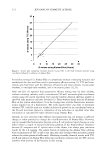
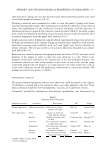
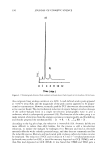
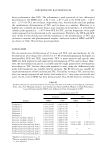
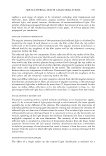
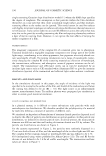
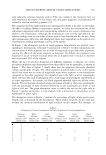
196 JOURNAL OF COSMETIC SCIENCE single-scattering Gaussian slope distribution model (11) where the RMS slope specifies the degree of roughness. The assumption is that particles within the film distribute themselves in a way such that they create a randomly rough surface, and that multiple- scattering effects at the surface can be ignored. This model cannot be used for surfaces with highly structured topologies or surfaces with slope distributions that are known not to be Gaussian. It also cannot take into account RI differences across the surface that may arise due to the particles actually penetrating the film and exposing themselves without a layer of matrix covering them. However, it can capture the main effects of varying the surface roughness of a film. PIGMENT EFFECTS The imaginary component of the complex RI of a material gives rise to absorption. Titanium dioxide has a negligible imaginary component over a large part of the visible light range, contributing to its white appearance, but pigments selectively absorb cer- tain wavelengths of light. By running simulations over a range of wavelengths, respec- tive! y changing the complex RI of the scattering materials as a function of wavelength, the transmittance, reflectance, and absorption curves of pigment mixtures can be cal- culated. The transmittance and reflectance curves can in turn be multiplied by an incident light source such as CIE standard white illuminant D65 to give the intensity distribution (spectra) of the transmitted and reflected light under ambient conditions. RES UL TS AND DISCUSSION In the simulations discussed in this paper, the angle of incidence of the light was specified to be normal to the surface of the film, and the RI of the media above and below the coating was defined to be air (RI = 1.0). The light source is an infinitesimally narrow, monochromatic beam. Ten million photons were propagated per simulation in order to ensure good statistical resolution. EFFECT OF PARTICLE SIZE DISTRIBUTION In a physical system, it is difficult to create sub-micron scale particles with truly monodisperse size distributions. We therefore modeled the polydispersity of a material by explicitly defining a mixture of particles of different sizes. We simulated six hypothetical formulations of titanium dioxide particles dispersed in oil to observe the effect of particle size distribution on optical qualities. In this particle size distribution, we defined five discrete particle sizes. In all six systems, the mean particle diameter was 600 nm and the total loading of titanium dioxide was 2% by volume. The particle size distributions are shown in Figure 2. For the systems represented in Figure 2, the particles were randomly dispersed in a 25-micron-thick silicone oil film, and the wavelength of the incident light was 600 nm. The complex RI for titanium dioxide at wavelength 600 nm was defined to be 2.76 i0.0 (interpolated using values published by Almaz Optics (12)). The real RI for the silicone oil was defined to be 1.4 for all visible wavelengths. The transmission and haze values are shown in Figure 3.

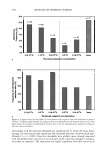
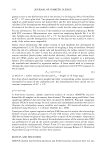
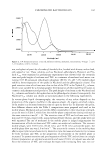
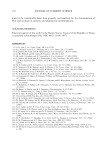
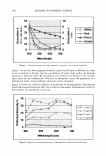
MIE-SCATTERING MONTE CARLO SIMULATIONS 197 Flat ..,,-=---- ·� 4: ·· . -�-, -- 1 -□.8 --------------'"!� :} jo.6 "'0.4 .! 0.2 0 0.2 0.4 0.6 0.8 Parlicle Sze (Microns) 0.2 U4 U6 0.8 Pill1m Size� Sharp # 0-8 +:,,,i,,..,,.,, __ ........ �----.:,, i 0.6 +.,---,.-..;.--�,.,__.........�--,--i 1 OA .:i 0.2 -+,-........ 0 �------..--......,_--"-r-;.;;.._..-j-l_-t;c_:t,----....,.--- 0.2 0.4 06 0-8 Pm:tide Size (lvlcrons) Bias B ----�7 -OB +.-',-'-..,.-.---,,--.....,...-.-.i,---'-- jofl -i,.--. ........ __,,........----'----i;-----i 'l!I 0.4 -i-,;.;,-�---.;...._.----lc,.,--'........'--l _! 02 0 0.2 0.4 0.6 OB Pa-tide Sze [Microns] Wde 1�� f �.il1:ZI 0 I I I 1 02 0.4 0.6 0.8 Partide Size(MCIOOS) U2 0.4 U6 0.8 Pmd!!Slze(Mcmnt Figure 2. Particle size distributions of six hypothetical batches of titanium dioxide dispersed in oil. For all six distributions, the mean particle size is 600 nm and the total amount of titanium dioxide is 2% by volume. 511 48 -+------��--------! 46 +--.,,,..,.--,,--....,-,,c-- 44 -+---- 42---- 40 +--..:..:..:..--'- 311 Exlreme Flat Biase Wde BiasA Shap 100 99 98 97 96 Eldrnrne Flat Biase Wde BiasA ShalJ) Figure 3. Transmission (left) and haze (right) values for six hypothetical batches of titanium dioxide dispersed in oil. The data shown in Figure 3 demonstrate that the distribution of particle sizes in the chosen mixtures affected transmission and haze values tremendously, even though the nominal mean particle size and loading of particles were equivalent. In this study, the spread was over 10 percent for transmission and over 3 percent for haze. These results highlight the importance of knowing the particle size distribution, and not just the mean particle size, of any material that is included in a coating formulation and point to the potential for controlling light-scattering properties through manipulating these parameters. These results further illustrate the effects of agglomeration on optical prop- erties such as transmission and haze and emphasize the importance of particle dispersion in physical systems. The values in Figure 3 are rank-ordered in order of increasing transmission or decreasing reflection in other words, the distributions toward the left of the graph provided higher opacity. Comparing the transmission and haze plots, we see that for these sets of
Purchased for the exclusive use of nofirst nolast (unknown)
From: SCC Media Library & Resource Center (library.scconline.org)