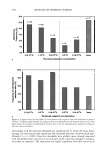
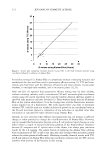
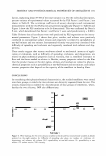
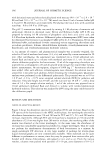
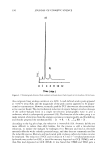
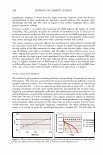
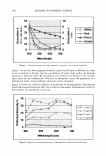
198 JOURNAL OF COSMETIC SCIENCE mixtures, the haze decreased as transmission increased, although the shape of the curves (rate of the dropoff) is not exactly the same and so the relationship is not strictly linear. In these simulations, we do not imply that a certain type of particle size distribution is optimum for a given formulation, but simply demonstrate the necessity of knowing, and perhaps manipulating, the particle size distribution of any given material, since mean particle size and loading alone do not give sufficient information to characterize optical properties. The optimum distribution depends on the specific materials used in the formulation, as well as the desired output. The simulation program described is a useful tool for modeling these and other significant parameters. EFFECT OF FILM THICKNESS We investigated the change in optical properties of the coating as a function of film thickness, using a total volume loading of 2%, the flat distribution of titanium dioxide particles (as defined in the first plot in Figure 2) dispersed in oil (RI = 1 .4), and 600 nm wavelength incident light, as described above. We varied the film thickness by powers of two in order to investigate the optical behavior over a large range of thicknesses, from microscopic to macroscopic. The transmission and haze values as a function of film thickness are shown in Figure 4. The transmission decreased exponentially with film thickness, which is consistent with results derived using other methods. As in the previous example shown above, haze increased with decreasing transmission. As illustrated in Figure 4, the haze increased more quickly and saturated faster than the transmission decayed. Figure 5 shows the spatial intensity distribution of light that was scattered by the particles within the film and subsequently exited the film. The x-axis denotes the C C · ti) ·e ti) C � 100 80 60 40 20 0 0 20 40 60 Thickness (microns) 100 80 60 40 20 0 80 m N � :c -+- Trans: --- Haze Figure 4. Transmission (diamonds) and haze (squares) values as a function of film thickness for a dispersion of titanium dioxide in oil.

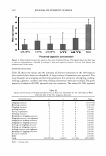
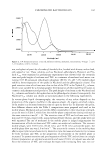
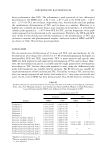
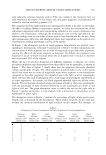
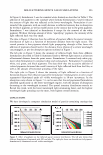
1vHE-SC1\TTERING MONTE CARLO SIMULATIONC 1.00& 2 ..----------� 1. � 1.00E+Q" � :s -a· '? 1.cm 1.00E- 1 .OOE- 1.00E-10 1.0(JE- 199 -5micron :Figure 5. Spatial intensity distribution of light reflected (left) and transmitted (right) from a film of titanium dim:ide dispersed in oil. Only the thic ·ness of the film varies. horizontal distance from the incident light source. l•or a non-turbid, perfectly clear medium, there will be no spatial spreading of the light beam as it passes th.rough the film, and so the intensity at all points of the graph under these conditions would be zero, except at the origin. The reflected intensity is the intensity of light that i' scattered back by the partides and exits the top surface of the film, whereas the transmitted intensity is the intensity of the light passing through the bottom of the fi Im. Cimulations indicated that as the thickness of the film increased, the overall intensity of the reflected light increased, regardless of the horizontal distance from the source. This is not surprising, considering that less light is transmitted thmu 7 h, i.e., more light is reflected from, a thicker film. In addition, the size of the "ring" of ligh spreaclir g our fror the ·ource was larger for the thicker film, which i again n t surprising given rha. rhe light lu s more opportunities to scatter and spread in a thicker film. i ulat:ion sho,v cl that for the transmir eel intensity, ch spatia intensity profile ·was v ·ry similar to chat or the refl i::ed imensity at 100+ microns a ay from che source horizont lly). However, che behavior closer to die source ,:vas very different: the inten- sity of transmitted light near the origin (light source) was much higher for the thinner films, suggesting that much of the light passed through without being significantly deflected, and th horizontal s1 read feJl off sharply. The thicker films exhibited less intensity near the origin, and the intensity of light dropped off more sJowly further from the source. Because less Ii -.hr is trnnsmitted through a thicker film, one might eXJ)ect that for a thicker 1Jm, the intensity o · the transmitted light would be lower tner alJ di:tances from the light source these simulations slmw drnt this is not trne. Instead, thc.: shape of the intensity j)rofile as a function of discance from the .light source was affected as the film thickne s was varied. EFFECT OI SURFACE ROUGHNESS ·'Cl.re investigated the effects of film surface roughness on the optical properties of the film. In order to highlight the effect of the rough surface, we simulated a formulation ,vith a relativdy I.ow concentration of TiO2 (1 % by volume toral) suspended in silicone oil. This particle loading was simulated as a panide mixture with the f1 t distribution of particles introduced above: 0.2% volume loading each of five particle sizes r nging from 0.2 to 1.0 microns, with an average diameter of 600 nm. We varied the RMS slope of the film by powers of two to investigate the optical behavior o- rer a wide range of film
Purchased for the exclusive use of nofirst nolast (unknown)
From: SCC Media Library & Resource Center (library.scconline.org)