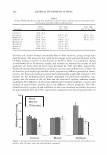
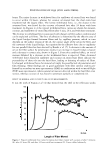
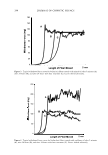
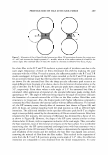
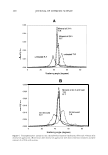
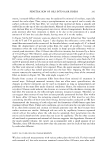
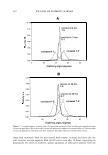
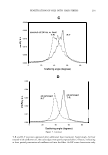
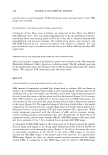
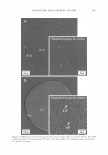
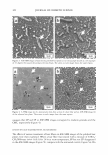
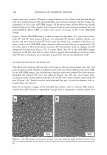
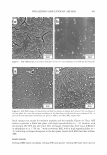
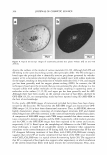
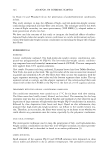
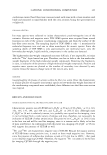
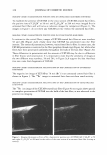
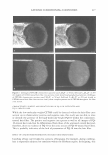
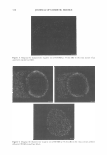
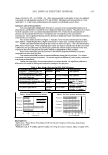
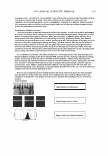
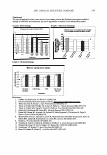
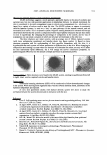
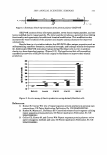
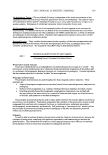
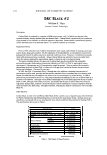
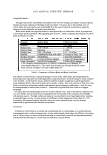
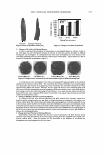
VISUALIZING HAIR LIPIDS BY ASE-SEM 305 Figure 7. ASE-SEM images of transverse thin hair sections of 1-µm thickness (a) and 90-nm thickness (b). Figure 8. ASE-SEM images of transversely polished hair planes incubated with ethanol. Pre-incubation of the hair plane for 2 min (a) and post-incubation of the hair plane for 60 min (b) were performed. Pre- or post-incubation represents treatments just prior to ASE or just after ASE, respectively. black opaque one, except for melanin granules and the medulla (Figure 9). Thus, ASE seems to generate a black hair plane with high reproducibility (n = 4). Analysis with microscopic IR/ A TR was also tried. This technique revealed that there was a difference in absorption at ca. 17 40 cm- 1 with or without ASE, with a high reproducibility (n = 4), indicating a stronger absorption in the hair plane treated with ASE than that without ASE. DISCUSSION Etching-SEM based on plasma etching (PE) and sputter etching (SE) have been used to

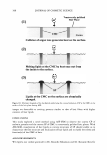
306 JOURNAL OF COSMETIC SCIENCE Figure 9. Optical microscopic images of transversely polished hair planes without ASE (a) and with ASE (b). observe the surfaces or the insides of various materials (10-19). Although both PE and SE belong to the same dry etching system, their principles differ. The PE technique is based upon the principle that a chemically reactive gas plasma generated by radiofre quency or by a microwave electrical discharge can readily react with surface molecules on the target, resulting in the production of volatile molecules (10,13-18), and oxygen gas has been generally used for oxygen plasma etching (OPE). In contrast, the SE technique is based upon the principle that gas ions generated by glow discharge in a low vacuum collide with surface molecules on the target, resulting in sputtering atoms or molecules at the surface (11,12,19), and argon gas has been generally used for ASE. Although there have been studies on the internal structure of hair fibers observed by OPE-SEM (14, 15 ), no corresponding study has been reported using SE (ASE)-SEM to the best of our knowledge. In this study, ASE-SEM images of transversely polished hair planes have been charac terized for the first time. We found that the ASE-SEM images are distinct from OPE SEM images (14, 15) in their three-dimensional structures. Thus, in ASE-SEM, there are highly characteristic images consisting of circular-shaped structures (CP) and slender thread-shaped ones (SP) with convexity in the cortex of transversely polished hair planes. A comparison of ASE-SEM images with TEM images revealed that these convex struc tures correspond to melanin granules and the CMC, respectively, while melanin granules and the CMC in the OPE-SEM images have been reported to be convex and concave, respectively (14,15). Based upon the morphological differences in the CMC between those techniques, it would be of considerable interest to determine what components contribute to the convex formation of SP during ASE. Our observation that SP but not CP disappear following treatment of hair fibers with CHC1/CH 3 OH/water strongly suggests that convex SP are mainly comprised of hair lipids of the CMC since treatment with CHC1/CH 3 OH/water is a typical solvent for removing lipids (20). The suggestion that SP is comprised of hair lipids also supports other experiments in which incubation of the solvent-treated hair fibers with lipids restores the convex formation. Thus, incu-
Purchased for the exclusive use of nofirst nolast (unknown)
From: SCC Media Library & Resource Center (library.scconline.org)