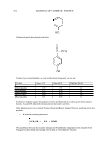
344 JOURNAL OF COSMETIC SCIENCE PROPERTY AND PERFORMANCE COMPARISON OF HAIR FIXATIVE POLYMERS FOR 55% voe HAIRSPRAY Terry A. Oldfield, Suzanne W. Dobbs and Kab S. Seo Eastman Chemical Company, Kingsport, TN INTRODUCTION New state VOC (volatile organic compound) regulations went into effect January 1, 2005, in states that adopted the Ozone Transport Commission's model rule for consumer products. Delaware, Maryland, New Jersey, New York, Pennsylvania, and the District of Columbia, as well as California, now limit VOCs in hairspray to 55%. A similar rule in Maine takes effect in May 2005. One approach to reducing voes in hairspray is to replace a portion of the ethanol with water. However, if this is done without also changing the hair fixatiye polymer, the result can be larger spray droplets, greater initial curl droop, and slower drying compared to 80% VOC formulations. Typical polymers used in 80% VOC hairsprays are vinyl polymers such as V Ncrotonates/vinyl neodecanoatc copolymer, octylacrylamide/acrylates/butylaminoethyl methacl}fate copolymer, and esters of PYM/MA copolymer. Suppliers of hair fixative polymers ha\'e either modified these existing polymers or developed new ones to accommodate the higher water content of 55% voe formulations. For example, the Yiscosity of ethanol/water solutions of vinyl pol:ymers can be reduced by decreasing the molecular weight of the polymer. In the case of the water-dispersible polyester used in an alcohol-free hairspray, the monomer content was adjusted to accommodate 55% ethanol. When selecting a hair fixative polymer for a 55o/o VOC hairspray, the formulator needs to consider the properties of the polymer and how those properties relate to the desired performance characteristics on the hair. MATERIALS AND METHODS The hair fixative polymers listed in Table 1 were evaluated in ethanol/water aerosol concentrates at 7 7 \\1% (without propellant) or at a concentration of 5.0 \\1% in aerosols with dimethyl ether propellant. The total concentration of VOCs, ethanol (SDA 40-B) plus dimetl1yl ether, in tl1e aerosol was 55%. The polymers requiring neutralization were neutralized with aminomethyl propanol (Af..11'). The purpose of this study was to compare polymer properties without the influence of other ingredients. Therefore, no other additiyes were used in tl1e formulations. The test metl10ds used are as follows. Po(rmer Particle Size and Concentration - Particle size and the concentration of polymer particles in dispersion/solution were determined using the Polymer Laboratories PL-PSDA particle size distribution analyzer. The PL-PSDA operates on the principle of packed column hydrodynamic chromatography (HDe), a technique for separating particles based on their size, eluting in order largest to smallest. Vi. cosity - The Yiscosity of the aerosol concentrates was measured using the Brookfield viscometer. model LVDV-1+. Dry Time -The aerosol formulations were sprayed in a controlled manner on hair tresses and dl}· time was assessed by feeling tl1c tresses as they dried. Dry time was also determined by dynamic mechanical analysis (OMA). The test developed at Eastman Chemical Company monitors changes in the ,iscoclastic properties of a polymer film during dl}·ing in real time. 1 About 0.1 ml of the polymer solution is transferred to a circular trough (0.2 mm deep) and the surface is smoothed with a straight edge. AT-bar mounted on a dynamic rheomcter is lm,ered into the liquid film. The T-bar oscillates at 10 rad/sec while the film dries, measuring complex ,·iscosity (ri*), viscous modulus (G"), and elastic modulus (f f ). T"ck - The tackiness of the aerosol formulations sprayed on hair tresses was assessed at the same time as the tactual assessment of dry time. DMA and other metJ10ds for determining tack arc being evaluated and will be discussed in tl1is presentation. Gloss -The aerosol formulations were sprayed on lacquer-coated Leneta chart paper to form a continuous film and allowed to dl}' overnight. The BYK-Gardner micro-TRI-gloss reflectometer was used to measure gloss of the polymer films at a 60° reflection angle. Curl Retention - Hair tresses of equal weight were washed, dried, hung on a pegboard, and cut to equal length (L)_ The pegboard is marked with graduations to facilitate length measurements. Tresses were tJ1en rewet and curled on 1 /2-in diameter Teflon rods. After drying overnight, each curl was carefully removed from its curling rod and hung back on the pegboard. The original curl length (Lo) of each curl was recorded. Each curl was rotated while being sprayed for 4 seconds, tl1en immediately re-hung on the pegboard. After 10 minutes, curl length (L1) was measured. This length is a measure of the initial curl

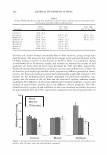
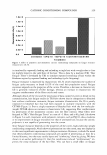
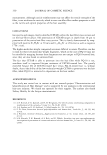
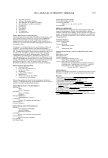
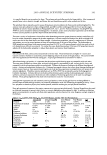
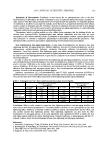
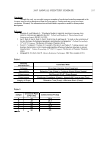
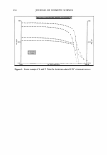
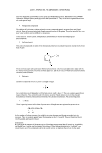
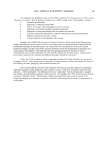
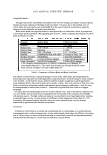
2005 ANNUAL SCIENTIFIC SEMINAR droop, calculated as: [(L - L1) x 100]/(L - Lu)- After measuring initial curl droop for all curls, the pegboard was placed in a high humidity chamber at 22°C and 90% RH. Subsequent curl measurements (Li) were made af1er I, 2, 3, and 5 hours, and the percent curl retention was calculated as given above. RESULTS AND CONCLUSIONS The water-dispersible sulfopolyester, Polyester-5, is known to have a measurable particle size in ethanol/water, and therefore is considered to be a dispersion rather than a solution. The particle size results for all fo-e polymers were very similar (mean diameters from IO to 13 nm), but the concentration of particles was much greater for Polyester-5 compared to the vinyl polymers at the same pol)·mer concentration. This is significant because polymer particles in dispersion release water faster than polymer molecules that are in solution. The \'iscosity results are shown in Figure I. Typically, lower viscosity solutions provide smaller spray droplets. Smaller droplets have a higher surface area to volume ratio, resulting in faster dry times. 2 llle dry times determined by feeling the hair tresses are shown in Figure 2. Dry time determined by OMA shows similar trends. When comparing these results, one needs to consider that the dry time on hair is affected by the sprayed droplet size and the spray pattern (the amount of sprayed solution on the hair), whereas the dry time of the polymer film (OMA method) is independent of these variables. Gloss results show higher gloss for Polyester-5 and VP/Vinylcaprolactam/DMAPA Acrylates compared to the other three polymers. Curl retention results did not show a statistical difference among the five polymers. Fi,·e tresses were tested with each polymer formulation. To ascertain significant differences, more tresses would need to be tested per formulation. Flaking and comb-ability characteristics on hair were also evaluated. No significant problems or dilTerences were noted for flaking and comb-ability among the five polymers. T bl a e 1. air n:ative ff F" o ,·mers or 55% fi VOCU . a1rspra,· Copoh-mer INCi Name Supplier Polyester-5 (formerly Diglycol/ Eastman CHDM/Isophthalates/SIP Copoly.) VP/Vinylcaprolactam/ DMAP A ISP Acrylates Copolymer Octylacrylamide/ Acrylates/ National Butylaminoethvl Methacn-Iate Cop. Starch Acrylates Copolymer# I BASF Acrylatcs Copolymer #2 National Starch Figure 1. Viscosity of Aerosol Concentrates Polyester -5 VP/V1nylcap Oclylacryl Acrylales #1 Acrylates #2 REFERENCES IBroolf,eld LVOV, Spindle #1. 60 rpm 10 15 V1scos1ty, cP 20 Supplied as ... Neutralization ... Pellets Not required 38-42% in ethanol Not required Powder Neutralized 75% (Acidity: 2.5 meq/g ) 35-39% in water Neutralized 100% (Aciditv: -1.0 meq/g ) 50% in water Neutralized 95% (Acidity: 1.5 meq/g) Figure 2. Dry Time - Aerosols Sprayed on Hair Polyester-5 VP/Vinylcap Octylacryl Acrylates #1 Acrylates #2 f-'='-'9-'=�=t'-'-'-'-'=-r='-4" � � oo oo � rn ,� Dry Time, Seconds 1 Kab S. Seo, J. Posey-D0\\1Y, Presented al XJVth International Congress on Rheology, Seoul, Korea, August 22-27, 2004. 2 Phillip M. Cook, S. W. Dobbs, and D.M. Garber, DO Drug & Cosmetic Industry, 160. p 34 (April 1997). 345
Purchased for the exclusive use of nofirst nolast (unknown)
From: SCC Media Library & Resource Center (library.scconline.org)