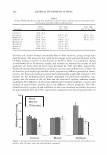
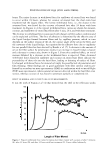
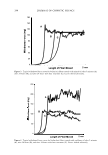
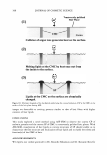
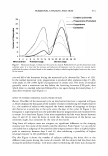
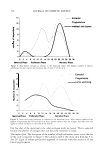
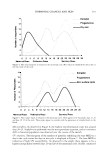
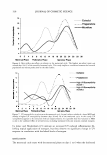
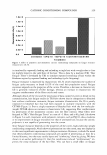
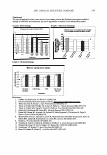
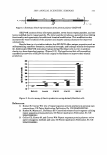
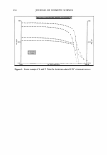
356 JOURNAL OF COSMETIC SCIENCE CORRELATING SENSORY PERCEPTION TO THE RHEOLOGICAL PARAMETERS OF EMULSIONS: A PREDICTIVE MODEL FOR FUTURE PRODUCT DEVELOPMENT? Introduction Andrew M. DiMuzio, Eric S. Abrutyn and Maggie Y. Cantwell Kao Brands Company, Cincinnati, OH Although the rheological characteristics and consumer skinfeel properties of emulsions have both been studied extensively oyer the last few decades, very few published studies have been devoted to finding a correlation between the two. Brummer and GoderskJ [ 1] broke down the skin feeling aspects into two groups: "Primary" (initial application) and ·'Secondary" (final rub-in). They correlated a product's '·primary" skin feeling with two rheological measurements: maximwn (zero-shear) viscosity, and yield value. "Secondary," skin feeling was correlated with the product's viscosity at approximately 5000 sec·'. Products that fell within the limits for each of these parameters were deemed pleasant-feeling, while those that fell outside those limits were deemed unsatisfactory. Lee ct al [2] found a correlation between the G'/G' crosso,·er point stress (what they tenncd a "critical shear stress") and a skin feeling index score. Wortel ct al [3] used mullirnriatc methods to determine that cohesi,eness scores could be correlated to the combination of yield Yalue and dynamic Yiscpsity. For the present study, we :uc anempting to find if there are any other rheological parameters that could be correlated with skinfcel, and whether more than one arc working in concert to generate a particular feeling on the skin. Materials and Methods Rheological Anal�sis: Six different o/w emulsions (with widely differing skinfeel properties) were analyzed al 25 ° C with an AR-1000 rheometer (T.A. Instruments). using a ..io mm serrated parallel plate. a 1000 micron gap, and a solYcnt trap (to pre,·ent edge drying). Three tests were performed on each sample: Stress Sweep, Creep. and Flow. During stress sweeps, the samples were exposed to increased oscillatory stresses, ranging from 0.1 to 200 Pa (log mode, 20 points per decade. I Hz), until the samples yielded. For creep tests, a stress value from within the linear viscoelastic region (L VR, obtained from the stress sweep) was chosen, and applied to the sample for 30 minutes, then rcmO\cd. with the sample being allowed to rccoYcr for 90 minutes. For flow tests, a two-step method was used. A steady-state flow test was employed from 10-100 Pa, while a continuous ramp was employed from 1-1000 sec· 1 • These 2 data sets were then merged to produce one continuous flow curve. ScnsOQ' Panel Analysis: All emulsion samples were submitted to a Skinfecl Spectrum TM DcscriptiYe Analysis panel, which uses physical intensity references for each product attribute, strict protocols for manipulation, and precisely defined terms to discriminate and describe the sensory properties of a giYen sample [-' l Scores arc gi\·cn for characteristics such as spreadability, firmness, and cohesiveness, with an intcnsitJ scale of 0-100 ( 100 = Very High). Data is then analyzed for significance. Data Analysis: Rheological and sensory panel data were analyzed (utilizing univari:He and multirnriate techniques) for correlation and regression with Minitab statistical software. Results and Discussion In aJI, 4-' rheological data points were obtained for each emulsion, and these were run against 21 sensory data points. Using regression anaJysis, we were able to uncover a number of interesting correlations (Sec Table 1). Cohesiveness, for example, correlates negatively with gel strength at the G' == G" crossover point (fable 2, Figure I). Three of the five correlations involve multiple variables each of these three incorporate data derived from the Creep analysis (relaxation time, equilibrium compliance, and minimwn [recovery] strain).

2005 ANNUAL SCIENTIFIC SEMINAR Conclusions Through this work, we were able to uncover a number of correlations heretofore unreported in the literature, most involving data derived from the Creep analysis. Further work may reveal even more correlations. Ultimately, the information derived should lead to a predictive model for future product development References I Brummer R, and Godersky S, "Rheological studies to objectify sensations occurring when cosmetic emulsions are applied to the skin'' Colloids and Surfaces A: Physiochemical and Engineering Aspects 152, 89-9..J ( 1999) 2 Lee Y, Baik S, Lee H, Nam Y, Goh Y, Kim S, Han S. and Kang H, "A study on the correlation of the skin feeling with rheological parameters and other physical properties'' Podium Proceedings, 23"1 JFSCC Congress, The Society of Cosmetic Chemists (200..J) 3. Wortcl V, Verboom C, Taelman M, Leonard S, Wiechers J, and Tadros T, "Linking sensory and rheology characteristics: a first step to understand the influence of emulsion structure on sensory characteristics .. Podium Proceedings, 23rd IFSCC Congress, The Society of Cosmetic Chemists (200-l) 4 Mcilgaard M, Civille G, Carr B. S!nsory Evaluation Techniques. CRC Press London ( 1991) Table I Sensory Correlated With Characteristic Fimmess Zero-shear Viscosity (from Creep test) Spreadability Relaxation Time (Creep) + Crossover Stress (Stress Sweep) Cohesiveness Gel Strength (G'=G", Stress Sweep) Cohesiveness Equilibrium Compliance (Creep) + Viscosity@ 2 inverse sec (Flow) Integrity of Shape Relaxation Time (Creep) + Minimum Strain (Creep) Table 2 Sample Crossover Point Cohesiveness-Pickup G'=G" (Pa) A 53 25.9 B 28 26.7 C 136 15 D 55 31.8 E 160 8.1 F 90 9.6 357
Purchased for the exclusive use of nofirst nolast (unknown)
From: SCC Media Library & Resource Center (library.scconline.org)