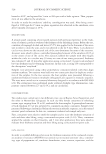
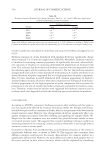
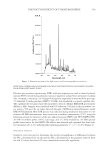
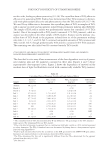
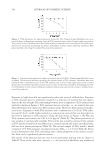
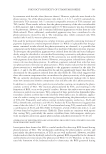
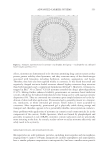
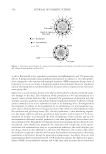
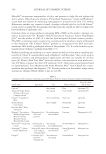
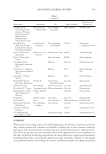
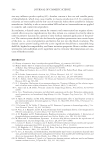
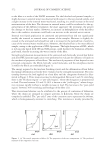
JOURNAL OF COSMETIC SCIENCE 544 photoexcitation of pigments isolated from permanent makeup inks. Figure 4 shows the effect of irradiation time on the ESR signal for a suspension containing the pigment iso- lated from ink 6, which was shown by X-ray diffraction to contain 100% TiO2 (anatase) (Table II). A four-line ESR signal, characteristic of the spin adduct between DMPO and the hydroxyl radical (DMPO-OH), was observed. The signal intensity increased with increasing irradiation times up to 20 minutes (Figure 4). Figure 5 shows the relationship between the concentration of the pigment from ink 6 and the intensity of the ESR signal, measured as the peak-to-peak height of the second line in the ESR spectrum for DMPO-OH. All samples were irradiated at 320 nm. The intensity of the ESR signal in- creased for suspensions containing up to 50 μg/ml of pigment and began to plateau thereafter. These results established the appropriate irradiation time (20 min) and con- centration (50 μg/ml) for measuring effi ciencies of hydroxyl radical generation. The effi ciencies for hydroxyl radical generation, evaluated as the ESR intensity of the sample relative to the ESR intensity of commercially available TiO2 (anatase), are shown in Table II. Except for the pigment isolated from ink 10, all pigments containing TiO2 (anatase) photocatalyzed the formation of hydroxyl radicals. There did not appear to be a correlation between the percentage of TiO2 (anatase) and the effi ciency of hydroxyl radical formation for pigments isolated from inks. This suggests that other properties, such as surface coating and particle size, signifi cantly infl uence the effi ciency of these pigments to photocatalyze the formation of hydroxyl radicals. Similarly, except for the pigment isolated from ink 10, all pigments that elicited photocytotoxicity also photocatalyzed the formation of hydroxyl radicals. These results are consistent with the role of ROS in the photocytotoxicity elicited by TiO2. However, there was little correlation between the PD50 measured for a pigment and its effi ciency for photocatalyzing the formation of the Figure 4. UVA dependence for the formation of the adduct between the hydroxyl radical and the spin trap, DMPO. The pigment isolated from ink 6 (50 μg/ml), suspended in water containing 50 mM DMPO, was irradiated for the indicated times with UV radiation (320 nm). The spin adduct, DMPO-OH, was detected by ESR as described in the Experimental section.

PHOTOCYTOTOXICITY OF TITANIUM DIOXIDE 545 hydroxyl radical. These results indicate that ESR is a useful method for qualitative screen- ing of inks and pigments containing TiO2 for photocytotoxicity, but that it has limited value for predicting the relative photocytotoxic potentials of these pigments. CONCLUSIONS Although there has been a dramatic increase in the popularity of permanent makeup, there has been little progress in the development of toxicological methods to determine the safety of the inks used. Undoubtedly, no single in vitro test will be fully adequate to demonstrate the safety of a permanent makeup ink. A battery of tests may be needed to assess the toxic, phototoxic, immunogenic, and carcinogenic potential of these inks. The assay described here allows an in vitro assessment of both toxicity and phototoxicity. We have found that this assay is applicable for testing inks used for decorative tattoos as well as permanent makeup (44). Because of the small number of permanent makeup inks studied in this work, we cannot view our results as a general survey of permanent makeup inks. However, our results sug- gest that inks containing TiO2 are frequently formulated with the photocatalytically active and photocytotoxic crystalline form of TiO2. The clinical consequences of this photocytotoxicity are unclear. Sunlight-induced adverse reactions in skin bearing decora- tive tattoos and permanent makeup have been reported. In most cases, the pigment(s) responsible for these adverse reactions is not known. However, because TiO2 strongly absorbs in the UV region of the terrestrial solar spectrum, is widely used in inks, and can elicit in vitro phototoxicity, concern over TiO2-induced phototoxicity is warranted. An- other concern is the effect of photocatalytically active TiO2 on the removal of tattoos and permanent makeup. Investigators have reported diffi culties in removing tattoos and per- manent makeup using laser ablation. It has been noted that the use of inks containing TiO2 is associated with some of these adverse outcomes (21,22,45). The use of inks con- taining photocatalytically active TiO2 may introduce deleterious photochemical reactions in the skin during laser ablation. An additional issue for individuals obtaining tattoos or permanent makeup is sun-induced fading. Individuals acquiring a new tattoo are com- monly instructed to protect tattooed skin from the sun. This precaution is consistent with studies that demonstrate that organic pigments commonly used in tattoo and permanent Figure 5. Concentration dependence for the formation of the adduct between the hydroxyl radical and the spin trap, DMPO. The pigment isolated from ink 6 was suspended in water containing 50 mM DMPO and irradiated for 20 minutes with UV radiation (320 nm). For each concentration of pigment, the ESR intensity, in arbitrary units, was obtained by measuring the peak-to-peak height of the second line of the ESR spectrum for the spin adduct, DMPO-OH. The conditions for detection of the ESR signal are described in the Experimental section.
Purchased for the exclusive use of nofirst nolast (unknown)
From: SCC Media Library & Resource Center (library.scconline.org)