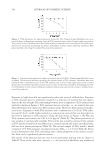
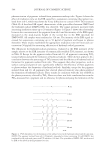
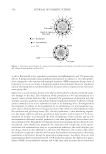
JOURNAL OF COSMETIC SCIENCE 576 treated hair samples, probably because of a decrease in their lipidic composition. IWL were able to improve the cohesion between the fi bers, increasing the hydrogen bonds and electrostatic forces and improving the cohesion between the matrix and the fi laments. This is especially true in the case of non-treated and bleached samples. ACKNOWLEDGMENTS The authors acknowledge the fi nancial support of the National Projects from Ministerio de Educación y Ciencia (Spain), Ref. CTQ2006-15404-C03-01 and CTQ2009-13967- C03-01, and the technical support of Mr. J. Carilla. Also, this work was supported by Keratec Limited (New Zealand). REFERENCES (1) S. B. Ruetsch and H. D. Weigmann, Mechanism of tensile stress release in the keratin fi ber cuticle, Proc. 9th Int. Wool Textile Research Conf., 2, 44–55 (1995). (2) J. D. Leeder, The cell membrane complex and its infl uence on the properties of the wool fi bre, Wool Sci. Rev., 63, 3–35 (1986). (3) J. A. Swift and A. W. Holmes, Degradation of human hair by papain. Part III. Some electron microscope observations, Text. Res. J., 35, 1014–1019 (1965). (4) A. K. Allen, J. Ellis and, D. E. Rivett, The presence of glycoproteins in the cell membrane complex of a variety of keratin fi bres, Biochim. Biophys. Acta, 1074, 331 (1991). (5) G. P. Mitchell, J. Mifsud, D. E. Rivett, and A. K. Allen, Characterization of formic acid-derived cell membrane complex protein from wool, Biochem. Soc. Trans., 20, 90S (1992). (6) L. N. Jones and D. E. Rivett, The role of 18-methyleicosanoic acid in the structure and formation of mammalian hair fi bres, Micron. 28, 469–485 (1997). (7) L. Duvel, D. Chun, D. Deppa, and P.. Wertz, Analysis of hair lipids and tensile properties as a function of distance from scalp, Int. J. Cosmet. Sci., 27, 193–197 (2005). (8) K. Nishimura, M. Nishino, Y. Inaoka, Y. Kitada, and M. Fukushima, Interrelationship between the hair lipids and the hair moisture, Nippon Koshohin Kagakkaishi, 13, 134–139 (1989). (9) Y. Masukawa, H. Narita, and G. Imokawa, Characterization of the lipid composition at the proximal root regions of human hair, J. Cosmet. Sci., 56, 1–6 (2005). (10) D. Braida, G. Dubief, G. Lang, and P. Hallegot, Ceramide: A new approach to hair protection and con- ditioning, Cosmet. Toiletr., 109, 49–57 (1994). (11) R. Ramírez, M. Martí, A. Manich, J. L. Parra, and L. Coderch, Ceramides extracted from wool: Pilot plant solvent extraction, Text. Res. J., 78, 73–80 (2008). (12) L. Coderch, J. Fonollosa, M. Martí, F. Garde, A. de la Maza, and J. L. Parra, Extraction and analysis of ceramides from internal wool lipids, JAOCS, 79, 1215–1220 (2002). (13) M. de Pera, L. Coderch, J. Fonollosa, A. de la Maza, and J. L. Parra, Effect of internal wool lipid lipo- somes on skin repair, Skin Pharmacol. Appl. Physiol., 13, 188–195 (2000). (14) L. Coderch, M. de Pera, J. Fonollosa, A. de la Maza, and J. L. Parra, Effi cacy of stratum corneum lipid supplementation on human skin, Contact Dermatitis., 47, 139–146 (2002). (15) L. Coderch, J. Fonollosa, M. de Pera, A. de la Maza, J. L. Parra, and M. Martí, Compositions of internal lipid extract of wool and use thereof in the preparation of products for skin care and treatment, Patent WO/2001/004244. (16) S. Méndez, C. Barba, A. Roddick-Lanzilotta, R. Kelly, J. L. Parra, and L. Coderch, Application of inter- nal wool lipids to hair, Skin Res. Technol., 14, 448–453 (2008). (17) R. Kelly, A. Roddick-Lanzilotta, S. Vorwerk, and L. Coderch, Treatement of hair or nails with internal wool lipids, Patent WO/2007/098075. (18) R. Ramírez, M. Martí, A. Cavaco-Paulo, R. Silva, A. De la Maza, J. L. Parra, and L. Coderch, Liposome formation with wool lipid extracts rich in ceramides, J. Liposom. Res., 19, 77–83 (2009). (19) N. Hayashi, A. Koyanagi, S. Daikai, N. Gotou, Y. Ueda, and K. Uehara, Effect to hair conditioner, an uniquely developed hybrid polymer consisted of hydrolyzed wheat protein, silicone and alkyl chain, Proc. 24th IFSCC Congress, Osaka, Japan, PE-216, 432–433 (2006).

DAMAGED HAIR AND CERAMIDE-RICH LIPOSOMES 577 (20) H. L. Liu, W. D. Yu, and H. B. Jin, Modeling the stress-relaxation behaviour of wool fi bers, J. Appl. Polym. Sci., 110, 2078–2084 (2008). (21) C. Zviak, Ed., The Science of Hair Care, (CRC Press, 1986). (22) B. A. Etemesi, Impact of hair relaxers in women in Nakuru, Kenya, Int. J. Dermatol., 46, 23–25 (2007). (23) A. Körner, S. Petrovic, and H. Höcker, Cell membrane lipids of wool and human hair form liposomes, Textile Res. J., 65, 56–58 (1995). (24) P. M. Elias., Lipids and the epidermal permeability barrier, Arch. Dermatol. Res., 270, 95–117 (1981). (25) M. Martí, A. M. Manich, M. H. Ussman, I. Bondia, J. L. Parra, and L. Coderch, Internal lipid content and viscoelastic behaviour of wool fi bers, J. Appl. Polym. Sci., 92, 3252–3259 (2004). (26) G. E. Rogers, Electron microscopy of wool, J. Ultrastruct. Res., 2, 309–330 (1959). (27) A. V. Rawlings and C. R. Harding, Moisturization and skin barrier function, Dermatol. Ther., 17, 43–48 (2004). (28) N. Hashimoto, N. Hayashi, A. Koyanagi, Y. Kasahara, T. Adachi, and K. Uehara, Characterization of a hydrolyzed pea protein, similar to hydrolyzed keratin, Proc. 24th IFSCC Congress, Osaka, Japan, PE-215, 430–431 (2006). (29) V. B. Gupta and D. Rama Rao, Stress relaxation studies on wool fi bers, J. Appl. Polym. Sci., 45, 253–263 (1992).
Purchased for the exclusive use of nofirst nolast (unknown)
From: SCC Media Library & Resource Center (library.scconline.org)