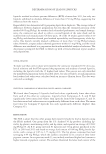
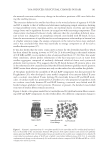
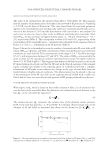
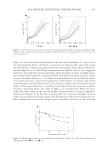
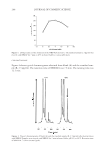
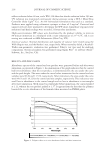
TGA-INDUCED STRUCTURAL CHANGES IN HAIR 181 the network structure without any change in the relative positions of SS cross-links dur- ing the swelling process. The extension behavior for swollen hair fi bers in the mixed solution of aqueous 8 M LiBr and BC is similar to that of rubbers and elastomers undergoing simple extension, showing (i) typical rubbery stress–extension curves, (ii) excellent elastic recovery, and (iii) lower energy losses and a signifi cant decrease in energy loss with increasing temperature. This characteristic mechanical behavior clearly indicates that the crystalline α-helical struc- ture in hair was changed to an amorphous network cross-linked with SS bonds. In fact, from the measurements of equilibrium force and temperature relationships in human hair at a higher extension range, the energy components in the retractive forces were analyzed, and it was concluded that there was essentially no energy component at all for such a swollen keratin system (17). It was also shown that the stress–strain curve in water for the deswollen hair fi ber, which has been relaxed by rinsing in water at 30°C for 24 h after swelling in the mixed solution of 8 M LiBr and BC, is very similar to that of untreated hair fi bers (17,19). Note that under these conditions, almost perfect reformation of the hair structure occurs in water from swollen aggregates composed of randomly deformed α-helical chains and cystine-rich globular matrix proteins. This suggests that the SS bonds between IF proteins play a role in the reformation of α-crystallites and that the SS bonds between globular matrix proteins (KAP) retain their relative positions not only on the surface but also within the globule. A two-phase model for the assembly of IF and KAP components was fi rst presented by Feughelman (20), who developed a zone model comprised of an uncross-linked X-zone and a covalent cross-linked Y-zone forming SS cross-links between IF and KAP mole- cules. A similar model was presented by Crewther (21), who proposed a hypothesis with no covalent cross-links between IF and KAP forming a network cross-linked with SS bonds between globular matrix proteins. However, at present, the detailed cross-linked structure of keratin fi bers remains uncertain. Figure 1 shows a two-phase model for (a) unswollen and (b) swollen keratin fi bers consist- ing of IF and KAP components. In the swollen fi ber, two different components change to Figure 1. Schematic representation of a two-phase model for (a) unswollen and (b) swollen hair keratin fi - bers. (a) Assembly of the intermediate fi lament (IF) proteins with eight tetramers and cystine-rich globular matrix proteins (KAP) (24). (b) Cross-linked structure model in the swollen state comprised of a densely SS cross-linked microdomain phase of KAP and a lightly cross-linked rubbery phase of IF (14). A reversible conformational change occurs alternately (b) in the mixed solution composed of 8 M LiBr and BC in a 55:45 volume ratio and (a) in water.

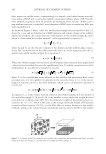
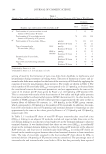
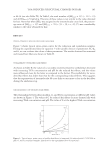
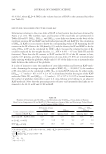
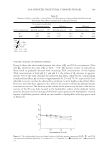
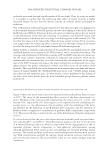
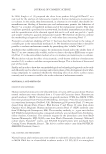
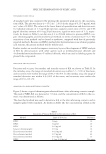
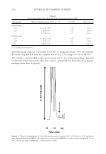
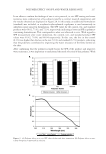
JOURNAL OF COSMETIC SCIENCE 182 their respective swollen states, corresponding to a densely cross-linked matrix microdo- main phase of KAP and a continuous lightly cross-linked rubbery phase of IF. The rub- bery network originates from IF proteins by hydrogen bond scission. When such a non-uniform structure is stretched, microdomains of KAP serve as reinforcing fi ller par- ticles in rubber (14). As shown in Figure 2, when a cube of a swollen fi ber sample was stretched by a force, F, along the z-axis and no deformation of KAP domains and volume change of the rubbery phase were assumed, the volume fraction of the domains in the swollen sample, ϕd, intro- duced to characterize the swollen network, can be represented by equation 1: I , d d d rs V V V (1) where Vd and Vrs are the effective volumes of the domain and the rubbery phase, respec- tively. The extension ratio of the rubber network chain, α, can be represented by the ex- tension ratio of the swollen sample, λ, in equation 2: D OI Id. 1 d (2) When the swollen sample was stretched, non-Gaussian chain statistics were applied and a theoretical relationship between the equilibrium force, F, and the extension ratio of the rubber phase, α, was derived as equation 3 (14,22): ^ ` D D Dn, -1 -3 2 -1 3 1 F G n L n L (3) where F is the equilibrium stress referred to the swollen and unstrained fi ber cross- sectional area, n is the number of segments in the network chain, L-1(x) is the inverse Langevin function, and G is the shear modulus, which can be calculated by equation 4 (14,22,23): ^ ` U I I J. 1 3 1 1 2M c 2 d d c G RT M v M (4) In equation 4, v2 is the volume fraction of hair in the swollen sample, ρ is the density of the unswollen sample (1.30 g/cm3), Mc is the number average molecular weight between cross-links in a rubbery chain (IF), M is the molecular weight of the primary chain (as- sumed to be 5.0 × 10⁴, which is the same as the average molecular weight of IF proteins in wool and hair keratins (24,25)), γ is the fi ller effect of matrix domains in the swollen network, and ϕd is the volume fraction of globular matrix proteins (KAP) in the swollen Figure 2. A simple model for extension of a swollen cube containing microdomains and elastic network chains with effective volume, Vd and the effective volume of rubbery chains, Vrs.
Purchased for the exclusive use of nofirst nolast (unknown)
From: SCC Media Library & Resource Center (library.scconline.org)