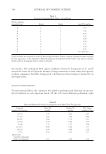
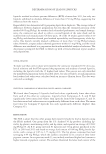
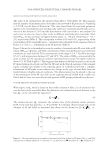
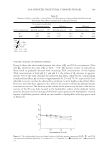
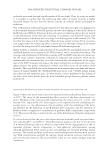
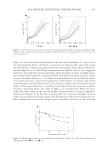
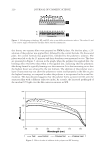
TGA-INDUCED STRUCTURAL CHANGES IN HAIR 183 sample. The fi ller effect, γ, is further represented by equation 5, using ϕd and a shape fac- tor, κ, as the length:breadth ratio for the rod-like fi ller (14,23): J NI N Id 2 2 1 2.5 14.1 . d (5) This semi-empirical equation is applicable to spherical or near-spherical fi ller particles in rubber, with the range of κ values assumed to be 1 ≤ κ ≤ 2. DETERMINATION OF STRUCTURAL PARAMETERS The shear modulus, G, of the swollen fi ber was defi ned as the slope of the initial straight line obtained from plots of the relationship between F and λ − λ-2, because the paren- thetical term in the non-Gaussian expression in equation 3 may be reduced to λ − λ-2 for small deformation of the network (14,15,22). The unknown four parameters, n, Mc, ϕd, and κ, can be determined by fi tting the stress–strain data to equation 3. Here the seg- ment length characteristic in hair proteins, Mc/n (= nr), was determined by fi tting equa- tion 3 to the stress–strain data for a tri-n-butylphosphine-reduced hair sample, which would be expected to have a ϕd value of zero. The value of nr = 1250 obtained was used as one of the known parameters (14,23). The unknown four parameters were thus reduced to three. Therefore, experimentally obtainable parameters were F, G, v2, and λ, and un- known parameters were Mc, ϕd, and κ. By fi tting the experimental data F, G, λ, and v2 for equation 3 with a suitable choice of parameters, ϕd, Mc, and κ, we can evaluate the values of these parameters. We attempted to fi t the equation to the experimental damping Gauss method of nonlinear least squares. These parameters can be obtained using the data over the range of extensions to the in- fl exion point observed at a higher extension range of the stress–strain curve. The least squares refi nement was executed by repeating cycles on the three parameters under the condition that one parameter was fi xed by the software. RESULTS FOR CROSS-LINKED STRUCTURE OF WOOL IF There are two types of IF protein species in wool and hair keratin: Type I and Type II proteins. These form heterodimers with α-helical rod domains and non-helical N and C terminals (25–27). These two types in wool keratin include four protein species each, which have approximately equimolar concentrations (28). The SS contents in the IF of wool and hair are also approximately the same (25,29). The number and location of the cystine residues in wool IF chains sequenced for each of the four species was originally published by Fraser et al. (30), and the average number of cysteines (1/2 cystine) in resi- dues per IF chain was calculated to be seven in the rod domain and 15 in the terminal domain, as given in Table I. When the average molecular weight of IF proteins was as- sumed to be 5.0 × 10⁴, the total cystine content in IF proteins could be calculated as 220 μmol/g (= 22 × 106/2 × 5.0 × 104), which includes 70 μmol/g in the rod domain and 150 μmol/g in the terminal domain (Table I). In 1996, the number, type, and location of cystine cross-links in the wool IF protein were demonstrated by Naito et al. (15) and Arai et al. (16), who investigated the permanent

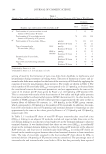
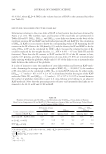
JOURNAL OF COSMETIC SCIENCE 184 setting of wool by the formation of new cross-links from disulfi des to lanthionine and lysinoalanine during treatment in boiling water. The rates of formation of inter- and in- tramolecular links were analyzed on the basis of the reactivity of SS bonds by applying the equation of state for non-Gaussian chain statistics. The results are shown in Table I. The total number of SS cross-links ([SS]total) was reported to be 213 μmol/g, as obtained from the correlation between the structural parameters, and was approximately the same as the value of 22 residues per IF chain given by Fraser et al. (220 μmol/g of IF protein) (30). This is consistent with results of the fractionation of low-sulfur and high-sulfur proteins from water-soluble S-carboxymethylcysteine (SCMC) derivatives (31). In other words, the number of SCMC groups in IF (low-sulfur) proteins is approximately the same as that in keratin fi bers of different SS contents, i.e., 400 μmol/g in the SCMC group content, which corresponds to 200 μmol/g as the number of SS cross-links. In addition, the num- bers of SS cross-links in the rod (72 μmol/g) and terminal domains (141 μmol/g) are also approximately the same as the values given by Fraser et al. (70 μmol/g and 150 μmol/g, respectively) (30). In Table I, 11 residues/IF chain of total IF–IF-type intermolecular cross-link sites ([SS]inter) linking to an adjacent IF molecule (coiled-coil rope) include three sites in the rod domain linking to an adjacent rod and eight sites in the terminals linking to adjacent terminal domains. It was further found that there are two sites ([SS]inter in residues/IF chain) in the terminal domains linking to either the adjacent IF molecule or the adjacent KAP molecule, and four sites of intramolecular links ([SS]intra in residues/IF chain) are located on the interface regions between the rod and terminal domains to form intrachain links. The type of cross-links assigned to the four residues/IF chain shown by [SS]U in terminal domain (39 μmol/g of IF protein) remains unresolved. The percentage ratio of intermolecular and intramolecular cross-links in IF for hair has previously been reported Table I Number, Type, and Location of SS Cross-Links in Rod and Terminal Domains of IF Chain in Wool Keratin Number, type, and location of SS cross-links in IF Domains Rod N and C terminals Total Aa Total number of cysteine residues in each domain of IF (residues/ IF chain) 7 15 22 Total number of SS cross-links in each domain of IF (μmol/g of IF protein) 70 150 220 Bb Total number of SS cross-links, [SS]total μmol/g 72 141 213 Residues/ IF chain 7 14 21 Type of intermolecular SS cross-links, [SS]inter IF-IF μmol/g 33 79 112 Residues/ IF chain 3 8 11 IF-IF or IF-KAP μmol/g 0 23 23 Residues/ IF chain 0 2 2 Intramolecular SS cross-links, [SS]intra μmol/g 39 0 39 Residues/ IF chain 4 0 4 Type of SS cross-links being unknown, [SS]U μmol/g 0 39 39 Residues/ IF chain 0 4 4 a Published by Fraser et al. (30). b Published by Naito et al. (15) and Arai et al. (16).
Purchased for the exclusive use of nofirst nolast (unknown)
From: SCC Media Library & Resource Center (library.scconline.org)