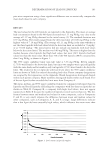
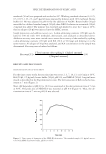
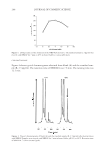
J. Cosmet. Sci., 63, 213–221 (May/June 2012) 213 Microscopic evaluation of polymeric fi lm properties of anhydrous sunscreen compositions and their relation to absorption and water resistance DONALD PRETTYPAUL and HANI FARES, Ashland Specialty Ingredients, 1361 Alps Road, Wayne, NJ 07470. Accepted for publication November 15, 2011. Synopsis The aim of this study was to investigate the mechanism by which a VA/butyl maleate/isobornyl acrylate co- polymer increases the SPF and water resistance of sunscreen formulations. Anhydrous sunscreen formulations with and without polymer were applied on polymethyl methacrylate (PMMA) plates and absorbance spectra were generated. Before immersion, the areas under the curve for the control and test samples were 98.49 and 117.09, respectively, and were 94.63 and 118.22, after immersion. Static and after-immersion, in vivo SPF values confi rmed a boost in SPF and an increase in water resistance for the formulation containing the polymer (VA/butyl maleate/isobornyl acrylate copolymer). Digital imaging of sunscreen fi lms combined with image analysis and contact angle measurements suggest that the polymer conformation changes upon exposure to water. The polymer forms a protective barrier over the sunscreen fi lm upon exposure to water, which explains the enhancement in water resistance. The poly- meric fi lm formed has a different refractive index than the sunscreen fi lm. The change in refractive indices causes diffraction of incident light, thus increasing its pathlength, leading to an increase in SPF. INTRODUCTION Polymers have been used in sunscreen products for many years. The primary purpose of adding polymers to sunscreens is to impart water resistance to the formulation. The use of polymers evolved through the years and their use is not limited to increasing water resistance, but has been extended to boosting SPF. Over the years, scientists have studied several facets of sunscreen formulations and pub- lished papers depicting mechanistic information. The solvent effect on spectrum shift was studied by Agrapidis-Paloympis et al. (1) and explained thoroughly. The photostabil- ity of sunscreens has received a lot of attention from scientists (2–4). Broad spectrum coverage and UVA damage to the skin has also been covered (5), as well as in vitro meth- odologies for SPF measurements (6). The mechanism by which polymers boost SPF and increase water resistance has not received much attention. Sayre (7) and Jones (8) de- scribed the effect of fi lm thickness and the effect of polymeric beads on increasing the pathlength of radiation, respectively, as a means of boosting SPF.

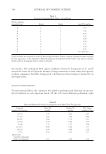
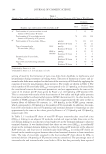
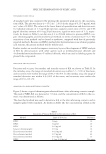
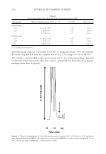
JOURNAL OF COSMETIC SCIENCE 214 The goal of this study is to investigate the mechanism associated with the ability of poly- mers to boost SPF and increase water resistance. We evaluated the effect of polymers on boosting SPF in solutions and in fi lms. Digital imaging and image analysis were used to evaluate the integrity of sunscreen fi lms formed on polymethyl methacrylate (PMMA) plates. We evaluated the hydrophobicity of fi lms using contact angle measure- ments in an effort to completely understand the mechanisms behind increasing SPF and water resistance. MATERIALS AND METHODS MATERIALS PMMA plates were obtained from Helioscience (Marseilles, France). The plates (Helio- plates® HD 6) are 5 × 5 cm wide, with a calculated surface roughness of six microns. Absorption spectra were taken with a Cary® 300 UV/Vis spectrophotometer (Varian®, Palo Alto, CA) equipped with a DRA-CA-30I integrating sphere (Labsphere®, North Sutton, NH). The contact angle was measured using a DSA10 Drop Shape Analyzer (Krüss® GmbH, Hamburg, Germany). Digital photography was conducted using a Hirox KH770 digital microscope fi tted with a MXG-5040RZ lens (Hirox, River Edge, NJ). Image analysis was performed with Adobe® Photoshop software (Adobe® Systems Incorporated, San Jose, CA). Avobenzone (Escalol® 517), Oxybenzone (Escalol® 567), Octisalate (Escalol® 587), Octocrylene (Escalol® 597), and VA/butyl maleate/isobornyl acrylate copolymer (Advantage® Plus) were all obtained from International Specialty Products (Wayne, NJ). Homosalate (Neo Heliopan® HMS) was obtained from Symrise® Inc. (Teterboro, NJ). METHODS Formulations. The sunscreen formulations used in this study are presented in Table I. The three formulations studied contained UVB and UVA sunscreens in an alcohol-based Table I Formulations Evaluated INCI Name Control Test Standard Avobenzone 3.00 3.00 3.00 Oxybenzone 6.00 6.00 6.00 Homosalate 15.00 15.00 15.00 Octisalate 5.00 5.00 5.00 Octocrylene 10.00 10.00 10.00 Ethyl alcohol 61.00 59.00 60.00 VA/butyl maleate/isobornyl acrylate copolymer (50% sol.) 2.00 Acrylates/octylacrylamide copolymer 1.00 Total 100.00 100.00 100.00
Purchased for the exclusive use of nofirst nolast (unknown)
From: SCC Media Library & Resource Center (library.scconline.org)