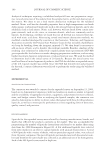
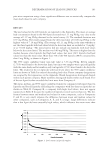
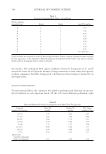
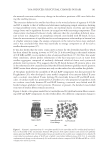
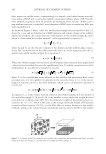
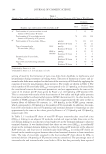
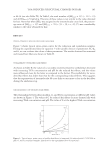
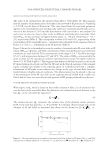
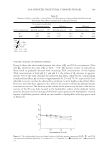
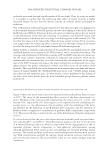
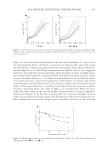
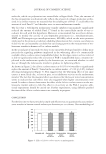
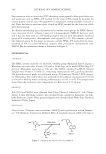
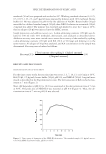
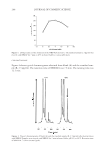
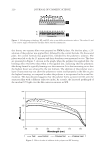
TGA-INDUCED STRUCTURAL CHANGES IN HAIR 191 molecules associated through a small number of SS cross-links. Thus, by using our model, it is possible to explain that the reinforcing fi ller effect of matrix proteins is highly decreased despite the fact that the domain volume, Idc, remains almost unchanged by reduction. One of the present authors previously reported (16) that there are eight cross-linking sites in the terminal domains of wool IF proteins and two sites linking to adjacent IF chains or KAP molecules (Table I). Parameter κ may also involve reinforcing effects directly related to the deformation of the network consisting of covalently cross-linked IF chains with globular proteins, which may serve as a large cross-linking point in the network (15). The fact that the values of κ for reduced hair fi bers decrease steeply at lower TGA concentra- tion suggests that the reinforcing effect is due to not only the shape change of the matrix but also the disruption of SS cross-links between IF and matrix proteins. Figure 8 shows a schematic representation of the possible SS cross-linked structure of IF and KAP proteins in (a) untreated, (b) TGA-reduced, and (c) reoxidized hair fi bers. The cleavage and reformation of SS bonds occurring in IF and KAP structures are shown un- der the usual cosmetic treatment conditions of reduction and oxidation. TGA attacks preferentially the intermolecular cross-links between the subcomponents in the aggre- gate of the KAP molecule and induces the shape change from an ellipsoidal into a near- spherical form. No perfect reformation of these cross-links occurs on the surface of the globules. This is probably due to the formation of intramolecular cross-links and the ex- istence of mixed disulfi de (R:–SSCH2COOH) and cysteic acid (−SO3H) groups during the reduction and oxidation steps. In other words, a severe problem for the damage of the hair cortex arises mainly from the mixed disulfi de groups between globular matrix proteins (8). MECHANICAL PROPERTIES OF KERATIN FIBER IN WATER AND CROSS-LINKS BETWEEN KAP Figure 9 shows the stress–strain curves for untreated and reoxidized hair fi bers in water at 20°C. The curve for the untreated hair fi ber consists of the three characteristic re- gions: Hookean, yield, and post-yield, ranging from the strains of 0–2%, 2–25%, and beyond 30%, respectively (33). Each region can be explained by the underlying mo- lecular event, i.e., the deformation of α-crystallites in IF, the unfolding of the α-he- lix followed by the formation of the β-pleated sheet structure, and the extension of β-sheets with a complicated contribution of globular KAP components, respectively (34). The post-yield slope is related to the ease of the deformation of matrix components (34,35). It can be observed that the post-yield slopes decrease markedly with increased reduc- tion at both pH 8.7 and pH 9.3. This phenomenon appears to be due to the decrease of κ values following reduction, which is responsible for the deaggregation of the el- lipsoidal globular matrix component to near-spherical subcomponents arising through preferential TGA attack on the cross-linking site between globular matrix proteins. The initial modulus, yield stress, and breaking stress decrease with increas- ing TGA concentration and pH. In contrast, break extension increases with the de- gree of reduction however, fi ber extensibility tends to cease under stronger reducing conditions.

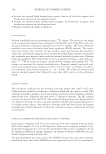
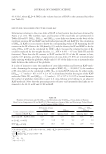
JOURNAL OF COSMETIC SCIENCE 192 Figure 8. Schematic representation of possible SS cross-linked structure of IF and KAP component proteins in TGA-reduced and reoxidized hair fi bers. The hair microfi bril consists of a unit of IF molecule (coiled-coil rope) with an average molecular weight (M) of 105 and a KAP molecule with M = 2 × 10⁴. The number of KAP molecules per IF molecule has been reported to be about 5 to 6 (26,30). The structures: (a) unreduced (untreated), (b) reduced with 0.2 to 0.7 M TGA in a usual cosmetic treatment condition, and (c) reoxidized with BrO3– ions, respectively. (a) Cross-link sites linking to adjacent IF chain: three sites are included in the rod domain (not described here) and eight sites in the terminal domains ( ), and two sites linking to either adjacent IF or KAP molecules are involved in the terminal domain ( ). The four intramolecular cross-links between the end of the α-helical section in IF and the non-helical end region are also shown in both sides as two links each. The cross-link sites in the non-helical section of the two terminal domains were assumed to be equally distributed in each domain, which aggregates through the cross-links between KAPs to form an ellipsoidal particle involving six subcomponent matrix molecules. (b) Targets of TGA attack are the SS bonds associated with the globular matrix. Some of the cross-links between subcomponent molecules, and between the IF terminal and KAP, are broken to form free SH groups and mixed disulfi de (R:–SSCH2COOH) groups, and as a result, the ellipsoidal shape of the cross-linked KAP molecule changes into near-spherical KAP molecules. (c) The SH groups reform intermolecular SS bonds and mechanically ineffective intramolecular bonds. Oxidation of SS bonds may form cysteic acid (–SO3H) groups, and the mixed disulfi de groups remain in the permanent-waved hair fi bers.
Purchased for the exclusive use of nofirst nolast (unknown)
From: SCC Media Library & Resource Center (library.scconline.org)