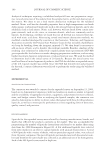
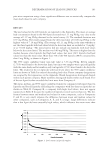
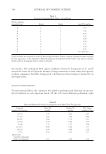
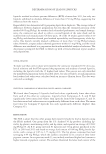
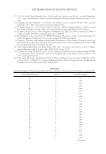
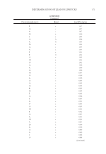
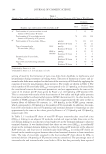
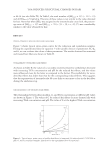
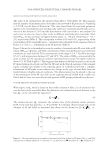
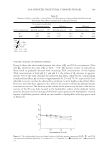
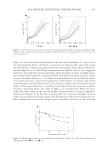
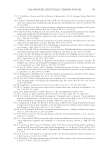
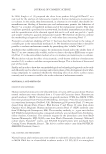
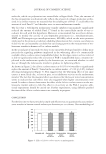
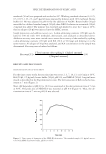
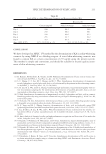
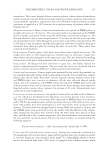
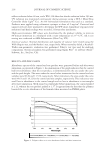
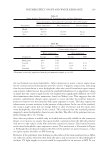
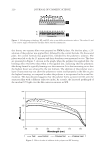
TGA-INDUCED STRUCTURAL CHANGES IN HAIR 189 VOLUME CHANGE OF MATRIX DOMAIN Figure 6 shows the relationship between the values of Ic d and TGA concentration. Note that Ic d0 represents the value of Ic d at TGA = 0 M. The domain volume in reduced hair fi bers tends to gradually decrease with increasing TGA concentration. At the highest TGA concentration at both pH 8.7 and pH 9.3, the values of Ic d decrease to approxi- mately 70% of the value obtained for untreated hair fi bers, while for the corresponding reoxidized hair fi bers, Ic d recovers to approximately 91.2% and 79.5%, respectively. Con- siderable recovery can thus be observed by oxidation even for highly reduced hair fi bers. However, note that there appears to be a limit to the extent to which the globular matrix structure can recover. The decrease in the volume of the matrix may be due to the discon- nection of the SS cross-links located at the hydrophilic surface of the globular matrix proteins, because minimal cleavage of SS bonds is anticipated in the hydrophobic internal regions of globular proteins, which are inaccessible to hydrophilic reducing agents such as TGA (13). Table IV Number of [SS]inter and [SS]intra Cross-Links (15): Micromole per Gram of Individual Protein and Percentage Values Based on Individual Component Protein Cortex components SS content in individual component protein [SS]inter [SS]intra (μmol/g·protein) (%) (μmol/g·protein) (%) (μmol/g·protein) (%) IF 200a 100 132c 66.0 68e 34.0 KAP 966b 100 115d 12.0 851f 88.0 a Ref. 31. b c I 540 966. d0 c 106/2Mc = 132. d c I 65 115. d0 e 200 – 132 = 68. f 966 – 115 = 851. Figure 6. The relationships between volume fraction of globular matrix component (KAP), Ic d , and TGA concentration at different pH levels: ( ) reduced, 8.7 ( ) reduced, 9.3 ( ) reoxidized, 8.7 ( ) reoxidized, 9.3.

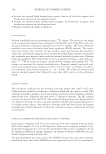
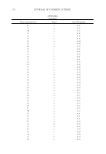
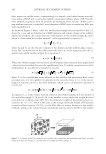
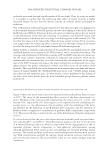
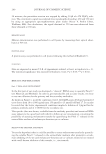
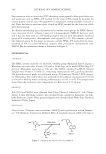
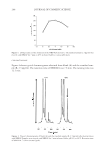
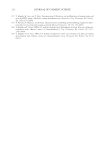
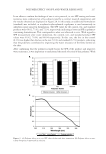
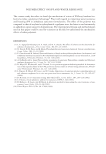
JOURNAL OF COSMETIC SCIENCE 190 SHAPE CHANGE OF MATRIX DOMAIN Figure 7 shows the relationship between the shape factor, κ, and TGA concentration at different pH values. The values of κ for reduced hair fi bers decrease steeply at the lower TGA concentration range and then reach a plateau. This suggests that TGA attacks the SS bonds between globular matrices and induces the change from an ellipsoidal to a near- spherical form that is associated with some simultaneous decrease of matrix volume. Sig- nifi cant recovery in κ can be observed through oxidation of reduced hair fi bers at lower pH, whereas low recovery is observed for the strongly reduced hair fi bers at higher TGA concentrations and pH. This indicates a diffi culty in the reformation of the deformed matrix shape, and differs from the recovery behavior observed for both matrix volume, Id,c and the number of intermolecular cross-links on IF chains, [SS]inter. As a result, the mod- ulus of the swollen fi ber, G, is considered to be mainly dependent on the magnitude of κ. In other words, the change in the shape of KAP molecules results from the scission of a small number of intermolecular SS cross-links between globular proteins. DISCUSSION CROSS-LINKED STRUCTURAL CHANGE INDUCED BY PERMANENT WAVE TREATMENT An IF molecule consists of a central α-helical coiled-coil rod domain at the core and rela- tively cystine-rich N and C terminal domains, forming a water-accessible region between the core and the globular matrix proteins (13,16,32). Accordingly, two types of matrix components may be expected: the N and C terminal domains located near IF and the so- called globular matrix proteins (KAP) existing around IF. The latter occupies a considerably larger portion of the matrix as compared to the former. In our model, KAP serve as fi ller particles and the magnitude of c Id has been discussed on this basis. As shown in Figure 4, G decreases dramatically with increasing TGA concentration, similar to the tendency of κ (Figure 7). This suggests that the scission of a small number of intermolecular SS cross-links between the globules has a critical infl uence on the mag- nitude of the shear modulus. Further, this suggests that the ellipsoidal KAP molecule is a unit of the matrix component, which is an aggregate consisting of some near-spherical Figure 7. The relationships between shape factor, κ, and TGA concentration at different pH levels: ( ) re- duced, 8.7 ( ) reduced, 9.3 ( ) reoxidized, 8.7 ( ) reoxidized, 9.3.
Purchased for the exclusive use of nofirst nolast (unknown)
From: SCC Media Library & Resource Center (library.scconline.org)