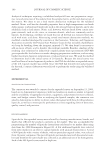
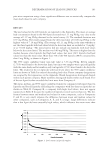
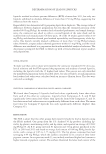
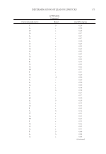
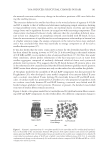
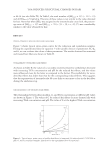
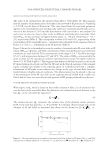
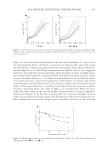
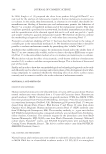
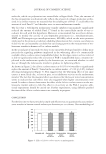
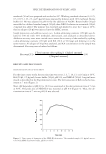
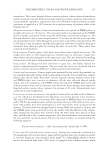
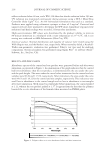
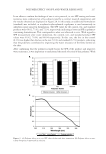
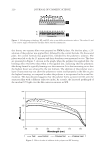
TGA-INDUCED STRUCTURAL CHANGES IN HAIR 187 MOLECULAR WEIGHT BETWEEN SS CROSS-LINKS IN IF The value of Mc evaluated for the untreated hair fi ber is 3600 (Table II). This suggests that the number of intermolecular cross-links in the network of IF proteins is 139 μmol/g (= 106/2Mc) on the basis of IF proteins. The value found from the structural parameter appears to be reasonable because mechanically ineffective intramolecular SS links are in- volved in hair keratin (15,16) and the distribution of SS cross-links is not random (30) and occurs in sites too close to play a role as different intermolecular cross-links. Note that [SS]inter for hair and wool are approximately equal, i.e., 139 and 135 μmol/g (= 112 + 23), respectively (Table I). This corresponds to about 63% and 61%, respectively, of the total number of SS cross-links (inter + intramolecular) obtained by the sequenced data of Fraser et al. (30), i.e., 220 μmol/g in the IF proteins (Table I). Figure 5 shows the relationship between the number of intermolecular SS cross-links in IF chains, [SS]inter in μmol/g, and TGA concentration. Here usual permanent wave treatment conditions are used with the TGA concentration in the range 0.2–0.7 M, pH in the range 8.5–9.5, and temperatures between 20° and 30°C. The values of [SS]inter are essentially the same as those for the unreduced condition (untreated hair) except for higher reduction above 0.75 M TGA at pH 9.3. This suggests that almost no SS bond scission occurs on the IF chains forming α-crystals, and that the SS bond in the SS-rich segments of the terminal region is highly inaccessible to the reducing agent. It is further noted that a complete reformation of SS bonds occurs without any change in the type of cross-links from the bonds broken in highly reduced conditions. This phenomenon may be related to the ease of the reformation of the SS cross-link on the segment directly linked with a stable rod- like α-helical chain at a sterically favored position of SH groups produced by reduction. VOLUME FRACTION OF MATRIX DOMAINS IN HAIR With respect to ϕd, which is based on the swollen volume of fi ber, it is of interest to dis- cuss the basis of the unswollen fi ber. By defi nition, the volume fraction of domains in dry hair, Ic d , can be calculated by equation 6: Q c I I . d d 2 (6) The volume fraction, c, Id represents the volume ratio of the globular matrix proteins, KAP, to the total hair proteins, i.e., IF and KAP. Accordingly, the percentage ratio in the volumes of IF and KAP in untreated hair fi bers can be shown by c I Ic 1 d0 d0 , i.e., Figure 5. The relationships between number of intermolecular SS cross-links in IF chains, [SS]inter, and TGA concentration at different pH levels: ( ) reduced, 8.7 ( ) reduced, 9.3 ( ) reoxidized, 8.7 ( ) reoxidized, 9.3.

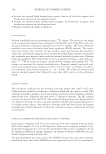
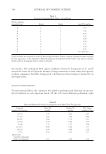
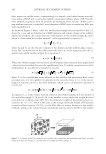
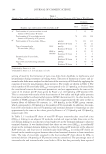
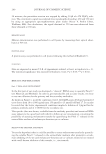
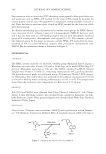
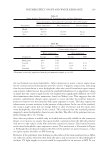
JOURNAL OF COSMETIC SCIENCE 188 43.4:56.6, where c I 0.566 d0 is the volume fraction of KAP in the untreated hair fi ber (see Table II). RESULTS FOR CROSS-LINKED STRUCTURE OF HAIR KAP Information relating to the cross-links of KAP in hair keratin has also been obtained by Naito et al. (15). The number, type, and location of SS cross-links are summarized in Tables III and IV. [SS]tot, [SS]inter, and [SS]intra cross-links are shown on the basis of the total hair proteins (IF and KAP) and individual proteins IF and KAP. For the calculation of [SS]tot in KAP, it is necessary to know the corresponding value of IF. Assuming the SS content in the IF of hair to be 200 μmol/g (33) and the density for IF and KAP to be the same, [SS]tot in IF can be calculated by Ic 200 1 d0 , because the volume fraction of Ic d0 could be replaced by the weight fraction, i.e., 200 × 0.435 = 87 (see Table III and the footnotes). Note that the SS content in KAP reaches 86.2% of the SS content in hair, namely, 627 μmol/g, and that a large portion of cross-links (75.8%) are intramolecular links existing within the globules, while only 10.4% of the links occur as intermolecular links between the surfaces of the globules. It is also of interest to note the numbers of cross-links within and between KAP mole- cules. Assuming the average molecular weight of KAP, Mave = 20,000 (15), the number of SS cross-links can be calculated as [SS] · Mave in moles/KAP molecule. In other words, [SS]intra = 17 moles (= 851 × 106 × 2 × 104) is distributed within the region of the KAP molecule (Table IV), and [SS]inter = 2.3 moles (= 115 × 106 × 2 × 104) is located between the surface of globular molecules to give 4.6 cross-linking sites linking to an adjacent KAP molecule. Note that the percentage ratios of inter- and intramolecular links are es- timated to be 66:34 in IF and 12:88 in KAP. Table III Number of Intermolecular SS ([SS]inter) and Intramolecular SS ([SS]intra) Cross-Links in Human Hair Cortex Components, IF and KAP (15): Micromole per Gram of Hair and Percentage Values Based on SS Content of Hair ([SS]tot) Cortex components (volume fraction of KAP, c Id0 ) SS Content of hair, [SS]tot [SS]inter [SS]intra (= [SS]tot − [SS]inter) (μmol/g·hair) (%) (μmol/g·hair) (%) (μmol/g·hair) (%) Hair total (IF + KAP) (1.000) 627 100 123 19.6 504 80.4 IF c I 1 0.435 d0 87a 13.8 58c 9.2 29e 4.6 KAP c I 0.565 d0 540b 86.2 65d 10.4 475f 75.8 a Calculation of [SS]tot in IF: refer to the text, c I u 200 1 200 0.435 87 d0 . b 627 – 87 = 540. c c I u 6 10 2 1 132 0.435 58. c d0 M d Ref. 15. e 87 – 58 = 29. f 540 – 65 = 475.
Purchased for the exclusive use of nofirst nolast (unknown)
From: SCC Media Library & Resource Center (library.scconline.org)