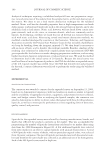
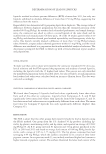
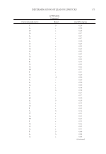
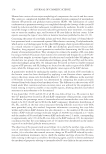
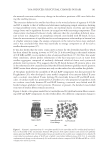
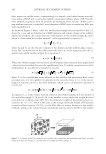
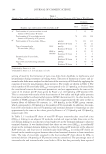
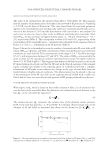
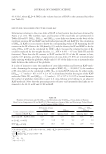
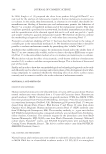
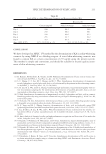
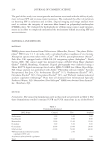
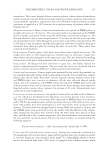
JOURNAL OF COSMETIC SCIENCE 184 setting of wool by the formation of new cross-links from disulfi des to lanthionine and lysinoalanine during treatment in boiling water. The rates of formation of inter- and in- tramolecular links were analyzed on the basis of the reactivity of SS bonds by applying the equation of state for non-Gaussian chain statistics. The results are shown in Table I. The total number of SS cross-links ([SS]total) was reported to be 213 μmol/g, as obtained from the correlation between the structural parameters, and was approximately the same as the value of 22 residues per IF chain given by Fraser et al. (220 μmol/g of IF protein) (30). This is consistent with results of the fractionation of low-sulfur and high-sulfur proteins from water-soluble S-carboxymethylcysteine (SCMC) derivatives (31). In other words, the number of SCMC groups in IF (low-sulfur) proteins is approximately the same as that in keratin fi bers of different SS contents, i.e., 400 μmol/g in the SCMC group content, which corresponds to 200 μmol/g as the number of SS cross-links. In addition, the num- bers of SS cross-links in the rod (72 μmol/g) and terminal domains (141 μmol/g) are also approximately the same as the values given by Fraser et al. (70 μmol/g and 150 μmol/g, respectively) (30). In Table I, 11 residues/IF chain of total IF–IF-type intermolecular cross-link sites ([SS]inter) linking to an adjacent IF molecule (coiled-coil rope) include three sites in the rod domain linking to an adjacent rod and eight sites in the terminals linking to adjacent terminal domains. It was further found that there are two sites ([SS]inter in residues/IF chain) in the terminal domains linking to either the adjacent IF molecule or the adjacent KAP molecule, and four sites of intramolecular links ([SS]intra in residues/IF chain) are located on the interface regions between the rod and terminal domains to form intrachain links. The type of cross-links assigned to the four residues/IF chain shown by [SS]U in terminal domain (39 μmol/g of IF protein) remains unresolved. The percentage ratio of intermolecular and intramolecular cross-links in IF for hair has previously been reported Table I Number, Type, and Location of SS Cross-Links in Rod and Terminal Domains of IF Chain in Wool Keratin Number, type, and location of SS cross-links in IF Domains Rod N and C terminals Total Aa Total number of cysteine residues in each domain of IF (residues/ IF chain) 7 15 22 Total number of SS cross-links in each domain of IF (μmol/g of IF protein) 70 150 220 Bb Total number of SS cross-links, [SS]total μmol/g 72 141 213 Residues/ IF chain 7 14 21 Type of intermolecular SS cross-links, [SS]inter IF-IF μmol/g 33 79 112 Residues/ IF chain 3 8 11 IF-IF or IF-KAP μmol/g 0 23 23 Residues/ IF chain 0 2 2 Intramolecular SS cross-links, [SS]intra μmol/g 39 0 39 Residues/ IF chain 4 0 4 Type of SS cross-links being unknown, [SS]U μmol/g 0 39 39 Residues/ IF chain 0 4 4 a Published by Fraser et al. (30). b Published by Naito et al. (15) and Arai et al. (16).

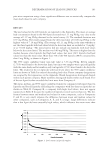
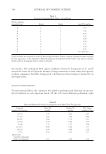
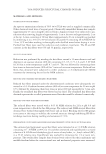
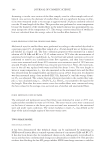
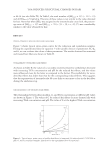
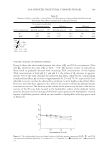
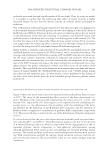
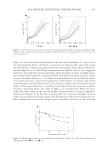
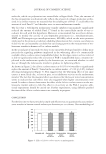
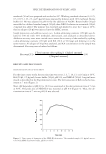
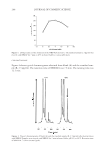
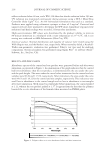
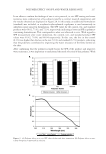
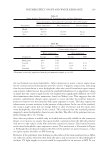
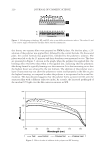
TGA-INDUCED STRUCTURAL CHANGES IN HAIR 185 as 66:34 (see also Table IV). In Table I, the total number of [SS]inter is 135 (= 112 + 23) and of [SS]intra is 39 μmol/g. The ratio of these values is not similar to the value obtained for hair. Note that when [SS]U was assigned to the intramolecular cross-link, the percent- age ratio of [SS]inter = 135 and [SS]intra = 78 (= 39 + 39, i.e., 63:37) was considerably similar to the value obtained for hair. RESULTS STRESS–STRAIN CURVE FOR SWOLLEN HAIR FIBER Figure 3 shows typical stress–strain curves for the reduction and reoxidation samples. Fitting the experimental data for equation 3 with suitable choices of parameters Mc, ϕd, and κ, we can evaluate the values of these parameters. The results obtained for untreated and treated hair fi bers are shown in Table II. SWELLABILITY OF TREATED HAIR FIBERS As shown in Table II, the values of v2 (an index inversely related to swellability) decreased with increasing TGA concentration and pH for the reduced hair fi bers, and the values were infl uenced more by the latter as compared to the former. The swellability for reoxi- dized hair fi bers was lower than that for the corresponding reduced fi bers. This suggests that the regeneration of intermolecular SS cross-links occurs more or less in the hair fi ber during the oxidation step. SHEAR MODULUS OF SWOLLEN HAIR FIBERS The relationships between shear modulus, G, and TGA concentration at different pH values are shown in Figure 4. The values of G for reduced hair fi bers decrease dramatically with increasing TGA concentration and pH. The value of G at the highest TGA concentration Figure 3. Typical stress–strain curves of swollen hair fi bers: (a) untreated, (b) reduced with 0.75 M TGA at pH 9.3, and (c) reoxidized samples. Lines fi tted to the experimental data by equation 3.
Purchased for the exclusive use of nofirst nolast (unknown)
From: SCC Media Library & Resource Center (library.scconline.org)