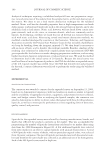
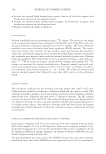
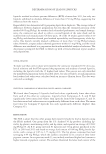
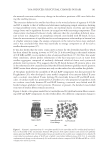
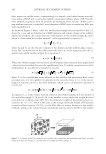
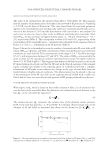
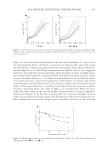
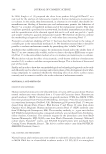
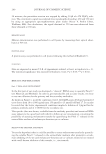
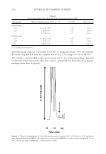
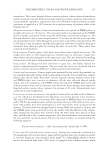
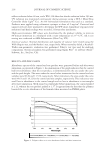
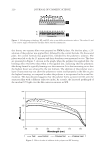
JOURNAL OF COSMETIC SCIENCE 192 Figure 8. Schematic representation of possible SS cross-linked structure of IF and KAP component proteins in TGA-reduced and reoxidized hair fi bers. The hair microfi bril consists of a unit of IF molecule (coiled-coil rope) with an average molecular weight (M) of 105 and a KAP molecule with M = 2 × 10⁴. The number of KAP molecules per IF molecule has been reported to be about 5 to 6 (26,30). The structures: (a) unreduced (untreated), (b) reduced with 0.2 to 0.7 M TGA in a usual cosmetic treatment condition, and (c) reoxidized with BrO3– ions, respectively. (a) Cross-link sites linking to adjacent IF chain: three sites are included in the rod domain (not described here) and eight sites in the terminal domains ( ), and two sites linking to either adjacent IF or KAP molecules are involved in the terminal domain ( ). The four intramolecular cross-links between the end of the α-helical section in IF and the non-helical end region are also shown in both sides as two links each. The cross-link sites in the non-helical section of the two terminal domains were assumed to be equally distributed in each domain, which aggregates through the cross-links between KAPs to form an ellipsoidal particle involving six subcomponent matrix molecules. (b) Targets of TGA attack are the SS bonds associated with the globular matrix. Some of the cross-links between subcomponent molecules, and between the IF terminal and KAP, are broken to form free SH groups and mixed disulfi de (R:–SSCH2COOH) groups, and as a result, the ellipsoidal shape of the cross-linked KAP molecule changes into near-spherical KAP molecules. (c) The SH groups reform intermolecular SS bonds and mechanically ineffective intramolecular bonds. Oxidation of SS bonds may form cysteic acid (–SO3H) groups, and the mixed disulfi de groups remain in the permanent-waved hair fi bers.

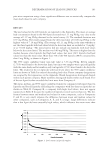
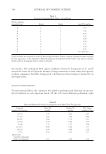
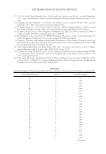
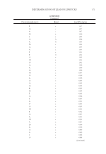
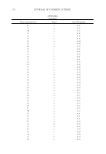
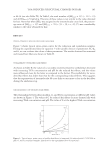
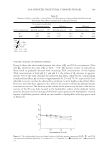
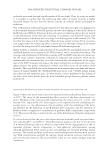
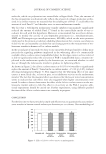
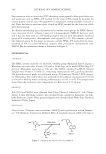
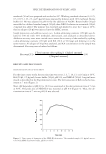
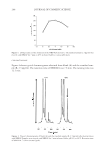
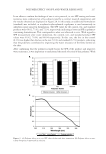
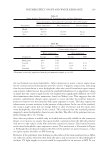
TGA-INDUCED STRUCTURAL CHANGES IN HAIR 193 Figure 10 shows the relationship between the wet initial modulus, Ew, observed for the reoxidized hair fi bers, and TGA concentration at different pH values. The curves are very similar to the patterns obtained for the relationships of the shear modulus, G, and the shape factor, κ, with TGA concentration (see Figures 4 and 7). It is suggested from these facts that the extension modulus of the hair fi ber in water is highly depen- dent on the small number of intermolecular SS cross-links located on the surface of the cystine-rich matrix proteins, i.e., 4.6 moles as cross-linking sites on the globular surface (15), which may play a role in the stabilization of the α-helix. In contrast, the type of intermolecular cross-links between IF, amounting to 3 moles of the rod domain and 8 moles of the terminal domain, is unlikely to be affected by the extension modulus, because as described above, the values of [SS]inter in reoxidized hair fi bers are essen- tially the same as that in the unreduced fi ber (untreated hair), except in highly re- duced cases (Figure 5). It has been reported that the extension modulus in water refl ects the mechanical stability against the deformation of the α-crystal and that sta- bility depends on not only the integrity of α-crystallites but also on the cross-link Figure 9. Stress–strain curves in water at 20°C for reoxidized hair fi bers after reduction treatments under different molar concentrations of TGA at (a) pH 8.7 and (b) pH 9.3. (1) untreated, (2) 0.3, (3) 0.5, (4) 0.75, (5) 1.0, and (6) 1.5. Figure 10. Relationships between initial modulus for hair fi bers in water, Ew, and TGA concentration at different pH levels: ( ) 8.7 and ( ) 9.3.
Purchased for the exclusive use of nofirst nolast (unknown)
From: SCC Media Library & Resource Center (library.scconline.org)