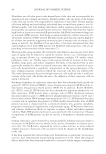
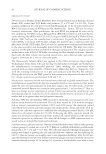
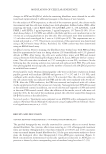
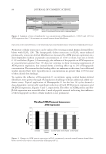
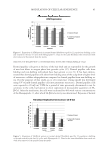
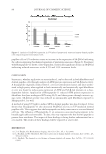
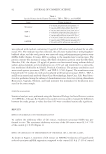
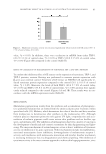
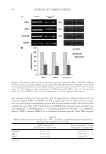
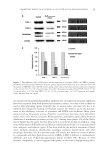
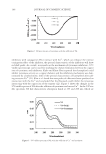
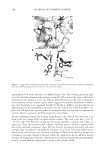
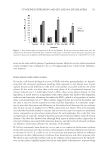
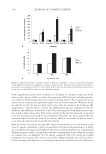
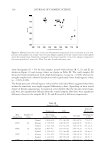
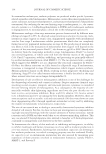
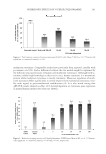
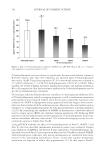
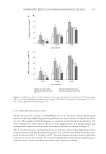
JOURNAL OF COSMETIC SCIENCE 142 N-feruloyldopamine was next shown to signifi cantly decrease total melanin content in B-16-F10 murine cells. Over 30% inhibition was observed when N-feruloyldopamine was used at 10 μM. Using linear regression, IC 50 in that model system was evaluated at 27.1 μM (% inhibition = −1.4758 × [N-feruloyldopamine] + 90.03 R² = 0.9045). Taken together, the results of human tyrosinase, mushroom tyrosinase, and melanin synthesis in B16 cells support the idea that tyrosinase inhibition by N-feruloyldopamine may be specifi c to mammalian-type tyrosinases. To investigate other mechanisms that may contribute to a melanogenesis inhibitory effect of N-feruloyldopamine, radical-scavenging properties as well as melanosome maturation gene regulation were evaluated. Indeed, one of the reactions catalyzed by tyrosinase is the oxidation of L -DOPA to dopaquinone using copper and molecular oxygen. Some antioxi- dants can thus interfere with the oxidation reaction. Moreover, other antioxidants such as vitamin C act as hypopigmenting agents by reducing intermediates of melanin polymers (24,25). By stimulating the synthesis of α-MSH in keratinocytes, ultraviolet-induced reactive oxygen species (ROS) also stimulate melanin production (26). Reducing ROS generation can thus help minimize melanin production. N-feruloyldopamine showed sig- nifi cant antioxidant effi ciency with around 70% of radical-scavenging activity for con- centrations equal to or higher than 30 μM. Using qRT-PCR methods, the effect of N-feruloyldopamine on Pmel17, MART-1, and Prot P—the best-described melanosome maturation genes—was evaluated. Despite poor inhibition of MART-1 and Protein P gene expressions, N-feruloyldopamine sig- nifi cantly decreased Pmel17 gene expression when used at 100 μM on cultured NHEM. Under physiological conditions, only mature melanosomes are transferred from mela- nocytes to the surrounding keratinocytes. Hence, factors that regulate melanosome maturation are expected to reduce skin pigmentation (27). In that respect, Pmel17 Figure 6. Effect of N-feruloyldopamine on Pmel17 mRNA level. qRT-PCR. Mean ± SD, n = 7. *Statisti- cally signifi cant vs. untreated control, p 0.05.

INHIBITORY EFFECTS OF N-FERULOYLDOPAMINE 143 plays a crucial role as structural proteins on which melanin deposits after production in the presence of MART-1 (9). In summary, our in vitro results show that N-feruloyldopamine, a molecule chosen for its structural analogies with the natural substrates and inhibitors of human tyrosinase, sig- nifi cantly decreased tyrosinase activity in NHEM as well as melanin synthesis in B16 cells. In addition, N-feruloyldopamine has demonstrated interesting antioxidant activity and a signifi cant ability to downregulate Pmel17 gene expression in NHEM, both of which may enhance the melanogenesis inhibition effect. In the absence of cytotoxicity at effi cient concentrations, N-feruloyldopamine represents an interesting alternative to the often-decried kojic acid, hydroquinone, and arbutin. ACKNOWLEDGMENT This work was funded by BASF Beauty Care Solutions France S.A.S. REFERENCES (1) P. J. Matts, B. Fink, K. Grammer, and M. Burquest, Color homogeneity and visual perception of age, health, and attractiveness of female facial skin, J. Am. Acad. Dermatol., 57(6), 977–984 (2007). (2) G. Prota, Regulatory mechanism of melanogenesis: Beyond the tyrosinase concept, J. Invest. Dermatol., 100, 156S–161S (1993). (3) D. S. Kim, S. H. Park, S. B. Kwon, E. S. Park, C. H. Huh, S. W. Youn, and K. C. Park, Sphingosylphos- phorylcholine-induced ERK activation inhibits melanin synthesis in human melanocytes, Pigment Cell Res., 19, 146–153 (2005). (4) H. Ando, H. Kondoh, M. Ichihashi, and V. J. Hearing, Approaches to identify inhibitors of melanin biosynthesis via the quality control of tyrosinase, J. Invest. Dermatol., 27(4), 751–761 (2007). (5) T. Hoashi, J. D. Muller, W. Vieira, F. Rouzaud, K. Kikuchi, K. Tamaki, and V. J. Hearing, The repeat domain of melanosomal matrix protein PMEL17/GP100 is required for the formation of organellar fi - bers, J. Biol. Chem., 28(30), 21198–21208 (2006). (6) H. Watanabe, J. C. Valencia, E. Le pape, and Y. Yamaguchi, Involvement of dynein and spectrin with early melanosome transport and melanosomal protein traffi cking, J. Invest. Dermatol., 128, 162–174 (2008). (7) T. Hoashi, H. Watabe, J. D. Muller, Y. Yamaguchi, W. Vieira, and V. J. Hearing, MART-1 is required for the function of the melanosomal matrix protein pmel17/GP100 and the maturation of melanosomes, J. Biol. Chem., 280(14), 14006–14016 (2005). (8) Y. Yamaguchi and V. J. Hearing, Physiological factors that regulate skin pigmentation, Biofactors, 35(2), 193–199 (2009). (9) G. Raposo and M.S. Marks, Melanosomes-dark organelles enlighten endosomal membrane transport, Nat. Rev. Mol. Cell. Biol., 8(10), 786–797 (2007). (10) N. Smit, J. Vicanova, and S. Pavel, The hunt of natural skin whitening agents, Int. J. Mol. Sci., 10, 5326–5349 (2009). (11) K. Maeda and F. M. Arbutin, Mechanism of its depigmenting action in human melanocytes culture, J. Pharmacol. Exp. Ther., 276(2), 765–769 (1996). (12) O. Nerya, J. Vaya, R. Musa, S. Izrael, R. Ben-Arie, and S. Tamir, Glabrene and isoliquiritigenin as tyrosinase inhibitors from licorice roots, J. Agric. Food Chem., 51(5), 1201–1207 (2003). (13) A. Khemis, A. Kajafa, C. Queille-Roussel, L. Duteil, and J. P. Ortonne, Evaluation of effi cacy and safety of rucinol serum in patients with melasma: A randomized controlled trial, Br. J. Dermatol., 156(5), 997–1004 (2007). (14) A. Greatens, T. Hakozaki, A. Koshoffer, H. Epstein, S. Schwemberger, G. Babcock, et al., Effective in- hibition of melanosome transfer to keratinocytes by lectins and niacinamide is reversible, Exp. Dermatol., 14(7), 498–508 (2005). (15) S. Okombi, D. Rival, S. Bonnet, A. M. Mariotte, E. Perrier, and A. Boumendjel, Discovery of benzyli- denebenzofuran-3(2H)-one (aurones) as inhibitors of tyrosinase derived from human melanocytes, J. Med. Chem., 49(1), 329–333 (2006).
Purchased for the exclusive use of nofirst nolast (unknown)
From: SCC Media Library & Resource Center (library.scconline.org)