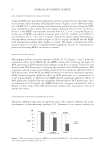
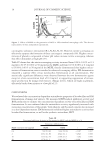
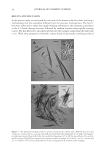
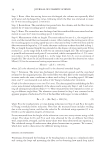
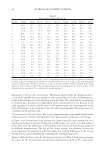
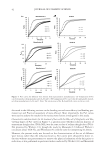
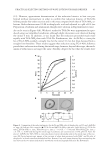
JOURNAL OF COSMETIC SCIENCE 24 cutting process that it was split into CuB and CuH, and CuB was further broken into CuB’ Figure 1(A). CuB’ was therefore recognizable as a small fl at substance having at least one jagged edge, being very similar in shape to the traditional Cu (2,9) cf. Diagram 2 (position: 3-i). On the other hand, CuH resembled the Co not only in shape but also in the richness of the fi brous substances (Mf) though the former part appeared to be more Table I Amino Acid Compositions of the Hollow Fibers and Whole Cuticle Amino acid Residues per 1000 amino acid residues Hollow fi ber from Hair III Whole cuticlea Cysteine + half Cysteine 155 180.8 Aspartic acid 54 32.4 Threonine 47 46.1 Serine 133 160.7 Glutamic acid 90 89.2 Proline 97 105.4 Glycine 93 88.4 Alanine 54 54.1 Valine 63 72.7 Methionine 1 4.6 Isoleucine 27 22.3 Leucine 52 44.6 Tyrosine 25 21.1 Phenylalanine 14 11.7 Lysine 39 34.4 Histidine 5 5.2 Arginine 36 26.4 aCited from reference 7. Figure 6. (A) The inner substances were squeezed out from hair (I) when the fi ber was heated in an aqueous solution of 6.4 M urea, 3.2 wt.% SDS and 20 wt.% ME at 80°C for 2 h staining with the Giemsa’s solution PL20× objective bar 50 μm. (B) The hollow fi ber PL20× objective bar 50 μm. Hair III was heated in 7 M urea, 3.5 wt.% SDS and 15 wt.% ME at 80°C for 7 h and subjected to the cutting process II silver staining (C) The cross section of the hollow fi ber bar 50 μm. Hair IV was heated in 7.6 M urea, 3.8 wt.% SDS and 5 wt.% ME at 80°C for 7 h, then subjected to the cutting process III Gentian violet staining. The wall is mainly consisted of the blade-like shaped parts (CuB) of the cuticular cells. The black amorphous substances on the inner surface of the wall are most likely the remnant of the handle-like shaped part (CuH) cf. Figure 9(B). The inset is the enlarged view of a part of the wall the small black spots may be melanin particles bar 5 μm.

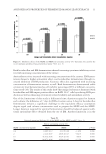
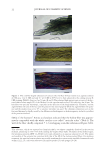
NEW ASPECTS OF THE STRUCTURE OF HUMAN HAIR 25 easily stained with Congo red than Co Figures 1(A) and 2 cf. Diagram 1 (position: 2-m vs. 8-m). By the way, honeycomb-like and overlapping scale-like patterns were observed in the inner and outer surfaces of the CuB region, respectively Figure 8 cf. Diagram 1 (position: 9-a and 9-f). A formation of these unique patterns is further discussed below. CUTICULAR THIN PLATE The present study indicated defi nitely the presence of a thin plate (CuP 0.4–0.6 μm in thickness) in the Cu region Figures 9(A), 9(B), and 10 cf. Diagram 1 (position: 9-e) and Diagram 2 (3-a and 4-g). CuP was a transparent material and its presence was revealed only by means of phase contrast microscopy conversely, CuP was neither colored by polarized light microscopy nor stained with the dyes such as CBB and Gentian violet. When the infants’ hair (I and II) were treated with the high concentrations of ME or for a long reaction time, CuP was isolated as a transparent fi lm-like substance Figure 9(C). Though the formation of CuP has not been explained well, it is conceivable that CuB fuse partially with the neighboring ones to build the honeycomb-like structure [Figure 8(A) and 8(B)], gradually merging into the single thin plate in the boundary zone between CuB and CuH. In fact, many merging sites were spotted in the inner surface of CuP see, for example, the site marked by the gray circle of Figure 10(A). By the way, CuP was extremely tolerant to heating in the aqueous solution of 20 wt.% ME. The hollow fi ber [Figure 6(B)] should not be stable without CuP in other words, the hollow structure may be decomposed if the wall were merely constituted from the overlapping Cu. It would Figure 7. The hand-like-shaped part (CuH) of the Cu was attached on the outer surface of the blade-like- shaped part (CuB) bar 40 μm. The black line-framed area is enlarged to give the inset. The CuB in these pictures appears to be somewhat short in length, presumably because a tip portion of the complete form was shaved off in the cutting process. Hair IV was heated in 8 M urea and 4 wt.% SDS (without ME) at 60°C for 6 h, followed by the cutting process III SM staining.
Purchased for the exclusive use of nofirst nolast (unknown)
From: SCC Media Library & Resource Center (library.scconline.org)