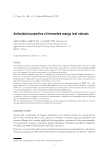
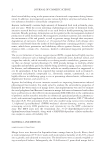
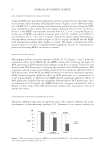
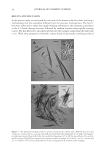
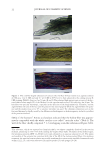
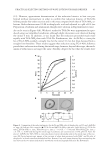
JOURNAL OF COSMETIC SCIENCE 26 also be deduced that the inner components of hair including the Co and medulla are physicochemically protected, at least to some extent, from the outside circumstance by the presence of CuP. MEDULLA This component has been considered for a long time as a loosely packed assembly of the cellular disks connected in series (1,3,31). Nevertheless, it was suggested in the present Figure 9. A cuticular thin plate (CuP) exists in between the regions of the blade-like shaped parts (CuB) and the handle-like shaped parts (CuH) of the Cu. (A) Hair III was heated in an aqueous solution of 7.4 M urea, 3.7 wt.% SDS and 8 wt.% ME at 50°C for 2 h and subjected to the cutting process II CBB staining PLL40× objective bar 50 μm. As observed in this panel, the CuB region was usually paired with the CuH region presumably because both regions were linked to each other through CuP. (B) Part of the Cu region PLL40× objective bar 50 μm. CuP is seen as a transparent substance between the CuB and CuH regions in the phase contrast microscopy. The hair III was treated as mentioned in the panel A, except for the cutting process III and double staining with CBB and Gentian violet. (C) Part of an isolated CuP PL20× bar 50 μm. Hair II was heated in an aqueous mixture of 7 M urea, 3.5 wt.% SDS and 15 wt.% ME at 80°C for 3 h and sub- jected to the cutting process III staining with Giemsa’s solution. Figure 8. (A) A honeycomb-like pattern in the inner surface of the region of the blade-like shaped parts (CuB) of the Cu PLL40× objective bar 50 μm cf. Diagram 1 (position: 9-a). (B) A so-called “scale” pattern was seen when the reverse side of the CuB region (of the panel A) was focused on note that the tiling direc- tion was opposite between the panels A and B. The specimens of both panels were prepared by heating hair IV in an aqueous mixture of 7 M urea, 3.5 wt.% SDS and 15 wt.% ME at 80°C for 7 h, followed by the cut- ting process III Gentian violet staining.

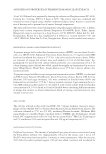
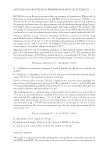
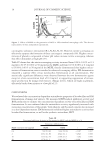
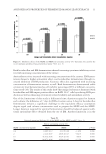
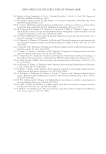
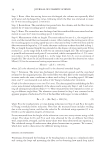
NEW ASPECTS OF THE STRUCTURE OF HUMAN HAIR 27 Figure 10. The honeycomb-like structure on the cuticular thin plate (CuP) PLL40× objective bar 50 μm cf. Figure 8. The pictures of the panels A and B were taken by focusing on the inner and outer surfaces of the plate, respectively. The gray circle in the panel A shows an example of the fusing sites of the blade-like shaped parts (CuB) of the Cu. The specimen was prepared by heating hair I in an aqueous mixture of 7 M urea, 3.5 wt.% SDS and 15 wt.% ME at 80°C for 2 h, then subjected to the cutting process III staining with Giemsa’s solution. Figure 11. (A) The medulla as a tubular substance with the wall of 1–2 μm in thickness cf. the image was enhanced using the color development software PL20× bar 30 μm. Hair III was heated in an aqueous mix- ture of 6.3 M urea, 3.4 wt.% SDS and 13 wt.% ME at 80°C for 6 h, then subjecting to the cutting process II double staining with CBB and Giemsa’s solution. (B) The medulla’s wall and the blade-like shaped parts (CuB) of the Cu bar 25 μm. It appears that the cortical cells and the handle-like shaped parts (CuH) were partially lost from the hair fi ber during the preparation of the specimen. Hair IV was warmed in an aqueous mixture of 0.3 wt.% Congo red and 0.08 wt.% SDS (without ME) at pH 5 and 65°C for 30 min, washed with water, then subjected to the cutting process III. study that the medulla was a tubular substance with a wall-like coating Figure 11 cf. Diagram 1 (position: 3-e). It was also found that the medulla, like CuB, CuP, and hollow fi ber, was stable to severe chemical treatments for instance, heating in an aqueous solu- tion of 20 wt.% ME at 50°C–80°C for 8–12 h. All of the hair samples (I–IV) showed that the medulla continuously streamed through in the center of the shaft. We have been in- vestigating the physicochemical property of the medulla and will be reported later.
Purchased for the exclusive use of nofirst nolast (unknown)
From: SCC Media Library & Resource Center (library.scconline.org)