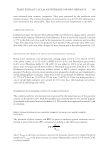
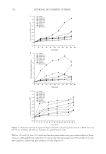
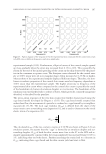
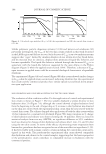
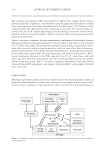
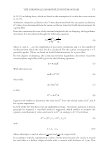
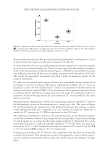
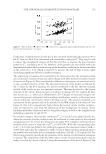
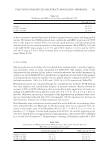
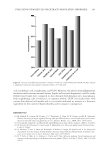
RHEOLOGICAL AND SENSORY PROPERTIES OF PETROLEUM-BASED COSMETIC CREAM 165 of the sample. Previous studies have shown that emulsions structured with xanthan gum were less affected by increasing probe speed or the container’s diameter during texture analysis due to the shear thinning behavior of this polysaccharide (21–23). The over- shoot behavior of G″ suggests that clusters of globules in the experimental skin cream potentially interact with each other and undergo structural rearrangement under shear (33), and such interaction is enhanced at higher frequencies, leading to an increased G″ overshoot. On the other hand, the yield stress observed from the control petroleum- based skin cream can be caused by its three-dimensional network structure that resists fl ow (28,34). However, the overshoot of G″ was independent of frequency and no struc- tural rearrangement took place upon the application of shear. Additionally, the higher frequency dependency of the yield point of the experimental skin cream than the control is possibly caused by its bigger droplet size, as higher force is needed to break or move larger droplets to reach a liquid-like fl ow behavior. A consequence of these differences in rheological properties was the noticeable difference in skin feel of the samples, as determined by sensory evaluation (27). Comments from panelists showed that the experimental lotion was harder to spread at the beginning but became “thinner” after a few rubs. Such skin feel of the experimental skin cream is pos- sibly attributed to its higher G′ at increased frequency but lower yield point, making it more elastic and harder to spread at fi rst, however, becoming thinner than the control sample after the yield point. On the other hand, no structural rearrangement took place in the control skin cream, making it easier to spread during the fi rst few rubs. The shape of Lissajous curve demonstrates the onset of plastic response with increasing strain amplitude (35). Measurements obtained at lower frequencies are able to refl ect more recovery of the material under shear compared with curves obtained at higher fre- quencies (36). Therefore, Lissajous curves obtained at 0.05 Hz for the two samples were compared in Figure 4. Both the skin creams showed narrow elliptical Lissajous patterns at strain amplitudes of 0.1% and 1% (Figure 4A and B), indicating that they were both in the LVR and had similar solid-like behavior (33). As the strain amplitude was in- creased to 10% (Figure 4C), the Lissajous curve of the control sample was still in an el- liptical shape, but showed a larger internal area (i.e., opened up) than those at lower frequencies. On the other hand, Lissajous curves of the experimental sample became Figure 3. (A) Storage modulus (G′) and loss modulus (G″), (B) yield point, and (C) G″ overshoot after the yield point obtained in the linear region measured at the frequencies from 0.05 to 1.0 Hz.

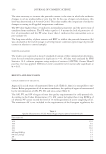
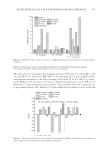
JOURNAL OF COSMETIC SCIENCE 166 tilted, adopting a rectangular shape with sharper angles at higher strains. Such changes in the shape of the Lissajous curves suggest that they were in a transition stage from linear to non-LVR and both skin creams were transforming from a gel-like solid to a yield fl uid (36). The faster opening-up of the experimental sample suggests that it behaves like a plastic material at lower strains than the control sample. Nonlinear behavior was clearly observed at 100% strain in both samples (Figure 4C), where the rectangular Lissajous curves suggested yield fl uid properties (36). Both skin lotions are described as gel like, with a weak strain overshoot. Their rectangular Lissajous curves are likely caused by the sliding of layers of emulsion droplets upon the application of shear which results in the breaking down of the emulsion structure (32). Upon further increase of the strain to 1000% and higher frequencies (Figure 4E and F), the experimental sample remained as a yield fl uid, indicated by rectangular Lissajous plots however, the control sample became more liquid like as suggested by elliptical curves with large internal areas (32,36,37). Normalized Lissajous curves of the skin creams obtained at various strains and determined at different frequencies are presented as Pipkin diagrams (Figure 5). The experimental sample (Figure 5A) was in the LVR at frequencies of 0.1–1.00 Hz under 0.1–1.0% strain, refl ected by narrow elliptical Lissajous curves. At 0.1% strain and frequencies between 0.25 and 1.00 Hz, saw-like curves were observed, which are possibly caused by low signal-to-noise ratio. Increasing the strain to 10%, caused the narrow elliptical curves of the experimental sample to open up, and sharp angles were formed at high strains, indi- cating that the sample shifted to the non-LVR. At 100% strain and 0.05 Hz, the experi- mental sample showed rectangular Lissajous curves, however, at higher frequencies the curves remain tilted. The yield liquid properties are therefore frequency dependent and are observed at lower % strain when measured at low frequencies. Increasing the strain on the experimental sample to higher than 1000%, caused the Lissajous curves to adopt a rectangular shape, but became wavy at frequencies higher than 0.5 Hz, suggesting pos- sible sliding or breaking of the emulsion structure, as observed in previous results. For the control skin cream, a similar Pipkin diagram was observed (Figure 5B). However, the narrow elliptical curve started to open up at 1% strain, earlier than that of the Figure 4. Lissajous curves of lotion samples measured at fi xed frequency (0.05 Hz) at (A) 0.1%, (B) 1%, (C) 10%, (D) 100%, and (E) 1000% strain.
Purchased for the exclusive use of nofirst nolast (unknown)
From: SCC Media Library & Resource Center (library.scconline.org)