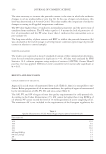
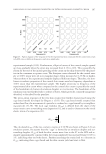
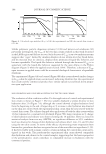
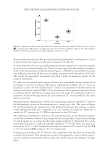
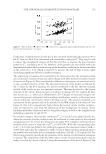
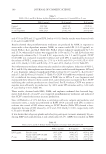
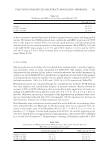
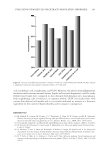
THE TORSIONAL LOSS MODULUS IN HUMAN HAIR 181 “repair” treatment (WBS-sample) is small for G′cu, the corresponding value of G″cu increases well beyond the value for virgin hair. This not only indicates that the “repair” agent improves the overall structural integrity of the cuticle but also introduces through its components, possibly, namely, through the polymer content a strong viscous compo- nent, which contributes to the increase of G″cu. CONCLUSIONS Using the values for the storage modulus, G′ and the logarithmic decrement Λ as param- eters obtained from the free torsional oscillation experiment on hair the values for the loss moduli G″ were determined. The raw data show a rather low discriminative power be- tween the different samples, despite their rather strong chemical pretreatment. This can be attributed to a strong component of variance due to the systematic decrease of G″ with fi ber moment of inertia. This decrease is associated with a decrease of the area fraction of the cuticle in the fi ber cross-section, when the fi bers get thicker. The effect is accounted for by a core/shell model for the cortex/cuticle structure of hair, yielding satisfactory coef- fi cients of determinations. These model fi ts may be used, with due caution with respect to Type I errors, to improve the discriminative power for G″ measurements, when inves- tigating hair samples with different processing histories. The more speculative aspects of the investigation relate to the determination of the loss moduli for cortex and cuticle. While the determination of G″co proved to be unsuccessful, values for G″cu show overall consistency. The distinct and plausible differences between the loss moduli for the cuticle for the samples support previous suggestions (3) that torsional measurements in the appropriate model context are a very sensitive tool to assess changes of the properties of the hair cuticle through cosmetic processes and ingredients, in line with expectations by Robbins (13). In conclusion and in agreement with Bogaty’s (1) considerations, it is sug- gested that imparting the appropriate balance of torsional storage and loss moduli in hair by cosmetic processes and products will make a major contribution to their ability to control the dynamic movement of a hair style in line with consumer expectations. ACKNOWLEDGMENTS The authors are indebted to Mr. J. Karwey, who through his BSc thesis provided the data basis for our investigation. The thesis was prepared in the context of a collaboration between the University of Applied Sciences of Suedwestfalen (Germany) and Cognis GmbH (now BASF Personal Care and Nutrition GmbH), Duesseldorf (Germany). Table I Estimates for the Loss Moduli of Cortex (G″co) and Cuticle (G″cu) Together with their 95% Confi dence Limits, as Obtained by Fits of Equation (9) to the Data in Figure 4 Sample G″co, GPa G″cu, GPa r2 G′co, GPa G′cu, GPa V (69) 0 ± 0.005 0.08 ± 0.01 0.722 0.61 3.60 WB (56) 0 ± 0.004 0.046 ± 0.004 0.600 0.40 4.84 WBS (23) 0 ± 0.009 0.11 ± 0.08 0.733 0.37 4.63 The number of measurements for each sample is given in brackets. r2 are the coeffi cients of determination for the fi ts. Furthermore, values for the storage moduli for cortex (G′co) and cuticle (G′cu) are given (3) to aid the discussion.

JOURNAL OF COSMETIC SCIENCE 182 REFERENCES (1) H. Bogaty, Torsional properties of hair in relation to permanent waving and setting. J. Soc. Cosmet. Chem., 18, 575–589 (1967). (2) BS EN ISO 6721-1, Plastics—Determination of Dynamic Mechanical Properties. Part 1: General Principles. [BSI (British Standards Institution)], London, UK, (2011). (3) F. J. Wortmann, G. Wortmann, H.-M. Haake, and W. Eisfeld, Analysis of the torsional storage modulus of human hair and its relation to hair morphology and cosmetic processing, J. Cosmet. Sci., 65, 59–68 (2014). (4) D. Persaud and Y. K. Kamath, Torsional method for evaluating hair damage and performance of hair care ingredients, J. Cosmet. Sci., 55, S65-S77 (2004). (5) BS EN ISO 6721-2, Plastics—Determination of Dynamic Mechanical Properties. Part 2: Torsion-Pendulum Method. [BSI (British Standards Institution)], London, UK, (2008). (6) F. I. Bell, P. Carpenter, and S. Bucknell, Advantages of a high-throughput measure of hair fi ber torsional properties, J. Cosmet. Sci., 63, 81–92 (2012). (7) R. J. Roark, Formulas for Stress and Strain (McGraw-Hill Book Co., New York, NY, 1965). (8) B. E. Read and G. D. Dean, The Determination of Dynamic Properties of Polymers and Composites (Adam Hilger Ltd., Bristol, UK, 1978). (9) T. A. Dankovich, Y. K. Kamath, and S. B. Ruetsch, Tensile properties of twisted hair fi bres, J. Cosmet. Sci., 55, S79-S90 (2004). (10) D. L. Harper and Y. K. Kamath, The effect of treatments on the shear modulus of human hair measured by the single fi ber torsion pendulum, J. Cosmet. Sci., 58, 329–337 (2007). (11) D. L. Harper, C. J. Qi, and P. Kaplan, Thermal styling: Effi cacy, convenience, damage tradeoffs, J. Cos- met. Sci., 62, 139–147 (2011). (12) L. J. Wolfram and L. Albrecht, Torsional behaviour of human hair, J. Soc. Cosmet. Chem., 36, 87–99 (1985). (13) C. R. Robbins, Chemical and Physical Behavior of Human Hair, 5th Ed. (Springer Verlag, Heidelberg, GER, 2012). (14) D. G. Phillips, Effects of humidity, ageing, annealing, and tensile loads on the torsional damping of wool fi bres, Text. Res. J., 57, 415–420 (1987). (15) F. J. Wortmann, B. J. Rigby, and D. G. Phillips, Glass transition temperature of wool as a function of regain, Text. Res. J., 54, 6–8 (1984). (16) F. J. Wortmann, M. Stapels, R. Elliott, and L. Chandra, The effect of water on the glass transition of human hair, Biopolymers, 81, 371–375 (2006). (17) P. Nordon, A damping maximum in the free torsional oscillation of wool fi bres, J. Appl. Polym. Sci., 7, 341–346 (1963). (18) M. Druhala and M. Feughelman, Dynamic mechanical loss in keratin at low temperature. Colloid & Polym. Sci., 252, 381–391 (1974). (19) M. Jeong, V. Patel, J. M. Tien, and T. Gao, DMA study of hair viscoelasticity and effects of cosmetic treatments, J. Cosmet. Sci., 58, 584–585 (2007). (20) F. J. Wortmann, M. Stapels, and L. Chandra, Humidity-dependent bending recovery and relaxation of human hair, J. Appl. Polym. Sci., 113, 3336–3344 (2009). (21) R. J. Young and P. A. Lovell, Introduction to Polymers, 3rd Ed. (CRC Press, Boca Raton, FL, 2011). (22) Y. Leray and N. Winsey, Torsional Properties of Single Hair Fibres in Relation to Ethnicity, Damage and Other Modes of Deformation (6th Int. Conf. Appl. Hair Sci., Princeton, NJ, 2014). (23) J. Jachowicz, Hair damage and attempts to its repair, J. Soc. Cosmet. Chem., 38, 263–286 (1987). (24) M. Gamez-Garcia, Cuticle decementation and cuticle buckling produced by Poisson contraction on the cuticular envelope of human hair, J. Cosmet. Sci., 49, 213–222 (1998). (25) M. Gamez-Garcia, Cracking of human hair cuticles by cyclical thermal stresses, J. Cosmet. Sci., 49, 141–153 (1998). (26) J. I. Dunlop, Dynamic mechanical properties of rhinoscerous horn keraton in the frequency range 2-20 KHz, Text. Res. J., 42, 381–385 (1972). (27) G. Danilatos and M. Feughelman, The internal dynamic mechanical loss in α-keratin fi bers during moisture sorption, Text. Res. J., 46, 845–846 (1976). (28) G. Danilatos and R. Postle, The time-temperature dependence of the complex modulus of keratin fi bres, J. Appl. Polym. Sci., 28, 1221–1234 (1983).
Purchased for the exclusive use of nofirst nolast (unknown)
From: SCC Media Library & Resource Center (library.scconline.org)