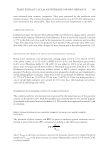
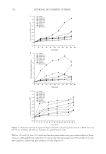
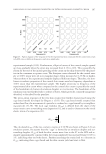
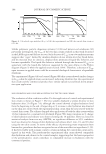
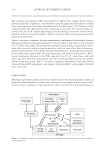
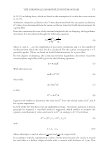
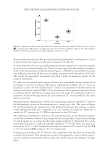
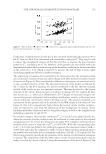
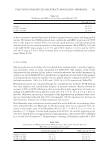
RHEOLOGICAL AND SENSORY PROPERTIES OF PETROLEUM-BASED COSMETIC CREAM 167 experimental sample (10%). Furthermore, elliptical curves of the control sample opened up more gradually when the strain was increased from 0.1% to 10%. This is possibly the reason for the ease of the initial spreading of the cream on the skin observed by the panel- ists in the consumer acceptance tests. The Lissajous curves observed for the control sam- ple at 100% strain were all in rectangular shapes when measured at 0.25 Hz or higher, whereas those of the experimental samples displayed different shapes. Therefore, the non- linear viscoelastic properties of the control skin cream were less frequency dependent at 100% strain than the experimental sample. The higher sensitivity to frequency of the experimental skin cream when compared to the control skin cream is possibly the result of the breakdown of clusters of emulsion droplets in its structure. The breakdown of the emulsion structure further leads to release of water, which provides a smooth (nongreasy) after-feel, as described by the panelists. The stress–strain responses of the two skin creams were further characterized using the cage-based model developed by Rogers et al.(31) The cage-based model assumes that under shear fl ow, the movement of a particle is confi ned in a cage formed by its neighbor- ing particles (31,38). The local cage modulus (Gcage) is defi ned from the slope of the stress–strain curve at vanishing stress [equation (1)], and is used to characterize the initial elastic strain of a suspension (31). σ=0 γ = dσ Gcage d (1) The calculated Gcage of the two cosmetic creams at 0.50 Hz are shown in Figure 6. In an emulsion system, we assume that the “cage” is formed by an emulsion droplet and sur- rounding droplets. Gcage of both the skin creams were close to the G′ in the LVR and re- mained approximately constant when the strain amplitude was increased from 0.01% to 1%, indicating they are both elastic. Further increasing the strain lead to a decrease in Gcage, indicating these cages break and the skin creams yield and start to fl ow. Figure 5. Pipkin diagram of the response of (A) the experimental skin cream and (B) the control skin cream to LAOS stress at different frequencies and stress amplitudes.

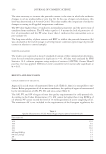
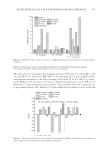
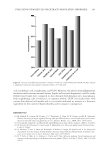
JOURNAL OF COSMETIC SCIENCE 168 Unlike polymeric particle dispersion systems (31,38) and water-in-oil emulsions (36) previously investigated, the Gcage of the two skin creams studied in this work decreased in the LAOS region and did not recover. Such decrease of Gcage in an o/w emulsion systems suggests that “cages” formed by emulsion droplets do not reform after they break down, and the material loses its elasticity, displays more pronounced liquid-like behavior, and becomes spreadable. The liquid-like behavior inferred through the decreased Gcage is in agreement with the liquid-like behavior suggested by the open ellipse in the Pipkin diagram (Figure 5) when the applied strain exceeds 100%. Therefore, a decrease of Gcage upon increases in applied strain could be an essential rheological characteristic of spreadable emulsions. The experimental (Figure 6A) and control (Figure 6B) skin creams showed similar changes in Gcage when the applied strain was increased, indicating therefore that the experimental skin cream and the commercial product have similar spread out and break down proper- ties upon application. SKIN HYDRATION AND CONSUMER ACCEPTANCE OF THE TWO SKIN CREAMS The evaluation of skin condition within 2 h after application of control and experimental skin creams is shown in Figure 7. The two samples displayed a similar decrease in skin hydration after 2 h (Figure 7A), although the control showed a higher hydration level from the beginning to the end. A larger drop in % increase in skin hydration was observed on the skin area treated with the experimental skin cream than the area treated with the control skin cream. The oiliness dropped after application of both the skin creams within 1 h but remained at a constant level afterward (Figure 7B). Large variations in % change of skin hydration and oiliness were observed among the 10 panelists. However, based on statistical analysis from two-way ANOVA, no signifi cant difference at 95% confi dence level was observed in changes of skin hydration and oiliness after 1 min, 1 h, and 2 h after using the two skin creams. In terms of the effi cacy of preventing water evaporation from human skin, petrolatum has been recognized as one of the most effective ingredients (1,39). It has been widely used in many cosmetic creams including the control skin cream inves- tigated in this work. The petroleum-free experimental skin cream showed comparable skin hydration and oiliness to the control samples, suggesting that the barrier properties of the petroleum-free cream contribute to comparable increase in hydration with the commercial product. Figure 6. Calculated cage modulus (Gcage) of (A) the experimental and (B) the control skin cream at 0.50 Hz.
Purchased for the exclusive use of nofirst nolast (unknown)
From: SCC Media Library & Resource Center (library.scconline.org)