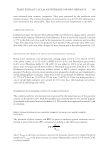
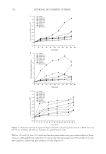
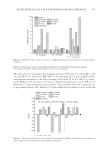
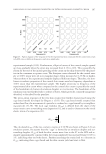
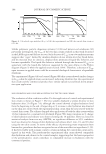
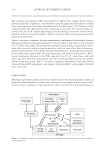
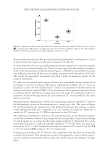
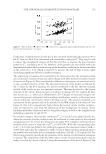
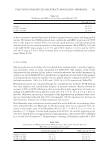
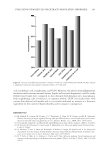
THE TORSIONAL LOSS MODULUS IN HUMAN HAIR 179 Coeffi cients of determination for the fi ts of the core/shell model through equation (9) to the G″ data (see Table I) are substantial and comparable to those for G′. They may be used to reduce the unexplained variance of the data and thus to improve the discriminative power for G″, similarly as for G′ (3). However, in the present case, this would need to be implemented with added caution in view of the boundary condition for the loss modulus of the cortex (G″co ≥ 0), which is expected to increase the risk of Type I errors, when identifying signifi cant differences between samples. The application of equation (9) is justifi ed by the observation that the torsional moduli are not material constants of hair, but rather change with fi ber diameter or rather moment of inertia (see Figure 4). This is attributed to differences of properties of cortex and cuticle in the core/shell structure of hair. The observed limitation of the model, as refl ected by the r2 values for the fi t of equation (9), may be attributed to the fact that the torsional moduli of the cuticle are not true material constants. This may be related to the layered structure of the cuticle, which in practice is subject to damage (23,24), namely, by ther- mal stresses as, e.g., refl ected in delamination (25). Changes of structural integrity are expected to generate substantial and overriding contributions, namely, to frictional inter- actions within the cuticle layers, which will impact on G″. This may be considered as an explanation for the apparent lack of fi t, namely, for the WB sample at low values of I (see Figure 4), that is for comparatively high-volume fractions of cuticle. Further complica- tions are expected to arise from the limitations of the assumptions of constant cuticle thickness with fi ber diameter as well as along fi ber length, as well as the simplifi cations underlying equations (3) and (9) (7). For all three samples, the boundary condition G″co ≥ 0 needed to be applied for the fi ts, where the necessity for this condition may be attributed to some extent to the required extrapolation to I→. Given this restriction, the upper 95% confi dence limit for the loss modulus of the cortex in virgin hair is G″co = 0.005 GPa. With the corresponding value of G′co = 0.61 GPa (see Table I) this yields with equation (6) a maximum value of tanδco = 0.008. This value may be compared to tanδ = 0.022 of rhinoceros horn perpendicular to the growth direction under not too dissimilar conditions (110 Hz, 5.2% regain) (18). For this testing geometry, specifi cally the properties of the matrix, are determined, analogous to torsion. The comparison of the data shows that even the calculated maximum value for tanδco is too low by a factor of about 3 using the extrapolation of the data in Figure 4. The Figure 3. Plot of Λ data ( ) and G″ data ( ) versus G′ for virgin hair. Linear regression lines and the coef- fi cients of determination r2 are given.

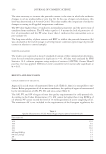
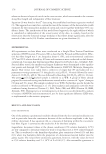
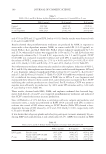
JOURNAL OF COSMETIC SCIENCE 180 fi ts on the basis of the core/shell model thus turn out to not be suitable to estimate the torsional loss modulus of the cortex. In contrast, tanδ – values for the cuticle with the applicable values for G″cu and G′cu (see Table I) yield a range of tanδ = 0.01–0.02, in acceptable agreement with expectation values for keratins for roughly comparable conditions (18–20,26–28). This gives some support for the overall validity of the estimated G″cu values in the absence of reference values. Because of the systematic decrease of G″ with I, the estimates for G″cu are substantially higher than the G″ means, though they follow the same pattern for all samples. The over- all behavior for G″cu is as to be expected for a material below the glass transition, in that G″cu decreases with an increase of G′cu for a sample and vice versa. The G″ value is reduced by a factor of about 2 compared to the virgin hair through the chemical processing of reduction and oxidation (WB), in line with considerations of in- creased stiffness and brittleness of the cuticle (3). Although the effect of the additional Figure 4. G″ versus polar moment of inertia for virgin (A:V), perm-waved and bleached (B: WB), and ad- ditionally shampoo-treated (C: WBS) hair. Solid lines are based on the fi t of equation (9).
Purchased for the exclusive use of nofirst nolast (unknown)
From: SCC Media Library & Resource Center (library.scconline.org)