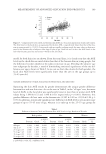
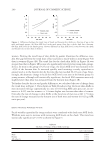
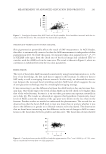
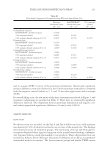
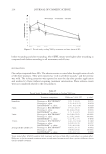
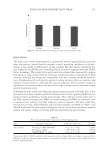
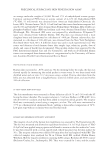
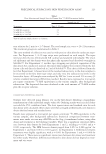
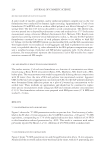
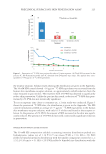
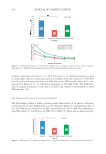
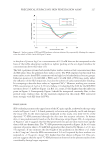
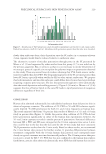
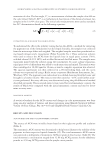
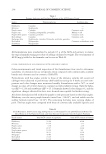
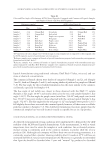
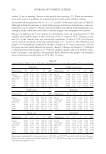
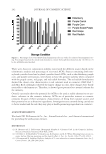
EVALUATE SKIN DISINFECTANT SPRAY 215 DISCUSSION The pilot study results demonstrated a signifi cantly more stinging/burning sensation from the positive control than the negative control providing confi dence in the reli- ability of this model to differentiate on this variable. The skin barrier disruption was also verifi ed by the TEWL after wounding which increased compared with the TEWL before wounding. The results of the pilot study also showed that numerically a higher proportion of subjects preferred the prototype disinfectant spray formulation to both controls, although the liking was comparable with the currently marketed formula- tion. A higher proportion of subjects reported cooling sensation relative to positive and negative control products. Although the sensory endpoints did not achieve statistical signifi cance, the observed effect size was used to help to design and calculate the sample size for the pivotal study. Following the pilot study and additional inhouse sensory research on healthy skin, it was decided to use a more sensitive and well-validated scale to detect potential differences in product sensory performance for the pivotal study. Three different rating scales such as the VAS, numerical rating scale (NRS), and verbal rating scale (VRS) are commonly used to measure pain, itching, and other subjective sensory responses. All these scales have been proven to have a high reliability and concurrent validity, and NRS-11, VRS-7, and VAS all worked well for pain intensity evaluation (18,19). To maintain consistency between clinical and sensory studies, a 100 mm VAS was selected for the pivotal study. Figure 3 . Pivotal study overall liking score by treatment (mean ± SE). Table V Pivotal Study Treatment Comparison on Overall Liking Score Time Treatment comparison Differencea (95% CIa) p-valuea After 15 min Prototype vs. BACTROBAN® 0.22 (-0.17, 0.62) 0.2663 Prototype vs. Saline 0.38 (-0.01, 0.78) 0.0561 BACTROBAN® vs. Saline 0.16 (-0.23, 0.56) 0.4169 a From mixed effect ANOVA analysis with treatment and site as fi xed effects and subject as random effect. Difference is the fi rst named treatment minus second named treatment such that a positive difference favors the fi rst named treatment.

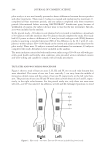
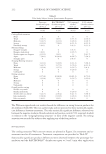
JOURNAL OF COSMETIC SCIENCE 216 Earlier market research had indicated that the addition of cooling attributes to the exist- ing BACTROBAN® disinfectant spray was desirable by consumers. In the pivotal study, although there was a signifi cant increase in consumer perceived cooling from the proto- type formulation, this did not correspond to a signifi cant increase in overall product lik- ing for the prototype compared with the existing marketed product in this study. CONCLUSIONS Experimental wound models are an effective means of evaluating sensory characteristics of disinfectant sprays. The prototype formulation containing a cooling agent delivered signifi cantly more cool- ing sensation than both BACTROBAN® disinfectant spray and the negative control product on experimental wounds at 3 and 5 min after product application, and overall for a 15-min period after application. No statistically signifi cant differences in product liking were observed between the pro- totype disinfectant spray compared with BACTROBAN® disinfectant spray formula- tions or negative control product. The prototype disinfectant spray, BACTROBAN® disinfectant Spray, and control prod- ucts were well-tolerated in these studies. ACKNOWLEDGMENTS This study was sponsored by GlaxoSmithKline (China) Investment Co., Ltd. Hereon we give our sincere thanks to all the subjects, investigators, and healthcare providers who had been involved in this clinical trial. The authors would also like to thank Alex Selmani (statistician) for his input to the original pilot study and report and MMR for their sen- sory expertise. REFERENCES (1) E . Proksch, J. M. Brandner, and J. M. Jensen, The skin: An indispensable barrier, Exp. Dermatol., 17(12), 1063–1072 (2008). (2) K . C. Madison, Barrier function of the skin: “la raison d’être” of the epidermis, J. Invest. Dermatol., 121(2), 231–241 (2003). (3) J. G. Thomas, and S. L. Percival, Indigenous microbiota and association with the host, in Microbiology and Aging: Clinical Manifestations, S. L. Percival, Ed. (Humana Press, New York, 2008), pp. 15–38. (4) S. L. Percival, C. Emanuel, K. F. Cutting, and D. W. Williams, Microbiology of skin and role of bio- fi lms, Int. Wound J., 9, 14–32 (2011). (5) J. S. Boateng, K. H. Matthews, H. N. E. Stevens, and G. M. Eccleston, Wound healing dressings and drug delivery systems: A review, J. Pharm. Sci., 97(8), 2892–2923 (2008). (6) A. Gravett, S. Sterner, J. E. Clinton, and E. Ruiz, A trial of povidone-iodine in the prevention of infec- tion in sutured lacerations, Ann. Emerg. Med., 16(2), 167–171 (1987). (7) T. Kunisada, K. Yamada, S. Oda, and O. Hara, Investigation on the effi cacy of povidoneiodine against antiseptic-resistant species, Dermatology, 195(Suppl 2), 14–18 (1997). (8) B. Marple, P. Roland, and M. Benninger, Safety review of benzalkonium chloride used as a preservative in intranasal solutions: An overview of confl icting data and opinions, Otolaryngol. Head Neck Surg., 130(1), 131–141 (2004). (9) Un ited States Food and Drug Administration, Topical anti-microbial drug products for over-the-counter human use tentative fi nal monograph for fi rst aid antiseptic drug products Docket No. 75N-183F.
Purchased for the exclusive use of nofirst nolast (unknown)
From: SCC Media Library & Resource Center (library.scconline.org)