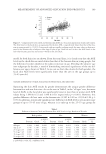
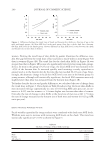
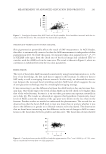
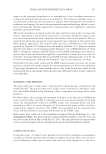
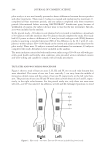
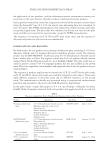
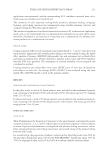
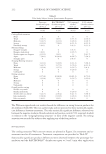
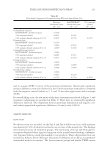
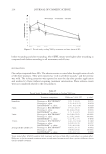
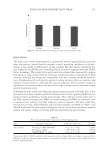
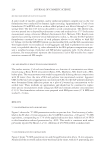
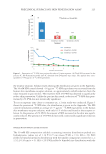
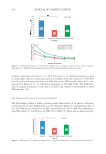
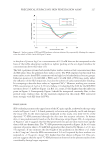
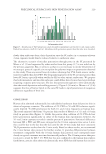
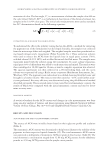
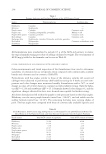
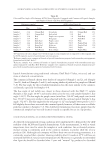
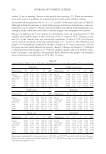
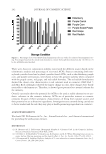
MEASUREMENT OF ADVANCED GLYCATION END-PRODUCTS 201 INFLUENCE OF PIGMENTATION ON SKIN AGE LEVEL Skin pigmentation potentially affects the result of SAF measurement. In AGE Reader, this effect is automatically corrected so that the AGE measurement is independent of skin pigmentation level. To verify this point, we measured skin color parameters (L*, a*, b*) in CIELAB color space from the cheek area of the facial image and calculated ITA° to correlate with the AGE levels in the same area. The result is shown in Figure 6, where no correlation is exhibited between the two skin parameters. DISCUSSION The level of facial skin AGE measured noninvasively using bioinstrumentation is, to the best of our knowledge, the fi rst such data to appear in the literature. It adds new data to SAF study as well as antiaging skincare research. In this study, we observed the associa- tion between the increased facial wrinkling and skin AGE level, which suggests the use of anti-glycation technology may be a meaningful antiaging strategy. It was interesting to see the difference between the AGE levels in face and in inner fore- arm skin. One would expect the levels of skin AGEs in the left cheek to be higher than that of the volar forearm, because it is an area that gets more sun exposure naturally in one’s daily life. The results we obtained are opposite this hypothesis. Consistently, lower levels of AGEs across the majority of the age span were shown on the face than on the forearm. Further studies are needed to understand the phenomenon. The second fact we observed was that the facial AGE level in men was lower than in women whether it was due to the difference in gender or in lifestyle remains to be elucidated. The observation that we found most interesting was the difference in the rate of change in AGE accumu- lation in the facial skin between genders and skin sites. The facial skin of men showed Figure 5. Correlation between skin AGE level and facial wrinkles. Facial wrinkles increased with the in- crease in skin AGE levels. The correlation was statistically signifi cant. Figure 6 . Correlation between skin AGE level and skin pigmentation. The r2 was 0.0006 ( p = 0.726), virtu- ally no correlation between these two skin properties.

JOURNAL OF COSMETIC SCIENCE 202 highest rate of change among all conditions studied. It may owe to the difference in life style—males possibly being more active in outdoor activity with less conscientious daily skin care. Nevertheless, these results of facial skin AGEs open up new research directions in skin aging and anti-glycation studies. CONCLUSION This study shows for the fi rst time the in vivo skin AGE data of the human facial skin as measured by autofl uorescence using a noninvasive technique. It adds new data to skin aging research. The low AGE level observed in the facial skin did not support the reported phenomenon that solar irradiation increases dermal glycation unless a signifi cant differ- ence in antioxidant activity is evident (34-36). The faster increase in AGE level in the facial skin of men may be due to their lack of adequate skin care when compared with women. Further study in the difference of antioxidant activity between genders may help elucidate the mechanisms of facial skin glycation and aging process. ACKNOWLEDGMENTS The authors would like to thank Gopa Majmudar, Charles Hu, Greg Hillebrand, Rong Kong, Robin Ray, and Yulia Park for their help in various aspects including concept discussion, reference collection, and clinical study organization. REFERENCES (1) R. Meerwaldt, R. Graaff, P. H. N. Oomen, T. P. Links, J. J. Jager, N. L. Alderson, S. R. Thorpe, J. W. Baynes, R. O. B. Gans, and A. J. Smit, Simple non-invasive assessment of advanced glycation endprod- uct accumulation, Diabetologia, 47, 1324–1330 (2004). (2) V. Vishwanath, K. E. Frank, C. A. Elmets, P. J. Dauchot, and V. M. Monnier, Glycation of skin col- lagen in type I diabetes mellitus correlation with long-term complications, Diabetes, 35, 916–921 (1986). (3) M. A. Smith, S. Taneda, P. L. Richey, S. Miyata, S. D. Yan, D. Stern, L. M. Sayre, V. M. Monnier, and G. Perry, Advanced Maillard reaction end products are associated with Alzheimer disease pathology, Proc. Natl. Acad. Sci. USA, 91, 5710–5714 (1994). (4) A. Stitt, C. He, S. Friedman, L. Scher, P. Rossi, L. Ong, H. Founds, Y. M. Li, R. Bucala, and H. Vlassara, Elevated AGE modifi ed ApoB in sera of euglycemic, normolipidemic patients with atherosclerosis: Relationship to tissue AGEs, Mol. Med., 3, 617–627 (1997). (5) T. Miyata, Y. Wada, Z. Cai, Y. Iida, K. Horie, Y. Yasuda, K. Maeda, K. Kurokawa, and C. van Ypersele de Strihou, Implication of an increased oxidative stress in the formation of advanced glycation end products in patients with end-stage renal failure, Kidney Int., 51, 1170–1181 (1997). (6) H. L. Lutgers , R. Graaff, T. P. Links, L. J. Ubink-Veltmaat, H. J. Bilo, R. O. Gans, and A. J. Smit, Skin autofl uorescence as a non-invasive marker of vascular damage in patients with type 2 diabetes mellitus, Diabetes Care, 29, 2654–2659 (2006). (7) H. L. Lutgers , E. G. Gerrits, R. Graaff, T. P. Links, W. J. Sluiter, R. O. Gans, H. J. Bilo, and A. J. Smit, Skin autofl uorescence provides additional information to the UK Prospective Diabetes Study (UKPDS) risk score for the estimation of cardiovascular prognosis in type 2 diabetes mellitus, Diabetologia, 52, 789–797 (2009). (8) J. D. Maynard , M. Rohrscheib, J. F. Way, C. M. Nguyen, and M. N. Ediger, Noninvasive type 2 diabe- tes screening superior sensitivity to fasting plasma glucose and A1C, Diabetes Care, 30, 1120–1124 (2007). (9) M. N. Ediger, B. P. Olson, and J. D. Maynard. Noninvasive optical screening for diabetes, J. Diabetes Sci. Technol., 3, 776–780 (2009).
Purchased for the exclusive use of nofirst nolast (unknown)
From: SCC Media Library & Resource Center (library.scconline.org)