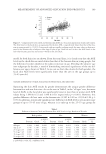
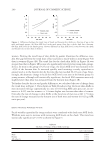
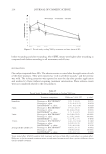
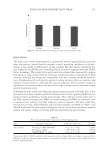
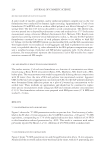
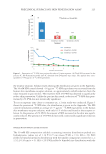
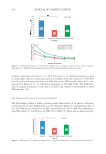
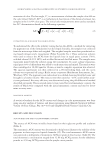
PRECLINICAL SURFACTANT SKIN PENETRATION ASSAY 227 in the plot of γ versus log C at a concentration of 0.23 mM that can be interpreted on the basis of the Gibbs adsorption isotherm as tighter packing at the air–liquid interface for concentrations above this value (15). The SLS + polymer systems both yielded lower surface tension at low concentrations than did SLS alone thus, the polymers were surface active. The PVA employed in this study was more surface active than PEO, consistent with its high level of unhydrolyzed acetate groups. Infl ection points at 0.22 mM (SLS + PEO) and 0.36 mM (SLS + PVA) may partly refl ect the infl uence of the SLS impurities, but also the advent of surfactant/polymer binding. It is tempting to describe these values as “apparent CACs.” However, working at a constant PEO concentration of 2 g/l or 0.2% w/v, Cabane (11) identifi ed the CAC for the SDS/PEO system as about 5.5 mM (see Figure 1 in Ref. 11), some 25-fold higher than the infl ection point in Figure 4. Consequently, Figure 4 should be interpreted cautiously. But, it does provide some evidence that, for the materials employed in this study, PEO interacted more strongly with SLS than did PVA. DISCUSSION SDS evidently penetrates the upper layers of the SC quite rapidly, as shown by the tape-strip results in Figures 1 and 2. It binds primarily to keratin and gradually swells and disrupts the tissue (16). In the short exposures employed in this study, very little ( 1%) of the deposited 14 C-SDS permeated through the skin into the receptor solutions. In human skin, it was predominately found on the fi rst three tape strips (Figure 2B). A comparison of Figures 1 and 2 suggests that free SLS penetrated into porcine skin much more rapidly than it did into human skin. The 14 C-SDS penetration reported in Figure 1A for a 10-min exposure of porcine skin to 50 mM SLS approaches that observed by Moore et al. (1) in a 5-h exposure. If one estimates the dry weight of the epidermis in the Moore et al. study to be 6.5 mg/cm2, then the SDS concentration of 2.6 wt% reported by these workers cor- responds to ~170 μg/cm2, about 70% higher than that shown in Figure 1A. The com- parison suggests that the rapid 14 C-SDS penetration observed in the present studies slows considerably during longer exposures. Figure 4. Surface tension of SDS and SDS/polymer solutions obtained by sequentially diluting the composi- tions described in Table I with Millipore™ water.

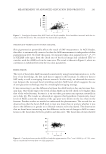
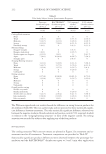
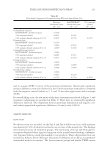
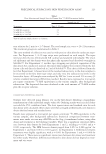
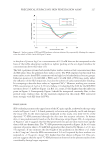
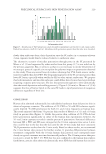
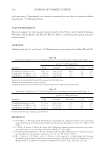
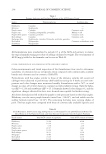
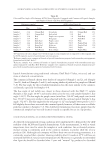
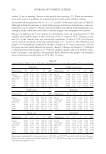
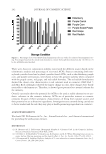
JOURNAL OF COSMETIC SCIENCE 228 Human skin treated for either 2 or 10 min also yielded a statistically signifi cant difference between SDS and SDS + PEO, although the magnitude of inhibition by the polymer was smaller than in porcine skin. The third treatment, 50 mM SLS + 2% PVA, yielded a sta- tistically signifi cant reduction in penetration versus SLS for porcine skin, but not for human skin. The reason for this difference is not known. However, the interaction of PVA with anionic surfactants is generally considered to be weaker than that of PEO this belief is encoded in an affi nity sequence PVA PEO MeC PVAc PPO ~ PVP originally at- tributed to Breuer and Robb (17) and republished frequently since that time, e.g., (6,18). One might anticipate from this sequence that PVA would have less impact on surfactant penetration into skin than PEO at comparable concentrations, as it binds the surfactant less tightly. The tensiometry data in Figure 4 support this hypothesis. In the present study, the PVA test material was not fully hydrolyzed, potentially pushing it closer to polyvinyl acetate (PVAc) in the surfactant affi nity sequence. Furthermore, the surface activity of the PVA material was higher than that of PEO. Positioning the effectiveness of this material to inhibit surfactant penetration was an objective of the test. Statistical differences between PEO and the control were stronger for the 10-min exposure time than for the 2-min exposure. This could be due to the fact that the skin used for the 10-min study had more consistent 3 H2O permeation results than that used for the 2-min study. This difference in consistency is highlighted in Table II the SD was lower for the 10-min exposure than for the 2-min exposure. Despite this difference, both experiments revealed a similar pattern of surfactant skin penetration. Figure 5 displays the distribu- tion of the 3 H2O permeation values for the membranes used in both experiments, which further emphasizes the difference in 3 H2O permeation. Unlike porcine skin, the treatment with 2% PVA did not statistically reduce 14 C-SDS skin penetration in either human skin experiment. This could be due to the fact that porcine skin does not contain eccrine sweat glands, which is an additional route of entry for excipi- ents, or to differences in pore structure that excluded SLS/PVA complexes from pig skin but not from human skin. However, it could simply result from chance. We are not convinced that the pore structure of the substrate is the major determinate of surfactant penetration and offer the following thoughts on this subject, without claiming to know the answer. The “penetration” process can be thought of as deposition and binding of surfactant onto surface keratins, leading to swelling and opening of the keratin structure, followed by more facile diffusion of unbound surfactant into underlying lipid and protein layers. In this scenario, penetration of both monomeric and micellar SLS into the outer SC is rapid because of the loss of barrier lipids in the desquamating layers. Bulky structures such as surfactant/polymer complexes diffuse from applied formulations to the skin surface more Table II Median, Mean, and SD Values for 3 H2O Permeation 10-min Expt. 1 2-min Expt. 2 Median 1.23 1.22 Mean 1.22 1.22 SD 0.34 0.68 Values refl ect pooled data from 3 or 4 donors.
Purchased for the exclusive use of nofirst nolast (unknown)
From: SCC Media Library & Resource Center (library.scconline.org)