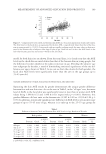
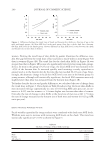
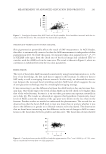
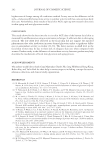
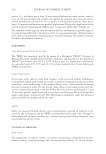
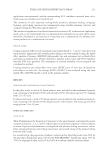
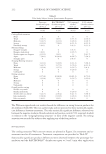
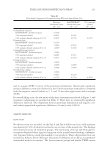
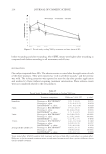
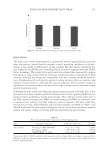
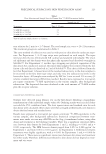
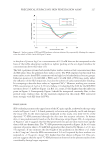
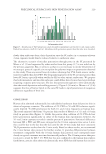
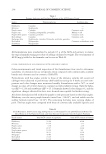
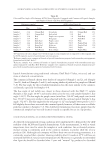
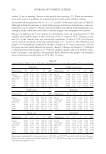
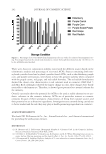
ANTHOCYANINS AS NATURAL ALTERNATIVES TO SYNTHETIC COLORS FOR LIPSTICK 241 Changes in hue angle varied between formulations, with the greatest changes observed with the elderberry and purple sweet potato formulas. The elderberry lipstick hue angles increased for all conditions, toward a more red hue angle. Conversely, the purple sweet potato lipstick hue angles decreased for all conditions, toward a more purple hue angle. The red radish lipstick hue angles also decreased for all conditions, toward a more red hue angle. Very little changes were observed in hue angle for purple carrot, red grape, and purple corn formulations. Delta E (ΔE*), or the total color difference, can be used to quantify changes in color (28). Just noticeable differences in color can be detected at a Delta E around 2.36 however, unexperienced observers notice differences in color when the Delta E is between 3.5 and 5 (28). Ten weeks at 45°C is considered a predictor for shelf stability of 2 year (24) there- fore, some color changes were expected by week 12. Red radish formulations showed the greatest ΔE* after 12 weeks at 45°C (ΔE*: 4.22), and elderberry and purple corn formu- las showed the smallest ΔE* after 12 weeks at 45°C (ΔE*: 1.27 and 1.18, respectively). Based on the detection limits of color differences, it was determined that the color changes recorded for the formulas at all conditions were within acceptable limits therefore, shelf stabilities of at least 2 year were predicted. In addition, the samples were stored in such a way to mimick an opened container, which increases the assurance of their stability. CHANGES IN TOTAL MONOMERIC CONTENT The recovered percentage of monomeric ACN content for the formulations were deter- mined based on the initial monomeric content by weight, after the accelerated environ- mental testing. In general, the highest recovery was seen for the freeze/thaw cycles for all formulations, with a recovery of 98.91% (±0.22) for purple corn to 91.72% (±0.18) for red grape. The recovery at 45°C was the lowest for all formulations, with a recovery of 93.81% (±0.24) for purple corn to 59.11% (±1.40) for red grape. The recovery rates for the formulations followed the same pattern for all accelerated environmental testing. In order of highest recovery the formulations were purple corn, purple sweet potato, elder- berry, red radish, purple carrot, and fi nally red grape (See Figure 1). Overall, the percentage of recovered ACNs from the formulations followed a similar pat- tern shown with the color measurements reported previously. These results were expected because of the association of changes in color with degradation, or changes in chemical structure, of ACNs (11). It is not surprising then that the formulations that showed the smallest changes in color, such as the purple corn and elderberry, should have the highest recovery of monomeric ACN content, depending on the storage conditions. It is interesting to note that although the red radish had the greatest change in color, its recovery rate was higher than that of the purple carrot or red grape for all testing conditions. This may be due to the low initial monomeric content, as seen with the purple carrot. Another possibility is that some irreversible binding occurred between the ACN and lipstick matrix, as may be the case for the red grape, which had the lowest recovery for all testing conditions. CONCLUSIONS ACNs incorporated into the matrix of lipstick formulations proved to be stable, even under the accelerated environmental testing used to predict a shelf life of at least 2 year.

JOURNAL OF COSMETIC SCIENCE 242 There were, however, variations in stability noted with the different sources based on the colorimetric analysis and percentage of recovered ACNs. Sources containing both non- acylated cyanidin–based and acylated cyanidin–based ACNs, such as the elderberry, purple corn, and purple sweet potato, were shown to have the greatest stability when compared with the purple carrot, red grape, and red radish formulas. The red radish formulations showed the closest color characteristics to red colorants used in cosmetics (D&C Red 7 and Mica Red) although it showed the largest change in color, these changes were barely noticeable to the human eye. Therefore, it showed great potential as a natural colorant for the industry. Overall, our results show the potential for ACNs to be used as stable alternatives to syn- thetic colorants in the cosmetic industry. ACNs are of particular interest as cosmetic colorants because of their synergistic characteristics of being from natural sources and their potential to act as bioactive ingredients. Investigations are currently being carried out to better understand the role they may play as health-promoting ingredients in cosmetics. ACKNOWLEDGMENTS We thank DD Williamson & Co., Inc., FutureCeuticals Inc., and Artemis International for providing the anthocyanin extracts. REFERENCES (1) N. Morante and J. DiGiovanna, Monograph Number 9: Colorants Used in the Cosmetics Industry. (Society of Cosmetic Chemists, New York, 2006). (2) S. E. Hill , C. D. Rodeheffer, V. Griskevicius, K. Durante, and A. E. White, Boosting beauty in an eco- nomic decline: Mating, spending, and the lipstick effect, J. Pers. Soc. Psychol., 103, 275–291 (2012). (3) S. Freeman and R. Stephens Cheilitis: Analysis of 75 cases referred to a contact dermatitis clinic, Am. J. Contact Dermat., 10, 198–200 (2010). Figure 1. Percentag e of recovered ACNs from formulations after 12 weeks of accelerated environmental test- ing. Percentages based on the initial total monomeric content by weight determined on day 1 ± S.D. (n = 3) by the pH-differential method.
Purchased for the exclusive use of nofirst nolast (unknown)
From: SCC Media Library & Resource Center (library.scconline.org)