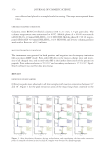
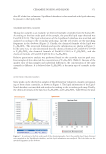
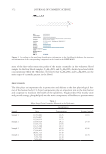
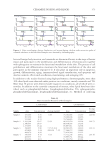
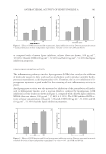
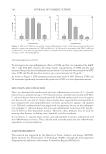
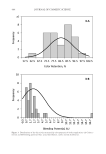
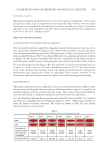
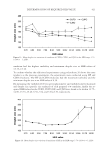
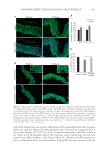
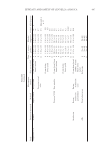
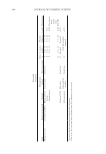
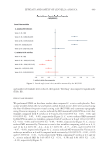
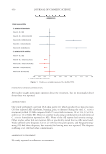
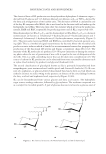
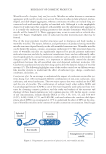
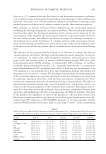
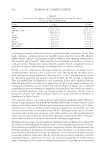
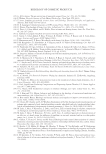
JOURNAL OF COSMETIC SCIENCE 406 CONSUMER RE LEVANCE OF THE QUANTIFIED LIP COLOR PROPERTIES Combining p anel perception results with their corresponding levels of color reten- tion and bleeding potential measured objectively, we obtained charts to demonstrate consumer relevance. As shown in Figure 4A, the percentage of panelists who per- ceived the levels of color retention acceptable decreased with the levels of the objec- tively measured property. Between color retention levels of 85% and 77.1%, the percentage of acceptability dropped dramatically from 79.8% to 13.1%, indicating the existence of a threshold in the region. For the ble eding potential, the percentage of panelists who perceived the levels of color bleeding acceptable decreased with increase in the bleeding potential measured objec- tively. Between the levels of 1.94 and 2.72, the percentage of acceptability dropped dramatically from 86.7% to 38.9%, suggesting a threshold in the region, as shown in Figure 4B. Interpolati ng within the threshold region using a binomial probability test at the given population of each perception study and under the condition of p 0.05, we fi rst deter- mined the minimal percentages of panel acceptability to be 60.12% and 60.56% for color retention and bleeding potential, respectively. The corresponding threshold values of color retention and bleeding properties were then derived from the linear equation, with the values being 82.67% and 2.37 for color retention and bleeding potential, respectively. Plot- ting the color parameters of all 30 participants in this study, we obtained Figure 5A and B to show the color properties relative to their threshold of acceptability. Sorting the color retention levels from high to low, we see in Figure 5A a gradual decrease in the property among different participants, which reaches the threshold at 82.67%, beyond which the color retention levels become unacceptable. Similarly, in Figure 5B, we see a gradual in- crease in bleeding potential reaching the threshold at 2.37 beyond which the bleeding level is too high to be acceptable. With these charts, we would be able to quantitatively evaluate the performance of a new lip color formulation during product development and fi nal claims’ substantiation. After using it for an expected time period such as 8 h in a usability study, should the measured mean value of color retention be higher than the threshold of 82.67%, or the mean value of bleeding potential be lower than 2.37, it would indicate with statistical confi dence that a claim of “long-lasting” or “non-bleeding” be substantiated. Table II Perception Results on Acceptability of Lip Color Bleeding Levels

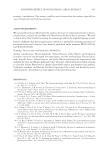
COLOR RETENTION AND BLEEDING POTENTIAL OF A LIPSTICK 407 CONCLUSION This study quantifi es changes in overall color properties of the lips after application of a liquid lip color in a controlled usability study. The image analysis methods were effective Figure 4. Correlations between results of panel perception and objectively measured lip color properties. (A) Color retention and (B) bleeding potential. Bars: objectively measured levels of color retention or bleeding. Solid lines with italic data label: percentage of panelists who perceived the property “acceptable.”
Purchased for the exclusive use of nofirst nolast (unknown)
From: SCC Media Library & Resource Center (library.scconline.org)