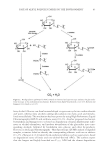
JOURNAL OF COSMETIC SCIENCE 94 rate of ~80% compared with its linear counterpart which was more than 90% degraded in the same duration. The presence of highly complex and branched structure increased the time taken for the alkyl chain oxidation supporting the alkyl chain oxidation. ARE APGS READILY BIODEGRADABLE? Biot ransformation or primary biodegradation is defi ned as a structural breakdown of a material such that it loses its inherent properties (9). Biodegradation profi le under both aerobic and anaerobic conditions is important to establish the ultimate behavior of molecules in natural and wastewater environment. Low degradation rate in anaerobic conditions can potentially lead to surfactant accumulation in wastewater treatment plants and eventual soil contamination if used as a fertilizer. Ultimate biodegradation or miner- alization is the conversion of the parent compound and its metabolites to carbon (9). In initial studies, Madsen et al. (15). have shown biotransformation of three APGs, namely, a linear, a branched and a monoester, and an alkyl ethoxylate in laboratory conditions. Ethyl glucoside esters, C10 and C12 ethyl glucoside esters, showed complete degradation in anaerobic conditions when exposed to three different innocula, freshwater sediment, marine, and digested sludge after typical lag periods of 3–4 weeks. Gas production was transiently inhibited in the early phase, but more than 75% of theoretical volume was achieved after 6 weeks (16). In another study, Jurado et al. (13) reported primary biodeg- radation pathways for C8–16 glucoside, commonly known as coco glucoside from days 1 to 12 as hydrolysis of the APG into alcohol and polysaccharide. Fact ors affecting the biodegradation rate: In isolated studies, various factors have been reported to affect the degradation rate. i. Init ial concentration: Usi ng the anthrone method analysis, the effect of concentration has been demonstrated (13). Signifi cant differences in degradation rates were noted as a function of initial concentration in aerobic conditions. Lower concentrations of 15 and 25 mg/L showed rapid degradation, whereas higher concentrations of 75 and 100 mg/L had an exponential decay curve with considerably lower degradation rates. Only 0.04% biotransformation in 50 h was noted for 100 mg/L compared with 62.09% for 15 mg/L (13). Starting concentration affected degradation rates 100 mg/L APG dose in anaerobic testing conditions did not show complete degradation. Only 40.05% mineralization reached after 60 d for C8–10, whereas longer chains showed less than 30% degradation in anaerobic conditions because of limited solubility (17). Thus, although APGs may be classifi ed as readily biodegradable under aerobic conditions, their slower metabolism in the absence of oxygen can lead to eventual accumulation of parent molecules and their metabolites in anaerobic environments. ii. S ize of the hydrophobic residue: Biot ransformation studies on linear and oxo derivatives of glucosides also confi rm the effect of chain length on the degradation rate. Latency time of 0.5 d was noted for C8 versus 2 d for C10 and above. After the primary degradation phase, the overall degradation rate was found to be similar for all chain lengths. The degradation rate was found to follow the following order: C8 C10 ~ C12 C14 (10,12). Similar observation had been previously reported for linear and branched glucosides and a monoester. The molecules showed higher degradation rates for lower alkyl chain length branching may lead to increase in degradation time (12,13).

FATE OF ALKYL POLYGLUCOSIDES IN THE ENVIRONMENT 95 Incr ease in the alkyl chain length will lead to increase in hydrophobicity of the surfactant, causing higher cellular penetration rate and faster metabolism. However, cell death associated with toxicity may also increase, resulting in overall lower degradation rates. Furthermore, the initial concentration in the infl uent can lead to confounding outcomes because longer alkyl chain APGs have poorer aqueous solubility. Hence, a balance in cellular toxicity, concentration, and solubility needs to be achieved to draw an unbiased conclusion (17). iii. Size of hydrophilic head: The effect of hydrophilic headgroup on the degradation rate has been reported in limited cases. Increase in the saccharide residues resulted in lower biodegradation rates due to increased hydrophilicity and lesser cellular penetrability (10). Mine ralization studies are simulated in the laboratory as per the OECD 301 guideline under aerobic and anaerobic conditions (9). The eventual fate of an APG molecule is the conversion of primary degradation products, fatty alcohols, and glucose to carbon dioxide and water by the microbiome. Jurado et al. (18) have classifi ed these reactions as stage 2 of degradation, lasting from days 13 to 21. Coco glucoside yielded a 99.20% total organic carbon (TOC) removal for the 15 mg/L (lowest test concentration) and a 45.21% TOC removal for the 100 mg/L (highest test concentration) within the 21-d test period in aerobic environment. Measurement of total Colony Forming Units showed initial reduction suggesting an acclimatization period for the microbiome. For materials to be classifi ed as readily biodegradable, the OECD 301 guideline recom- mends minimum of 60% CO2 evolution or O2 uptake in a 28-d test period with 10% in a 10-d window (9). The study by Madsen et al. (15) showed that all glycosides showed more than 60% CO2 generation, except C12 monoester which failed to clear the 10-d window in aerobic conditions. Longer alkyl chain lengths and branching can lead to lower effective concentration for metabolism. In the anaerobic conditions, too, C12 mono- ester showed a higher degradation rate and can be compared with that of sodium benzo- ate, with 80% mineralization for the former compared with 86% of the latter in 28 d. Similar degradation time has been reported in other studies (12,19). Overall, APGs of chain lengths from C8 to C14 continue to qualify as readily biodegradable with greater than 60% clearance in 28 d. However, in limited cases, they may not clear the 10-d window period (12,15,19). DO A PGS SHOW TOXICITY IN MARINE ENVIRONMENT? Surf actants when dissolved in water are known to accumulate at interfaces. Although this property makes them active for formulations, it can also intensify their toxicity potential at cellular interface. Surfactants can dissolve the phospholipid cell membrane of bacteria, damage protein envelopes leading to cellular disruption, and death. Most laboratory ex- periments with activated sludge report biodegradation tests with a maximum of 40 mg/L of surfactant concentration to minimize cellular toxicity (1,2). In one study by Rios et al. (17), test concentrations of 100 mg/L have been reported. However, the researchers do not comment on the toxicity at such high concentrations. C8 g lucoside showed least toxicity in three species, a microalga (Raphidocelis subcapitata/ Kirchneriella subcapitata), a plankton (Daphnia magna), and the zebrafi sh (Danio rerio/ Brachydanio rerio). D. rerio showed the highest sensitivity to APGs with an LC50 (lethal con- centration at which 50% of the test organisms die) of 558 mg/L for C8 and ~5 mg/L for C12–14
Purchased for the exclusive use of nofirst nolast (unknown)
From: SCC Media Library & Resource Center (library.scconline.org)